
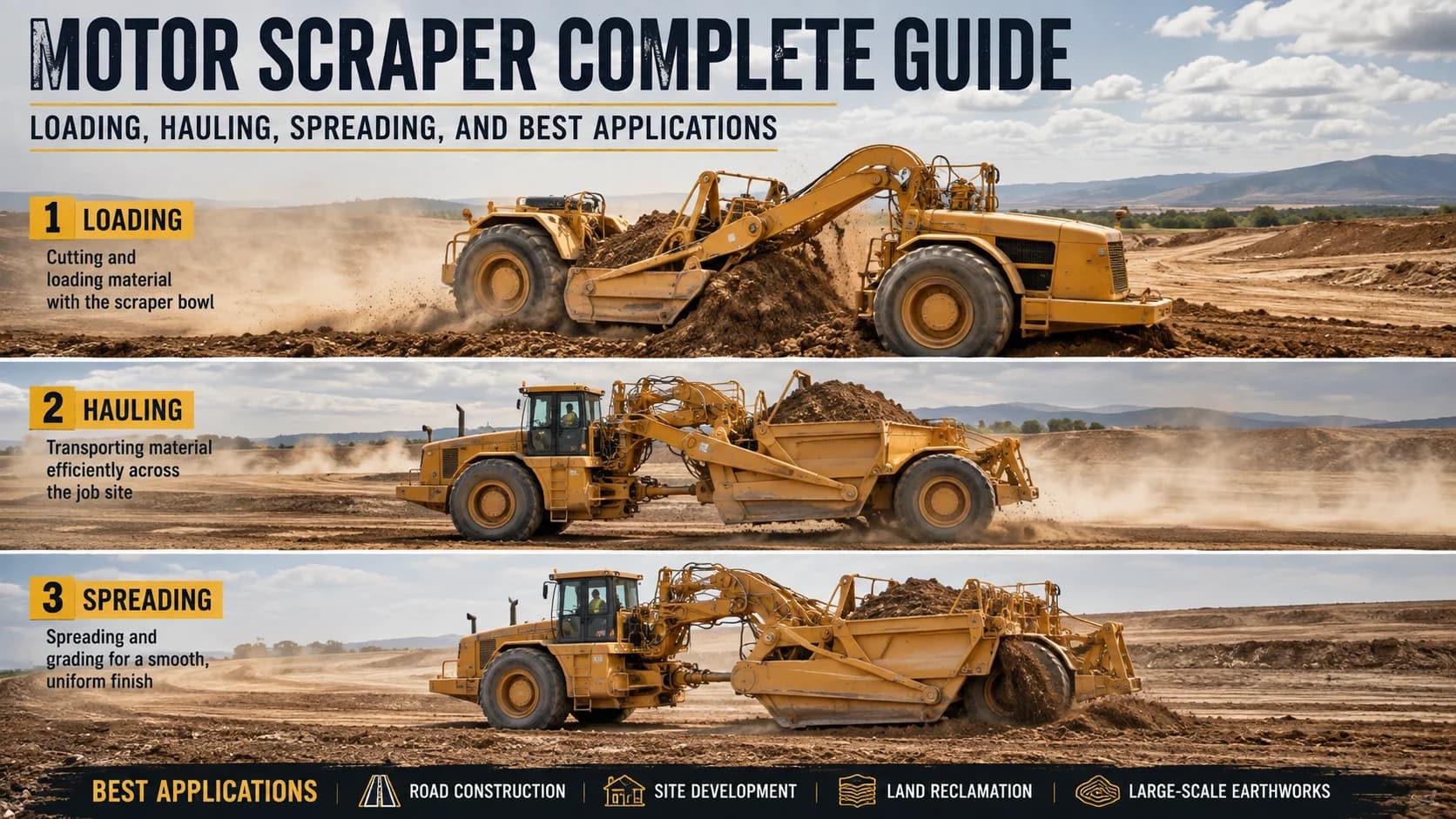

Motor scrapers are high-production earthmoving machines that cut soil from the ground, load it into an internal bowl, haul it, and spread it at the destination. When site and soil conditions are suitable, a scraper fleet can move enormous volumes without separate excavators and dump trucks. Their productivity comes from integrating loading, hauling, and spreading in one machine. That advantage is also their limitation: scrapers perform best when haul distances, grades, soil type, underfoot conditions, and loading areas fit the machine. Understanding the complete cycle is essential before choosing scrapers for a project.
Scraper Anatomy
A motor scraper typically consists of a tractor unit connected to a scraper bowl. The cutting edge at the front of the bowl slices soil as the bowl lowers. An apron controls the front opening, while an ejector or push plate forces material out during spreading. Elevating scrapers add a powered elevator that lifts material into the bowl, and twin-engine scrapers may power the rear wheels for extra traction. The articulation joint allows steering and helps the long machine negotiate turns. Every component is designed around a rapid cut-load-haul-spread-return cycle.
Loading by Cutting
During conventional loading, the operator lowers the bowl so the cutting edge enters the soil. Forward motion forces material into the bowl. The operator balances cut depth, speed, traction, and bowl fill. A cut that is too deep can stall the machine or cause wheel slip, while a cut that is too shallow increases loading time. Good loading areas are long enough for a smooth cut and have consistent material. Pre-ripping hard ground or moisture conditioning dry soil may dramatically improve load time.
Push-Pull and Push Loading
Some scrapers use a dozer to push from behind during loading, increasing tractive effort and allowing a deeper cut. Push-pull scrapers are equipped to assist each other, with one machine providing pushing or pulling force while both load sequentially. These methods can reduce load time but require disciplined coordination and compatible machines. The value comes from maximizing bowl fill quickly; however, the pusher or partner machine becomes part of the fleet balance and must be included in production calculations.
Elevating Scrapers
Elevating scrapers use a chain-and-flight elevator at the bowl opening to actively lift cut material into the bowl. They can self-load effectively without a pusher in many soils and are useful for smaller to medium earthmoving projects. Sticky clay can adhere to elevator components, while very large rocks can damage flights or chains. Elevator speed, cutting depth, and travel speed should be coordinated so the bowl fills evenly instead of building a mound at the front.
Hauling the Load
After loading, the bowl is raised to a safe travel position and the scraper accelerates along the haul road. Because scrapers can travel faster than many tracked machines, they are efficient over medium haul distances when roads are firm and grades are manageable. Rough roads reduce speed, increase tire and structural loads, and can cause material spillage. Haul-road maintenance is therefore a production function, not a secondary activity. The best scraper job often has broad flowing routes with limited sharp turns.
Spreading and Ejection
At the fill, the operator lowers the bowl to the desired spreading height, opens the apron, and moves the ejector forward while traveling. This places material in a controlled layer instead of dumping it in a pile. Layer thickness can be adjusted through bowl height, travel speed, and ejector rate. Scrapers can therefore feed compactors efficiently and reduce the need for separate spreading equipment. Consistent fill geometry and clear traffic flow are important because scrapers need room to enter, spread, turn, and exit without conflict.
Soil Conditions
Scrapers perform best in materials that can be cut and loaded without oversized rock or severe stickiness. Sandy soils, loams, and many clays can be excellent when moisture is appropriate. Hardpan may need ripping. Highly plastic wet clay can stick to the bowl and slow ejection. Large rock can damage cutting edges, apron components, tires, and elevator systems. Ground investigation should therefore consider both geotechnical classification and the practical excavating behavior of the material.
Haul Distance and Grade
Scraper economics depend strongly on haul distance. Very short hauls may favor dozers or loaders, while very long hauls may favor truck-and-loader systems. Scrapers often excel in the middle range, especially when they can maintain speed on firm roads. Grade affects loaded travel speed and retarding needs. Fleet studies should use travel-time estimates for the actual profile, including turns, crossings, loading approach, and fill maneuvering rather than using only straight-line distance.
Fleet Balance and Production
Production is the product of average payload and completed cycles per hour. Cycle time includes loading, hauling, spreading, turning, and returning. If pusher dozers are used, the number and placement of pushers must match scraper arrival rate. If compactors cannot process the fill as fast as scrapers deliver material, the entire system backs up. Good fleet planning treats scrapers, dozers, graders, water trucks, compactors, and support equipment as one production system.
Tires, Traction, and Road Maintenance
Scrapers operate on large tires and can travel quickly, so tire condition and haul-road quality have major cost implications. Sharp rock, ruts, potholes, and high-speed impacts damage tires and suspension components. Wheel slip during loading wastes fuel and tears up the cut. Tire inflation, tread condition, and traction management should be monitored. Graders and water trucks often pay for themselves by maintaining a smooth low-resistance route that protects tires and increases average speed.
Maintenance Focus
High-wear areas include cutting edges, router bits, bowl floor, apron pins, ejector rollers, elevator chains, hydraulic cylinders, articulation joints, tires, driveline components, and brakes or retarders. Dirt buildup can conceal cracks and leaks. Scraper fleets benefit from scheduled inspections because the machines work under high load for long cycles. Small delays such as a leaking cylinder or worn cutting edge can gradually extend cycle time across every load.
Best Applications and Limitations
Scrapers are ideal for large balanced cut-and-fill operations, highway construction, airfields, industrial sites, reservoir work, and land development where long open cuts connect to broad fills. They are less suited to cramped sites, very rocky excavation, narrow haul roads, deep mud, or projects with constant sharp turns. The decision should consider total earth volume, cut geometry, material type, haul profile, and support-equipment requirements. When those factors align, scrapers can achieve extremely high production with relatively few machine types.
Practical Planning Notes
Planning note 1. Design the cut so the scraper has enough straight loading distance to build a full bowl without sharp steering corrections. In practical terms, this should be converted into a written field decision rather than left as an informal expectation. The crew should know what will be checked, who is responsible, what condition triggers a change, and how that change affects the rest of the motor scraper guide operation. Good planning also uses observable data such as cycle time, machine loading, ground response, component temperature, fuel use, wear, or finished-work quality. When these observations are recorded consistently, supervisors can separate normal variation from a developing problem and make adjustments before production is lost. The most effective jobsites treat these checks as part of normal production management, not as paperwork added after the work is complete.
Planning note 2. Use ripping, moisture conditioning, or surface preparation when it materially shortens loading time; the cost can be recovered across hundreds of cycles. In practical terms, this should be converted into a written field decision rather than left as an informal expectation. The crew should know what will be checked, who is responsible, what condition triggers a change, and how that change affects the rest of the motor scraper guide operation. Good planning also uses observable data such as cycle time, machine loading, ground response, component temperature, fuel use, wear, or finished-work quality. When these observations are recorded consistently, supervisors can separate normal variation from a developing problem and make adjustments before production is lost. The most effective jobsites treat these checks as part of normal production management, not as paperwork added after the work is complete.
Planning note 3. Measure actual average payload rather than relying on nominal bowl volume, because soil density and fill factor vary greatly. In practical terms, this should be converted into a written field decision rather than left as an informal expectation. The crew should know what will be checked, who is responsible, what condition triggers a change, and how that change affects the rest of the motor scraper guide operation. Good planning also uses observable data such as cycle time, machine loading, ground response, component temperature, fuel use, wear, or finished-work quality. When these observations are recorded consistently, supervisors can separate normal variation from a developing problem and make adjustments before production is lost. The most effective jobsites treat these checks as part of normal production management, not as paperwork added after the work is complete.
Planning note 4. Maintain haul roads aggressively to protect tires and preserve travel speed; one rough section can control the entire cycle. In practical terms, this should be converted into a written field decision rather than left as an informal expectation. The crew should know what will be checked, who is responsible, what condition triggers a change, and how that change affects the rest of the motor scraper guide operation. Good planning also uses observable data such as cycle time, machine loading, ground response, component temperature, fuel use, wear, or finished-work quality. When these observations are recorded consistently, supervisors can separate normal variation from a developing problem and make adjustments before production is lost. The most effective jobsites treat these checks as part of normal production management, not as paperwork added after the work is complete.
Planning note 5. Coordinate fill-layer thickness with compaction capacity so scrapers do not outrun rollers and create uncontrolled stockpiles. In practical terms, this should be converted into a written field decision rather than left as an informal expectation. The crew should know what will be checked, who is responsible, what condition triggers a change, and how that change affects the rest of the motor scraper guide operation. Good planning also uses observable data such as cycle time, machine loading, ground response, component temperature, fuel use, wear, or finished-work quality. When these observations are recorded consistently, supervisors can separate normal variation from a developing problem and make adjustments before production is lost. The most effective jobsites treat these checks as part of normal production management, not as paperwork added after the work is complete.
Planning note 6. Use pushers only where their utilization justifies the added machine and operator; a poorly balanced pusher fleet can become an expensive waiting line. In practical terms, this should be converted into a written field decision rather than left as an informal expectation. The crew should know what will be checked, who is responsible, what condition triggers a change, and how that change affects the rest of the motor scraper guide operation. Good planning also uses observable data such as cycle time, machine loading, ground response, component temperature, fuel use, wear, or finished-work quality. When these observations are recorded consistently, supervisors can separate normal variation from a developing problem and make adjustments before production is lost. The most effective jobsites treat these checks as part of normal production management, not as paperwork added after the work is complete.
Planning note 7. Monitor cutting-edge condition because a dull edge increases draft force, wheel slip, and loading time. In practical terms, this should be converted into a written field decision rather than left as an informal expectation. The crew should know what will be checked, who is responsible, what condition triggers a change, and how that change affects the rest of the motor scraper guide operation. Good planning also uses observable data such as cycle time, machine loading, ground response, component temperature, fuel use, wear, or finished-work quality. When these observations are recorded consistently, supervisors can separate normal variation from a developing problem and make adjustments before production is lost. The most effective jobsites treat these checks as part of normal production management, not as paperwork added after the work is complete.
Planning note 8. Plan one-way circulation where possible so long machines do not meet head-on at narrow cuts, ramps, or fill exits. In practical terms, this should be converted into a written field decision rather than left as an informal expectation. The crew should know what will be checked, who is responsible, what condition triggers a change, and how that change affects the rest of the motor scraper guide operation. Good planning also uses observable data such as cycle time, machine loading, ground response, component temperature, fuel use, wear, or finished-work quality. When these observations are recorded consistently, supervisors can separate normal variation from a developing problem and make adjustments before production is lost. The most effective jobsites treat these checks as part of normal production management, not as paperwork added after the work is complete.
Common Mistakes to Avoid
- Selecting equipment from nominal capacity alone without checking the actual site, material, access, duty cycle, or support requirements of the motor scraper guide.
- Allowing production pressure to override inspection, setup, or maintenance checks that protect the machine and finished work.
- Using average conditions for planning when one steep grade, weak area, hard layer, narrow access point, or large starting load can control the whole operation.
- Failing to record operating data, which makes it difficult to identify whether a problem comes from the machine, material, road, tooling, operator technique, or maintenance condition.
- Changing several variables at once when troubleshooting, which makes it impossible to know which adjustment actually improved or worsened performance.
A useful way to think about motor scraper guide is as a system rather than a single machine or component. Equipment selection, site conditions, operator technique, maintenance, logistics, and quality requirements interact continuously. Improving only one element can move the bottleneck somewhere else. For example, a faster machine may create queues at loading, dumping, servicing, or material handling if the rest of the process is not prepared. This systems view is especially important on large projects because small inefficiencies repeat over hundreds or thousands of cycles. Measuring the complete process and adjusting it deliberately is usually more valuable than chasing the highest theoretical machine specification.
Frequently Asked Questions
What is a motor scraper used for?
It cuts soil, loads it into an onboard bowl, hauls the material, and spreads it at the fill. It is best suited to large-volume earthmoving with suitable haul distances and ground conditions.
Do scrapers need bulldozers?
Not always. Conventional scrapers may use push dozers, while elevating or push-pull scrapers can reduce or eliminate separate push loading in suitable soils.
What soil is best for scrapers?
Many sands, loams, and clays work well when moisture is appropriate and oversized rock is limited. Very rocky or highly sticky material can reduce productivity.
Why are haul roads important for scrapers?
Scrapers rely on travel speed and large tires. Rough roads increase cycle time, tire damage, fuel use, and structural stress.
Final Takeaway
The best results with motor scraper guide come from matching equipment capability to real working conditions and then managing the complete production system. Specifications provide the starting point, but field success depends on setup, material behavior, access, maintenance, operator decisions, and the way the machine interacts with the rest of the project. Before work begins, define the expected duty, identify the conditions most likely to reduce performance, and establish clear limits for when the crew should stop, inspect, or change the plan. During production, use simple measurable indicators such as cycle time, penetration, payload, fuel use, wear, temperature, quality, or electrical loading to confirm that the system is operating as intended. That disciplined approach improves productivity while protecting equipment, workers, and the finished construction work.
Get More Expert Guides & Updates
Subscribe for Machinery.org guide updates and product learning content.