
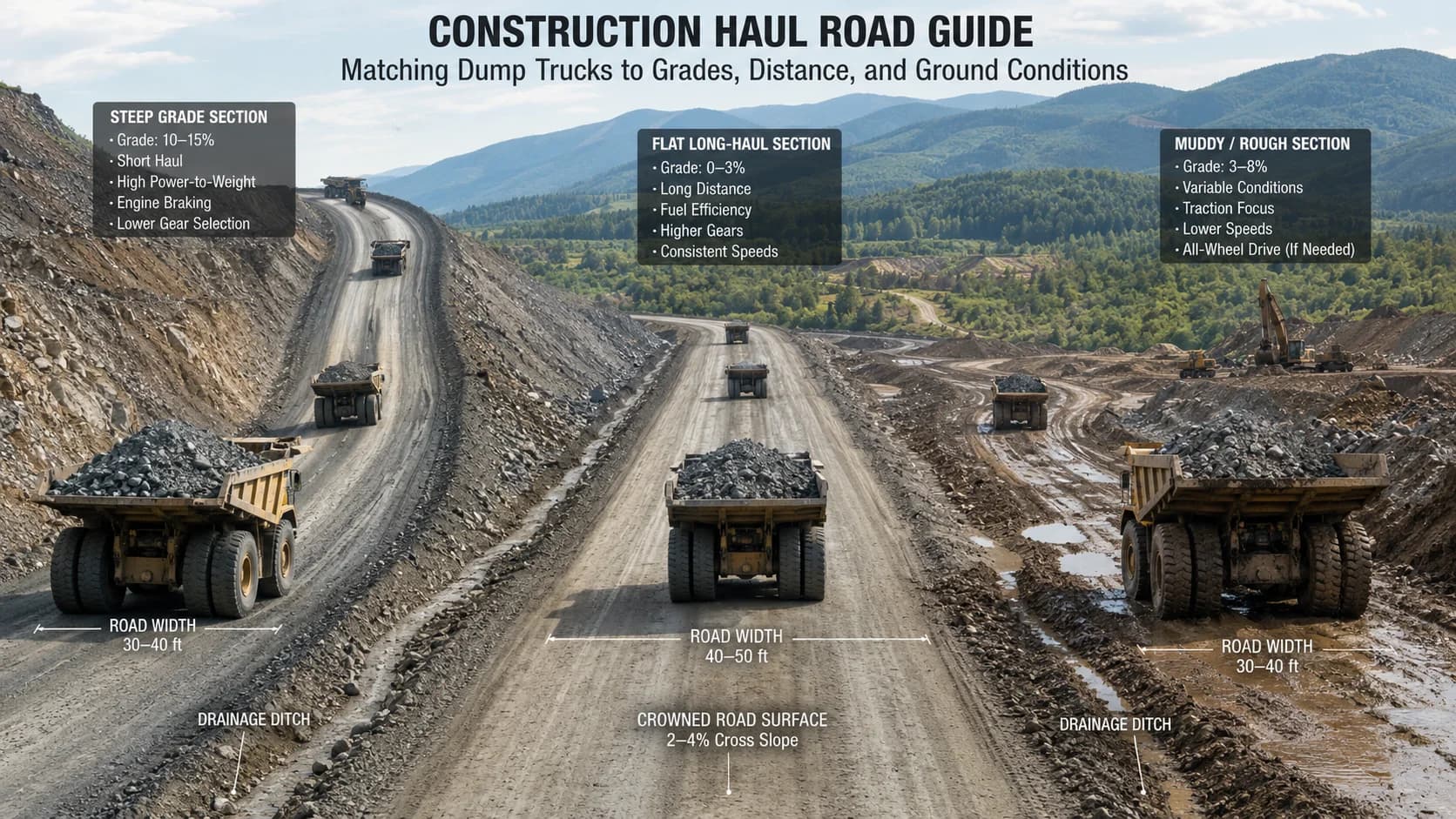
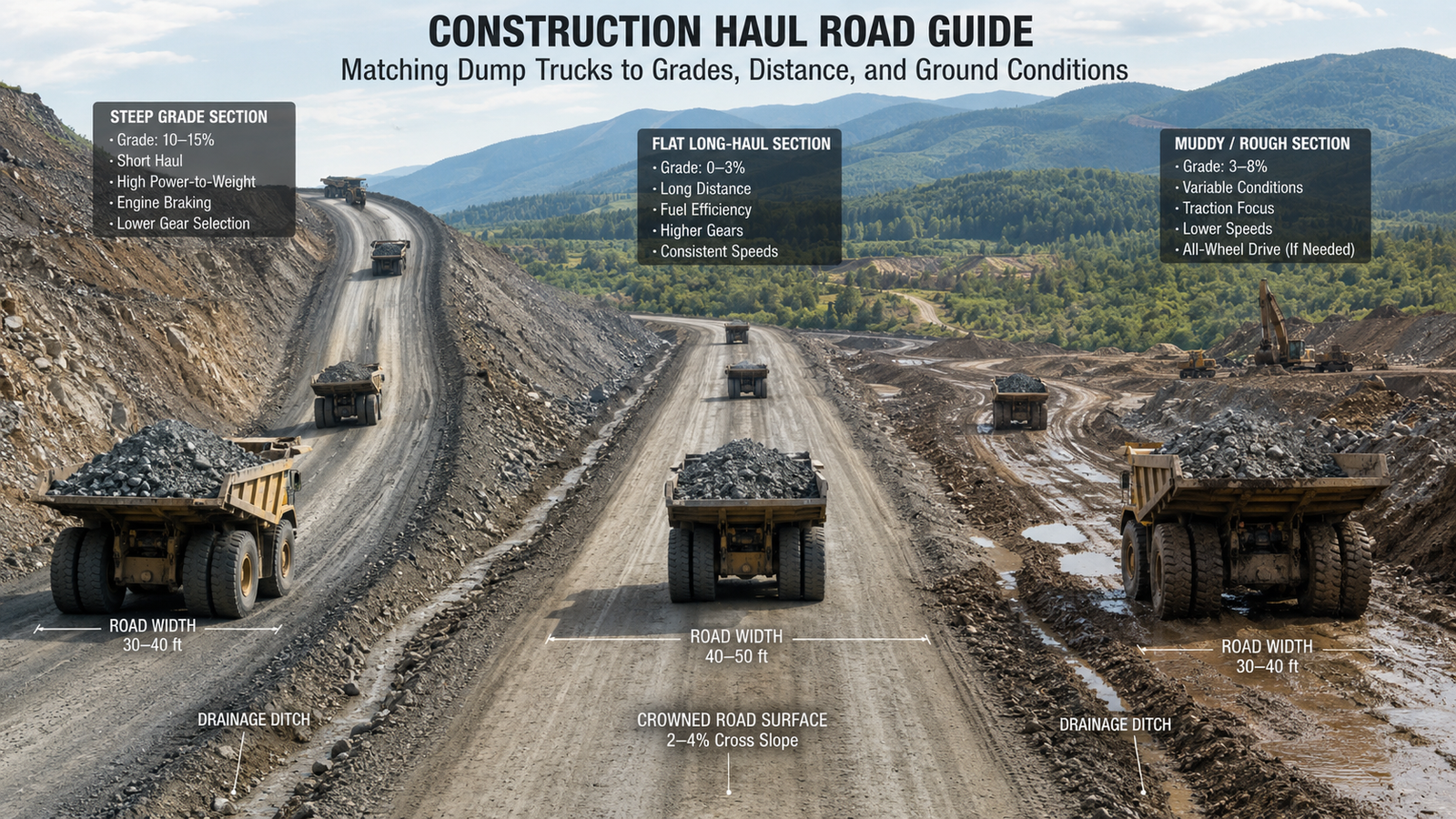
A haul road is a production asset. Its width, grade, rolling resistance, drainage, surface material, intersection design, and maintenance determine how quickly and safely dump trucks move material. Contractors often focus on truck capacity while underestimating the road that allows the truck to use that capacity. A well-designed road can reduce cycle time, fuel consumption, tire damage, and operator fatigue. A poor road can erase the advantage of expensive trucks. Matching truck type to haul distance, grade, and ground conditions should therefore be done together with road design rather than as two separate decisions.
Road Width and Traffic Flow
Road width must accommodate the largest truck, lateral clearance, berms, drainage, and the traffic pattern. One-way roads can be narrower than two-way roads but require a circulation plan. Two-way roads need sufficient width for trucks to pass without dropping wheels onto soft shoulders or berms. Curves require extra width because long vehicles track inside the steering path. Passing bays may be practical on temporary routes with low traffic. Road geometry should be based on actual machine dimensions and operating practice, not passenger-vehicle assumptions.
Grade and Truck Performance
Grade directly affects travel speed and power demand. Loaded trucks climbing steep grades may become the cycle bottleneck, while downhill grades increase retarding and braking requirements. Short steep ramps can be acceptable when traction is reliable, but long sustained grades create heat and fuel penalties. Manufacturer performance charts or fleet modeling should be used for the actual truck weight and grade profile. Average grade is not enough because one severe section can control total travel time.
Rolling Resistance
Rolling resistance is the force required to move tires over the road surface. Deep ruts, loose gravel, mud, soft subgrade, and potholes all raise resistance. Even a modest increase can significantly reduce speed and raise fuel consumption, especially for loaded trucks. Road maintenance therefore has a measurable production return. Compaction, grading, drainage, and appropriate surfacing reduce resistance. Operators also report road problems early when the site culture treats road condition as a production issue rather than a maintenance complaint.
Ground Conditions and Subgrade
The road is only as strong as its foundation. Soft clay, fill, organics, wet subgrade, buried utilities, and uncompacted trenches can cause rutting or failure. Construction may require excavation of weak material, geotextiles, stabilization, thicker aggregate, or staged improvement. Heavy rigid trucks place high loads on the road and generally need stronger support than smaller ADTs. Temporary routes should still be engineered for expected traffic volume and weather because repeated loading can quickly destroy an underbuilt surface.
Drainage
Water is one of the biggest enemies of unpaved haul roads. Ditches, cross-drains, culverts, crown, and cross slope should remove runoff before it saturates the running surface. Standing water accelerates potholes and soft spots, while flowing water can erode shoulders and fills. Drainage maintenance should be continuous, especially after storms. A road that is correctly graded but cannot drain will deteriorate quickly regardless of the quality of the aggregate.
Matching ADTs to Variable Roads
Articulated dump trucks are well suited to routes with changing surfaces, soft areas, tighter turns, and temporary construction. Their all-wheel drive and flexible chassis help maintain traction, but they still benefit from good roads. Excessive mud and roughness raise fuel use and tire wear even if the truck can physically travel through them. ADTs should be chosen when the cost or schedule does not justify building rigid-truck-quality roads, or where the route changes as earthworks progress.
Matching Rigid Trucks to Permanent Hauls
Rigid dump trucks are most effective on broad, firm, smooth routes where their payload and speed can be used safely. Large quarries and mines often invest heavily in haul roads because the savings repeat over millions of tons. Curve radius, grade, sight distance, berms, intersections, and dump approaches are designed around the truck class. Using rigid trucks on poorly supported temporary roads can create chronic speed loss and tire or frame problems that outweigh payload benefits.
Short Haul vs Long Haul
Short hauls emphasize loading and dumping time, maneuverability, and acceleration. Long hauls place greater weight on road speed, rolling resistance, fuel efficiency, and operator comfort. The most economical truck can therefore change as the face moves farther from the dump point. Projects should periodically recalculate the fleet as haul distance changes rather than assuming the original truck choice remains optimal for the entire job.
Curves, Intersections, and Sight Distance
Sharp curves reduce speed and increase tire scrub. Intersections create conflict points and queueing. Sight distance must allow loaded trucks to stop safely for obstacles or traffic. Good layouts use sweeping curves, limited cross traffic, and clear right-of-way rules. Blind crests and corners may require controlled traffic or warning systems. The objective is a predictable route where operators can maintain steady speed without repeated hard braking and acceleration.
Berms, Edges, and Dump Areas
Edge protection should be appropriate to the truck class and the hazard. Berms help define safe travel limits but do not replace stable ground. Dump areas need regular inspection because fill edges change throughout the shift. Soft shoulders should be kept out of travel lanes. Where trucks reverse to edges, spotters or engineered dumping systems may be required according to site procedures. A strong haul road that ends at an unstable dump point is not a safe system.
Maintenance Strategy
Grading, watering, dust control, pothole repair, drainage cleaning, compaction, and resurfacing should be planned based on traffic and weather. Maintenance intervals can be optimized by tracking truck speed and road-condition data. If one road segment repeatedly causes slowdowns or tire damage, targeted reconstruction may provide better value than constant light grading. Maintenance equipment should be available when production is running, not only after the road becomes unusable.
Fleet Modeling and Continuous Improvement
The most useful road metrics are loaded and empty travel time, average speed by segment, queue time, fuel per ton, tire incidents, and road-maintenance cost. GPS and fleet-management systems can identify slow zones and recurring congestion. Even without advanced software, simple timed cycles and operator feedback reveal where improvements will pay back. The best haul-road program is dynamic: road geometry, maintenance, and truck assignment evolve with the project.
Practical Planning Notes
Planning note 1. Break the haul into segments and assign grade, rolling resistance, speed, and condition to each segment instead of using one average value. In practical terms, this should be converted into a written field decision rather than left as an informal expectation. The crew should know what will be checked, who is responsible, what condition triggers a change, and how that change affects the rest of the construction haul road guide operation. Good planning also uses observable data such as cycle time, machine loading, ground response, component temperature, fuel use, wear, or finished-work quality. When these observations are recorded consistently, supervisors can separate normal variation from a developing problem and make adjustments before production is lost. The most effective jobsites treat these checks as part of normal production management, not as paperwork added after the work is complete.
Planning note 2. Design drainage before adding expensive surface aggregate; without water control, the surfacing will deteriorate rapidly. In practical terms, this should be converted into a written field decision rather than left as an informal expectation. The crew should know what will be checked, who is responsible, what condition triggers a change, and how that change affects the rest of the construction haul road guide operation. Good planning also uses observable data such as cycle time, machine loading, ground response, component temperature, fuel use, wear, or finished-work quality. When these observations are recorded consistently, supervisors can separate normal variation from a developing problem and make adjustments before production is lost. The most effective jobsites treat these checks as part of normal production management, not as paperwork added after the work is complete.
Planning note 3. Use wider curves and intersections than the straight roadway requires because off-tracking increases with vehicle length. In practical terms, this should be converted into a written field decision rather than left as an informal expectation. The crew should know what will be checked, who is responsible, what condition triggers a change, and how that change affects the rest of the construction haul road guide operation. Good planning also uses observable data such as cycle time, machine loading, ground response, component temperature, fuel use, wear, or finished-work quality. When these observations are recorded consistently, supervisors can separate normal variation from a developing problem and make adjustments before production is lost. The most effective jobsites treat these checks as part of normal production management, not as paperwork added after the work is complete.
Planning note 4. Select ADTs when mobility and road-construction savings outweigh the payload advantage of rigid trucks. In practical terms, this should be converted into a written field decision rather than left as an informal expectation. The crew should know what will be checked, who is responsible, what condition triggers a change, and how that change affects the rest of the construction haul road guide operation. Good planning also uses observable data such as cycle time, machine loading, ground response, component temperature, fuel use, wear, or finished-work quality. When these observations are recorded consistently, supervisors can separate normal variation from a developing problem and make adjustments before production is lost. The most effective jobsites treat these checks as part of normal production management, not as paperwork added after the work is complete.
Planning note 5. Use rigid trucks only when road strength, width, turning radius, and maintenance support allow them to operate near design speed. In practical terms, this should be converted into a written field decision rather than left as an informal expectation. The crew should know what will be checked, who is responsible, what condition triggers a change, and how that change affects the rest of the construction haul road guide operation. Good planning also uses observable data such as cycle time, machine loading, ground response, component temperature, fuel use, wear, or finished-work quality. When these observations are recorded consistently, supervisors can separate normal variation from a developing problem and make adjustments before production is lost. The most effective jobsites treat these checks as part of normal production management, not as paperwork added after the work is complete.
Planning note 6. Track slow zones through cycle data and repair the road section that controls travel time rather than grading the entire route uniformly. In practical terms, this should be converted into a written field decision rather than left as an informal expectation. The crew should know what will be checked, who is responsible, what condition triggers a change, and how that change affects the rest of the construction haul road guide operation. Good planning also uses observable data such as cycle time, machine loading, ground response, component temperature, fuel use, wear, or finished-work quality. When these observations are recorded consistently, supervisors can separate normal variation from a developing problem and make adjustments before production is lost. The most effective jobsites treat these checks as part of normal production management, not as paperwork added after the work is complete.
Planning note 7. Separate light vehicles from haul traffic wherever possible to reduce conflict and sudden braking events. In practical terms, this should be converted into a written field decision rather than left as an informal expectation. The crew should know what will be checked, who is responsible, what condition triggers a change, and how that change affects the rest of the construction haul road guide operation. Good planning also uses observable data such as cycle time, machine loading, ground response, component temperature, fuel use, wear, or finished-work quality. When these observations are recorded consistently, supervisors can separate normal variation from a developing problem and make adjustments before production is lost. The most effective jobsites treat these checks as part of normal production management, not as paperwork added after the work is complete.
Planning note 8. Recalculate fleet needs when haul distance or dump location changes; the correct number and type of trucks is not fixed for the life of the project. In practical terms, this should be converted into a written field decision rather than left as an informal expectation. The crew should know what will be checked, who is responsible, what condition triggers a change, and how that change affects the rest of the construction haul road guide operation. Good planning also uses observable data such as cycle time, machine loading, ground response, component temperature, fuel use, wear, or finished-work quality. When these observations are recorded consistently, supervisors can separate normal variation from a developing problem and make adjustments before production is lost. The most effective jobsites treat these checks as part of normal production management, not as paperwork added after the work is complete.
Common Mistakes to Avoid
- Selecting equipment from nominal capacity alone without checking the actual site, material, access, duty cycle, or support requirements of the construction haul road guide.
- Allowing production pressure to override inspection, setup, or maintenance checks that protect the machine and finished work.
- Using average conditions for planning when one steep grade, weak area, hard layer, narrow access point, or large starting load can control the whole operation.
- Failing to record operating data, which makes it difficult to identify whether a problem comes from the machine, material, road, tooling, operator technique, or maintenance condition.
- Changing several variables at once when troubleshooting, which makes it impossible to know which adjustment actually improved or worsened performance.
A useful way to think about construction haul road guide is as a system rather than a single machine or component. Equipment selection, site conditions, operator technique, maintenance, logistics, and quality requirements interact continuously. Improving only one element can move the bottleneck somewhere else. For example, a faster machine may create queues at loading, dumping, servicing, or material handling if the rest of the process is not prepared. This systems view is especially important on large projects because small inefficiencies repeat over hundreds or thousands of cycles. Measuring the complete process and adjusting it deliberately is usually more valuable than chasing the highest theoretical machine specification.
Frequently Asked Questions
How steep should a haul road be?
There is no universal grade. It must be matched to the truck, surface, traction, braking or retarding capability, and site design. Manufacturer performance data should be used.
Why does rolling resistance matter?
Higher resistance reduces speed and increases fuel use. Mud, ruts, loose material, and soft subgrade can make a major difference to cycle time.
When should I use ADTs?
ADTs are attractive on temporary, soft, rough, or changing routes where building and maintaining high-quality roads is difficult.
When are rigid trucks better?
Rigid trucks are strongest on stable, wide, well-maintained routes where high payload and sustained travel speed can be fully utilized.
Final Takeaway
The best results with construction haul road guide come from matching equipment capability to real working conditions and then managing the complete production system. Specifications provide the starting point, but field success depends on setup, material behavior, access, maintenance, operator decisions, and the way the machine interacts with the rest of the project. Before work begins, define the expected duty, identify the conditions most likely to reduce performance, and establish clear limits for when the crew should stop, inspect, or change the plan. During production, use simple measurable indicators such as cycle time, penetration, payload, fuel use, wear, temperature, quality, or electrical loading to confirm that the system is operating as intended. That disciplined approach improves productivity while protecting equipment, workers, and the finished construction work.
Get More Expert Guides & Updates
Subscribe for Machinery.org guide updates and product learning content.