
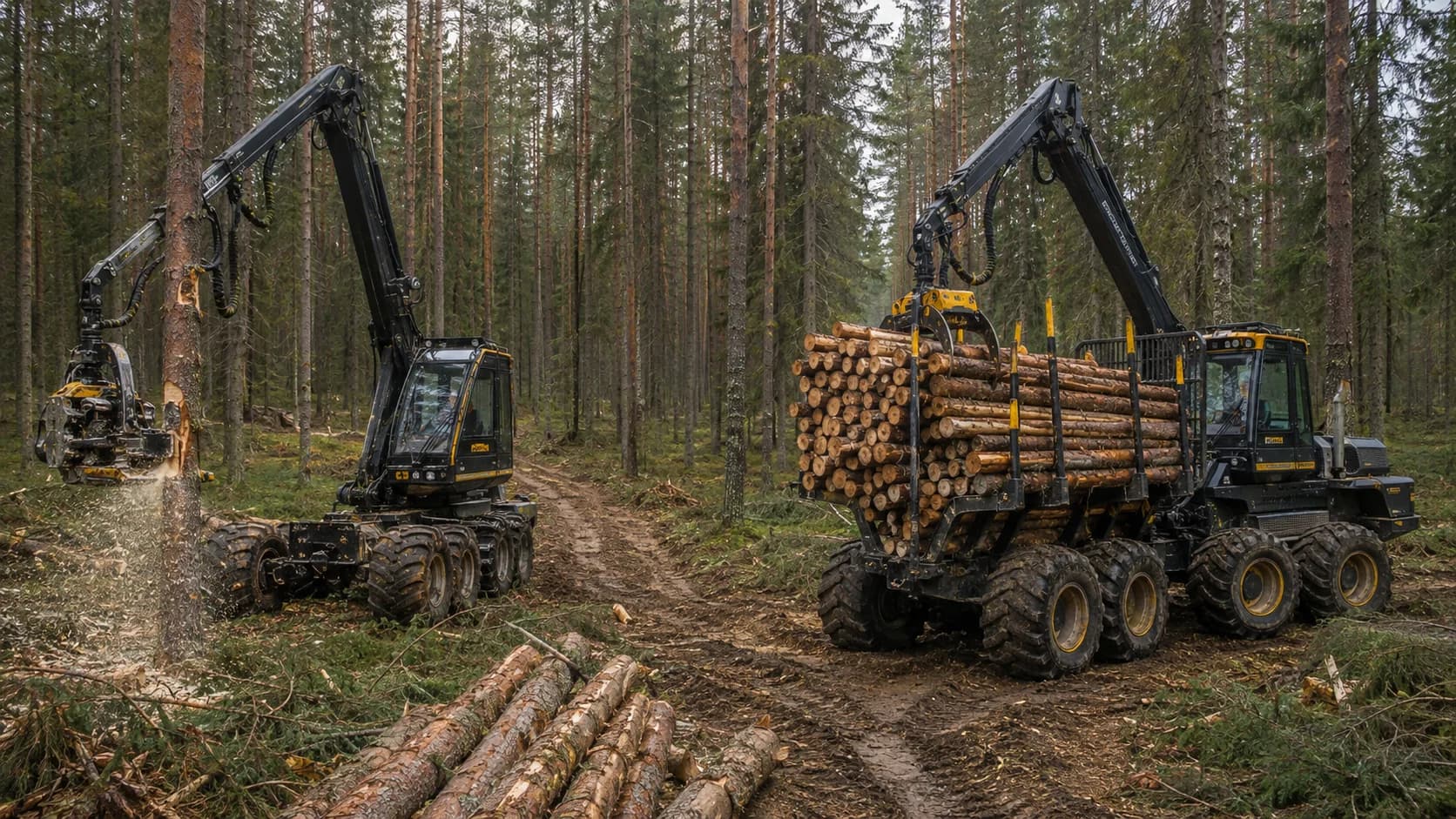
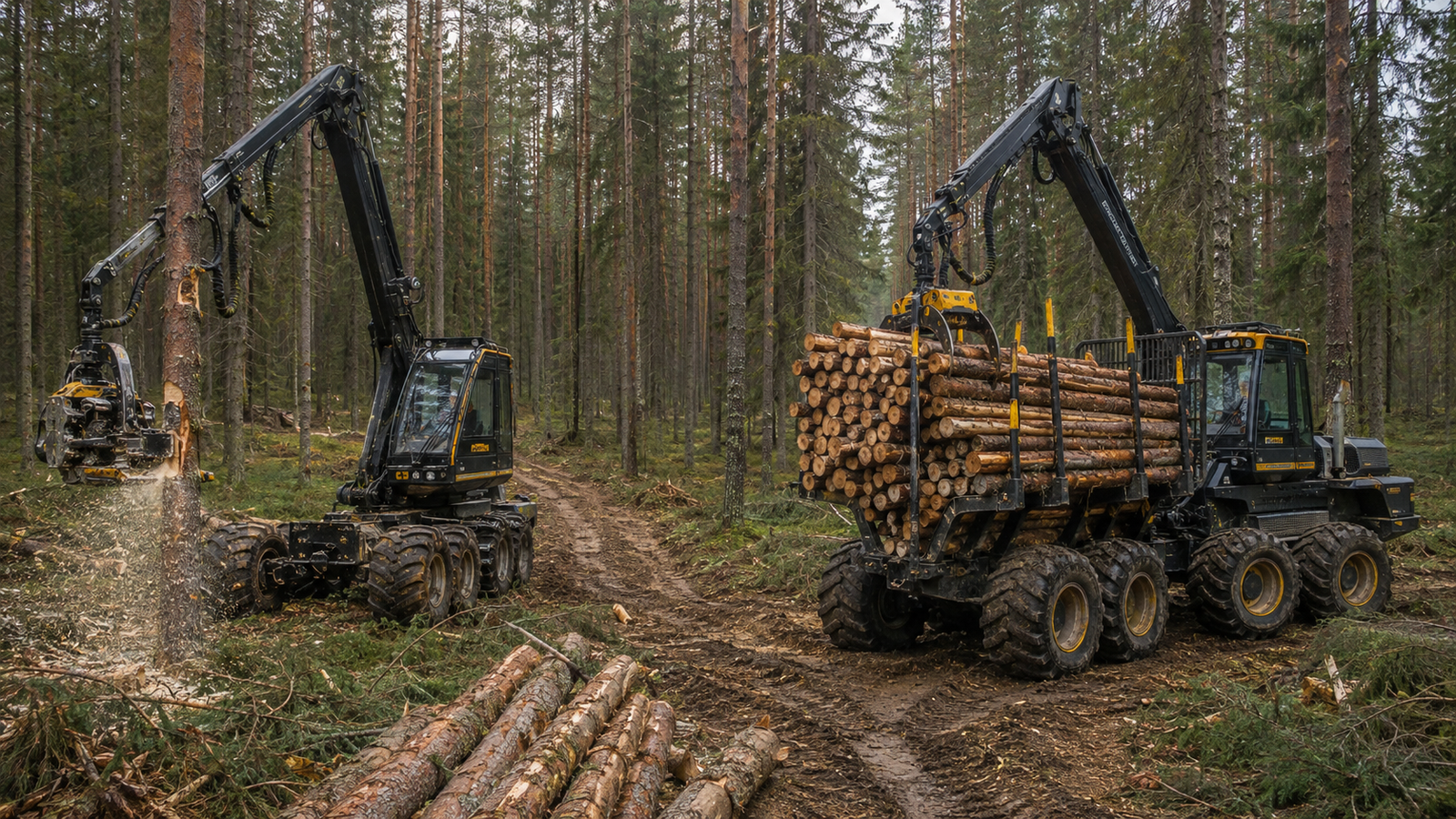
Mechanized cut-to-length logging commonly relies on two specialized machines: the harvester and the forwarder. The harvester fells the tree, delimbs it, measures the stem, and cuts logs to specified lengths. The forwarder collects those processed logs and carries them off the forest floor to a roadside landing. They are designed to work as a coordinated system. Understanding their roles helps explain why modern forestry can achieve high productivity while controlling log quality, soil disturbance, and worker exposure compared with traditional manual felling and skidding methods.
What a Forestry Harvester Does
A harvester uses a carrier with a hydraulic boom and a processing head. The head grips a standing tree, cuts it at the stump, feeds the stem through delimbing knives, measures diameter and length, and crosscuts logs according to a cutting instruction. Wheeled harvesters are common in managed forests, while tracked carriers may be used on steep or soft ground. The operator works from a protected cab using computerized controls that store product specifications and production data.
What a Forwarder Does
A forwarder is a purpose-built carrier with a rear load bunk and hydraulic grapple crane. Instead of dragging logs along the ground, it lifts them into the bunk and transports them completely off the ground to the landing. This reduces log contamination and soil disturbance compared with skidding. Forwarders range from compact thinning machines to heavy units carrying large payloads. Bogie axles, wide tires, tracks, or chains can improve flotation and traction.
The Cut-to-Length Workflow
The harvester moves through the stand, felling and processing trees into sorted log piles along extraction trails. The forwarder follows later and loads those piles by product class. Good harvester placement minimizes crane work for the forwarder and keeps logs accessible without forcing the machine off planned trails. The forwarder then carries full loads to roadside stacks, where logs are separated by species, length, grade, or destination. Productivity depends on both machines maintaining a balanced rhythm.
Harvester Head Components
The processing head usually includes a felling saw, feed rollers, delimbing knives, measuring wheel, hydraulic cylinders, and sensors. Feed rollers pull the stem through the head while the knives remove branches. The computer combines wheel travel and diameter measurement to determine log length and volume. Saw-chain lubrication, bar condition, feed-roller grip, knife adjustment, and calibration all affect quality. A head that is poorly maintained can mismeasure logs, damage stems, or slow processing even when the carrier is operating normally.
Forwarder Crane and Load Bunk
The forwarder crane must reach log piles efficiently while maintaining stability. The grapple gathers stems and places them in the bunk, where headboard and stakes contain the load. Operators try to build a dense balanced load without exceeding payload or axle limits. Long crane reaches can reduce travel but increase cycle time if each grapple holds too little material. Load arrangement also affects visibility, machine stability, and unloading efficiency at the roadside.
Matching Machine Size
A large harvester can process trees faster than a small forwarder can remove them, creating roadside or trail congestion. Conversely, an oversized forwarder may spend too much time waiting for enough logs to justify a load. Machine size should match average tree volume, terrain, trail spacing, extraction distance, and production target. Thinning operations often prioritize narrow width and low ground pressure, while final felling can use larger carriers with more powerful heads and higher forwarder payloads.
Terrain and Soil Protection
Forest soils can be vulnerable to rutting and compaction, especially when wet. Machine traffic should be concentrated on planned extraction trails. Slash from harvester processing can be placed on trails to distribute loads and protect the surface. Wide tires, bogie tracks, low tire pressure, and careful timing help reduce impact. Forwarders generally create more repeated traffic on main routes because every load travels to the landing, so trail design and maintenance are especially important.
Steep Terrain
Slope increases traction and rollover risk and can reduce crane stability. Some modern harvesters and forwarders use winch-assist systems to improve stability and mobility on steep slopes, while purpose-built tracked systems may be used in extreme terrain. Operators must follow machine-specific slope limits and work methods. Boom position, load direction, travel path, and ground roughness all affect stability. Steep terrain planning should be conservative because recovery or rescue operations in forests are difficult.
Log Quality and Optimization
The harvester computer can optimize bucking based on desired lengths, diameters, and product values. Accurate calibration is critical because small measurement errors repeated across thousands of logs create significant value loss. The operator also influences quality by choosing where to cut around defects and by avoiding excessive stem damage. Forwarder handling should preserve that value by preventing unnecessary dirt contamination, breakage, and mixing of assortments.
Productivity Factors
Harvester output depends on tree size, branchiness, species, visibility, terrain, operator skill, head capacity, and move distance between trees. Forwarder output depends on payload, crane productivity, log concentration, extraction distance, trail speed, and unloading time. Longer forwarding distance often becomes the system bottleneck. Production studies should therefore measure both machines and adjust trail layout, landing location, and machine balance rather than judging performance by harvester trees per hour alone.
Maintenance
Harvesters require close attention to saw systems, hydraulic hoses, boom pins, head rollers, knives, sensors, lubrication, and guarding. Forwarders focus on crane structures, grapple, bunk stakes, bogies, tires, tracks, driveline, and brakes. Both machines work around branches, stumps, mud, and debris that can damage hoses or wiring. Daily cleaning and inspection reduce fire risk because dry forestry debris can accumulate around hot components.
Safety and Work Organization
Mechanized forestry reduces direct exposure to chain saws and falling trees but still presents major hazards. The harvester creates a large felling and boom-swing zone that must be kept clear. Forwarders have blind spots, suspended log loads, and rollover exposure. Radio communication, machine separation, emergency access, fire prevention, and planned work zones are essential. Ground personnel should not enter the operating radius unless the machine is stopped and communication has been established.
Practical Planning Notes
Planning note 1. Design extraction trails before harvesting so the harvester can place processed logs within easy forwarder crane reach. In practical terms, this should be converted into a written field decision rather than left as an informal expectation. The crew should know what will be checked, who is responsible, what condition triggers a change, and how that change affects the rest of the forestry harvester vs forwarder operation. Good planning also uses observable data such as cycle time, machine loading, ground response, component temperature, fuel use, wear, or finished-work quality. When these observations are recorded consistently, supervisors can separate normal variation from a developing problem and make adjustments before production is lost. The most effective jobsites treat these checks as part of normal production management, not as paperwork added after the work is complete.
Planning note 2. Match forwarder payload to extraction distance; longer distances often justify larger loads if ground conditions and trail width allow. In practical terms, this should be converted into a written field decision rather than left as an informal expectation. The crew should know what will be checked, who is responsible, what condition triggers a change, and how that change affects the rest of the forestry harvester vs forwarder operation. Good planning also uses observable data such as cycle time, machine loading, ground response, component temperature, fuel use, wear, or finished-work quality. When these observations are recorded consistently, supervisors can separate normal variation from a developing problem and make adjustments before production is lost. The most effective jobsites treat these checks as part of normal production management, not as paperwork added after the work is complete.
Planning note 3. Use slash mats strategically on wet or weak sections to reduce rutting and keep traffic on designated trails. In practical terms, this should be converted into a written field decision rather than left as an informal expectation. The crew should know what will be checked, who is responsible, what condition triggers a change, and how that change affects the rest of the forestry harvester vs forwarder operation. Good planning also uses observable data such as cycle time, machine loading, ground response, component temperature, fuel use, wear, or finished-work quality. When these observations are recorded consistently, supervisors can separate normal variation from a developing problem and make adjustments before production is lost. The most effective jobsites treat these checks as part of normal production management, not as paperwork added after the work is complete.
Planning note 4. Calibrate harvester length and diameter measurement regularly because product-value losses can exceed the cost of calibration time. In practical terms, this should be converted into a written field decision rather than left as an informal expectation. The crew should know what will be checked, who is responsible, what condition triggers a change, and how that change affects the rest of the forestry harvester vs forwarder operation. Good planning also uses observable data such as cycle time, machine loading, ground response, component temperature, fuel use, wear, or finished-work quality. When these observations are recorded consistently, supervisors can separate normal variation from a developing problem and make adjustments before production is lost. The most effective jobsites treat these checks as part of normal production management, not as paperwork added after the work is complete.
Planning note 5. Sort logs in small organized piles by assortment to reduce forwarder handling and prevent mixing at the landing. In practical terms, this should be converted into a written field decision rather than left as an informal expectation. The crew should know what will be checked, who is responsible, what condition triggers a change, and how that change affects the rest of the forestry harvester vs forwarder operation. Good planning also uses observable data such as cycle time, machine loading, ground response, component temperature, fuel use, wear, or finished-work quality. When these observations are recorded consistently, supervisors can separate normal variation from a developing problem and make adjustments before production is lost. The most effective jobsites treat these checks as part of normal production management, not as paperwork added after the work is complete.
Planning note 6. Keep the forwarder close enough to prevent log inventory buildup but not so close that machines interfere with each other’s work zones. In practical terms, this should be converted into a written field decision rather than left as an informal expectation. The crew should know what will be checked, who is responsible, what condition triggers a change, and how that change affects the rest of the forestry harvester vs forwarder operation. Good planning also uses observable data such as cycle time, machine loading, ground response, component temperature, fuel use, wear, or finished-work quality. When these observations are recorded consistently, supervisors can separate normal variation from a developing problem and make adjustments before production is lost. The most effective jobsites treat these checks as part of normal production management, not as paperwork added after the work is complete.
Planning note 7. Inspect hydraulic hoses and clear dry debris daily to reduce fire risk in hot forestry conditions. In practical terms, this should be converted into a written field decision rather than left as an informal expectation. The crew should know what will be checked, who is responsible, what condition triggers a change, and how that change affects the rest of the forestry harvester vs forwarder operation. Good planning also uses observable data such as cycle time, machine loading, ground response, component temperature, fuel use, wear, or finished-work quality. When these observations are recorded consistently, supervisors can separate normal variation from a developing problem and make adjustments before production is lost. The most effective jobsites treat these checks as part of normal production management, not as paperwork added after the work is complete.
Planning note 8. Place landings where road access, truck loading, slope, and forwarding distance create the best overall system rather than simply the easiest roadside location. In practical terms, this should be converted into a written field decision rather than left as an informal expectation. The crew should know what will be checked, who is responsible, what condition triggers a change, and how that change affects the rest of the forestry harvester vs forwarder operation. Good planning also uses observable data such as cycle time, machine loading, ground response, component temperature, fuel use, wear, or finished-work quality. When these observations are recorded consistently, supervisors can separate normal variation from a developing problem and make adjustments before production is lost. The most effective jobsites treat these checks as part of normal production management, not as paperwork added after the work is complete.
Common Mistakes to Avoid
- Selecting equipment from nominal capacity alone without checking the actual site, material, access, duty cycle, or support requirements of the forestry harvester vs forwarder.
- Allowing production pressure to override inspection, setup, or maintenance checks that protect the machine and finished work.
- Using average conditions for planning when one steep grade, weak area, hard layer, narrow access point, or large starting load can control the whole operation.
- Failing to record operating data, which makes it difficult to identify whether a problem comes from the machine, material, road, tooling, operator technique, or maintenance condition.
- Changing several variables at once when troubleshooting, which makes it impossible to know which adjustment actually improved or worsened performance.
A useful way to think about forestry harvester vs forwarder is as a system rather than a single machine or component. Equipment selection, site conditions, operator technique, maintenance, logistics, and quality requirements interact continuously. Improving only one element can move the bottleneck somewhere else. For example, a faster machine may create queues at loading, dumping, servicing, or material handling if the rest of the process is not prepared. This systems view is especially important on large projects because small inefficiencies repeat over hundreds or thousands of cycles. Measuring the complete process and adjusting it deliberately is usually more valuable than chasing the highest theoretical machine specification.
Frequently Asked Questions
What is the difference between a harvester and a forwarder?
The harvester fells and processes trees into logs. The forwarder collects those logs and carries them off the forest floor to a landing.
Why not use one machine for both jobs?
Specialization allows each machine to be optimized. Harvesters need processing heads and felling control, while forwarders need payload capacity and efficient log transport.
Do forwarders drag logs?
No. A forwarder carries logs in a bunk so the load is off the ground, reducing soil disturbance and contamination compared with skidding.
What controls forestry productivity most?
Tree size, terrain, operator skill, extraction distance, trail layout, and the balance between harvester output and forwarder capacity all matter.
Final Takeaway
The best results with forestry harvester vs forwarder come from matching equipment capability to real working conditions and then managing the complete production system. Specifications provide the starting point, but field success depends on setup, material behavior, access, maintenance, operator decisions, and the way the machine interacts with the rest of the project. Before work begins, define the expected duty, identify the conditions most likely to reduce performance, and establish clear limits for when the crew should stop, inspect, or change the plan. During production, use simple measurable indicators such as cycle time, penetration, payload, fuel use, wear, temperature, quality, or electrical loading to confirm that the system is operating as intended. That disciplined approach improves productivity while protecting equipment, workers, and the finished construction work.
Get More Expert Guides & Updates
Subscribe for Machinery.org guide updates and product learning content.