
Wood chippers convert branches, tops, logs, brush, and green waste into smaller chips that are easier to transport, process, compost, burn, or use as mulch. The heart of the machine is the cutting system, most commonly a drum or disc fitted with replaceable knives. Chipper performance depends on much more than engine horsepower: feed opening, feed rollers, knife angle, anvil clearance, material species, moisture, contamination, discharge system, and maintenance all influence production. Understanding drum and disc designs helps users select the machine that best fits their material stream and maintenance capability.
How a Wood Chipper Works
Material enters through an infeed chute and is gripped by hydraulic or mechanical feed rollers. These rollers meter the wood into the cutting chamber. Knives mounted on a rotating drum or disc shear the wood against an anvil or bed knife. The rotating assembly also creates airflow or throws chips toward a discharge chute. Electronic feed controls may pause or reverse the rollers when engine speed falls, allowing the cutting system to recover. Consistent feeding and sharp knives are the foundation of good chip quality.
Drum Chippers
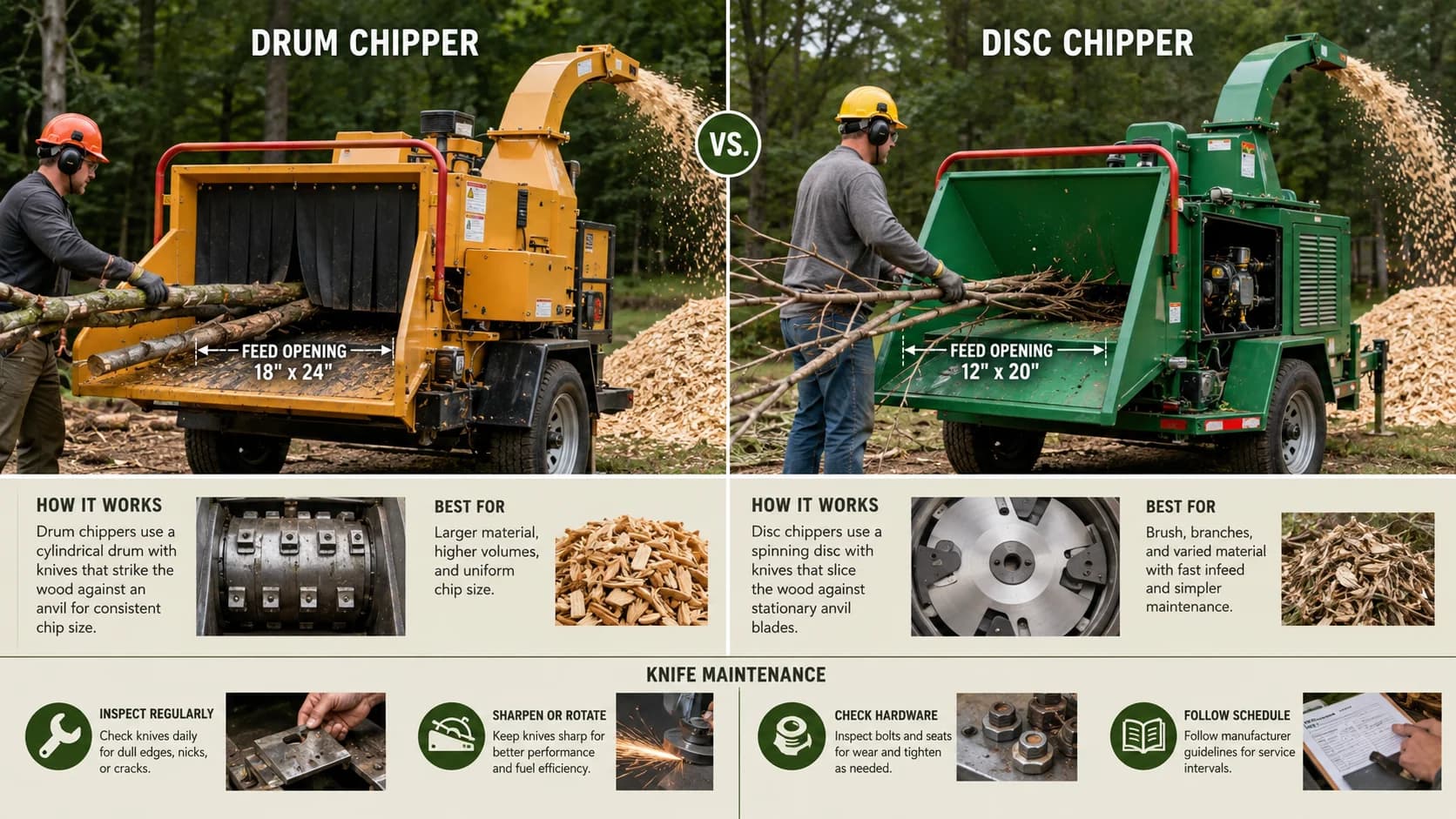
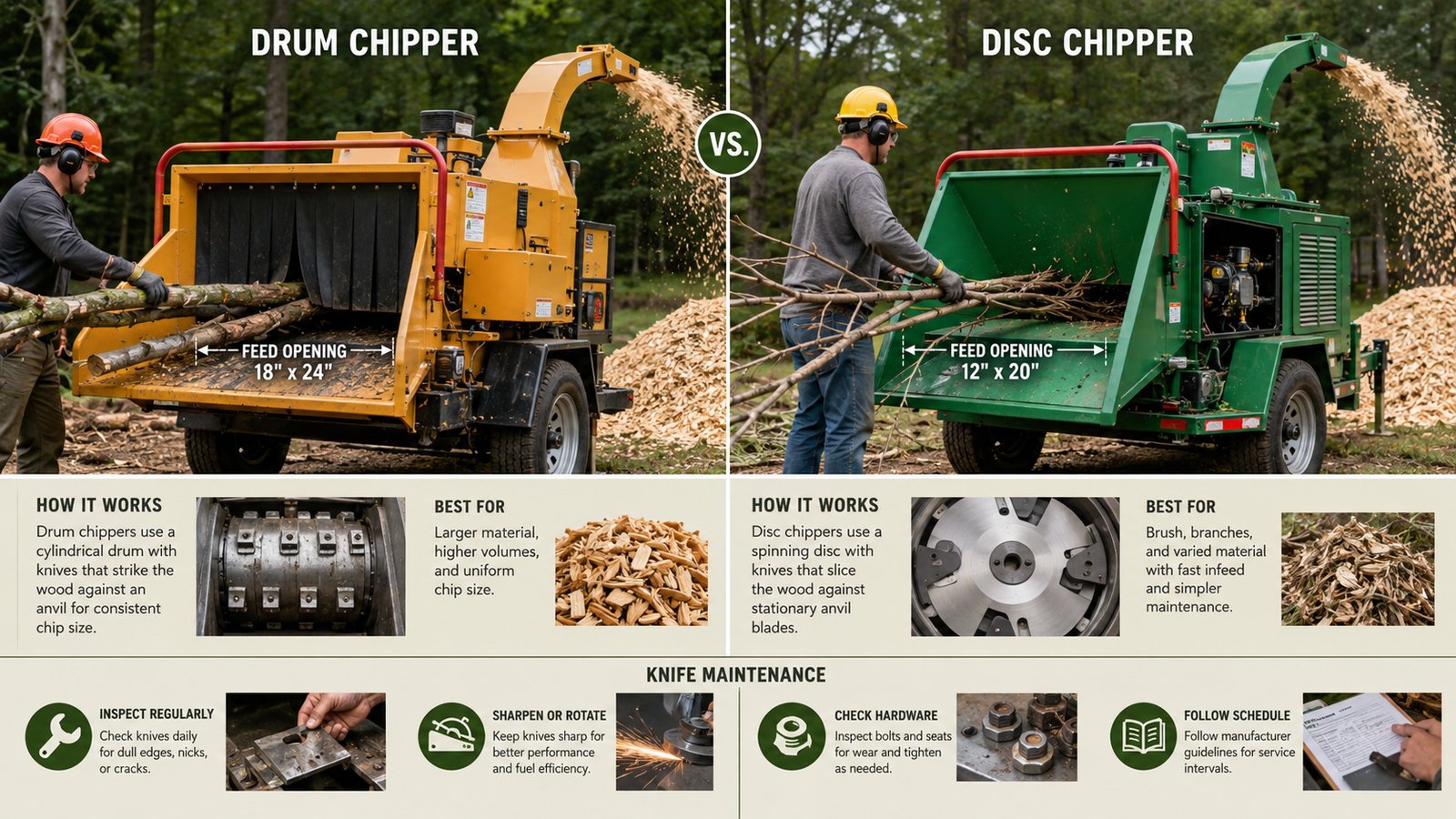
Drum chippers mount knives around a cylindrical rotor. As the drum rotates, successive knives cut material across the feed opening. Drum designs often provide aggressive infeed and can handle bulky, irregular material efficiently. They are common in tree-care, biomass, and high-volume applications. Because the drum has significant rotating mass, it can carry energy through heavy cuts, but it also requires robust guarding and careful maintenance. Knife pockets, bolts, bearings, and the drum surface should be inspected for damage.
Disc Chippers
Disc chippers mount knives radially on a large rotating disc. Material enters toward the disc face, and each knife slices a chip before the disc carries or blows it toward the discharge. Disc machines can produce uniform chips and may be mechanically simple. They are widely used in tree care and smaller commercial work. Feed geometry, disc speed, knife projection, and anvil clearance strongly affect chip size and feeding behavior. A worn or incorrectly adjusted disc system can produce stringy material and excessive fines.
Feed Opening and Capacity
Feed opening dimensions determine the maximum physical size of material that can enter, but they should not be confused with continuous production capacity. A machine may accept a large branch that still takes significant time to process. Capacity depends on species, moisture, forked branches, density, knife condition, engine power, and how consistently operators feed material. A wide rectangular opening often handles brush better than a narrow round-equivalent opening because side branches require space even when the main stem is small.
Feed Rollers and Infeed Control
Hydraulic feed rollers pull material into the chipper and help control cutting load. Roller downforce and tooth condition affect grip, particularly on smooth wet stems or leafy brush. Auto-feed systems monitor engine speed and pause the rollers when the rotor is overloaded. Reverse functions allow the operator to clear forks or reposition material without reaching into the chute. Feed control should be maintained carefully because uncontrolled infeed can cause plugging and unsafe operator behavior.
Knife Design and Sharpness
Sharp knives cut wood cleanly with lower power demand. As edges round over, the machine begins to tear and crush, increasing vibration, fuel use, fines, and feed effort. Knife material, bevel angle, projection, and balance must match the manufacturer’s specification. Some knives can be sharpened several times before replacement, while others are indexed or replaced. Knives should be sharpened as a matched set so mass and projection remain consistent around the rotor or disc.
Anvil or Bed-Knife Clearance
The anvil provides the stationary reaction surface for the rotating knives. Clearance that is too large produces poor cutting, stringy chips, and high shock loads. Clearance that is too small risks contact between the knife and anvil as parts heat or flex. Wear on the anvil edge also reduces cutting quality. Clearance should be checked after knife changes and at the maintenance interval specified by the manufacturer. Accurate adjustment is one of the most cost-effective ways to restore chipper performance.
Chip Size and Discharge
Chip size is influenced by knife projection, feed speed, number of knives, rotor speed, and material. Biomass applications may require consistent chips for downstream screens or boilers, while tree-care work may prioritize throughput. The discharge chute must stay clear and correctly aimed. Wet fibrous material can plug chutes, especially when knives are dull or airflow is reduced by buildup. Operators should stop and isolate the machine before clearing blockages.
Material Type and Contamination
Clean wood chips differently from leafy brush, palm material, vines, wet bark, or dead dry hardwood. Dirt, rocks, metal, nails, wire, and construction debris can damage knives instantly and may create dangerous projectiles. Feed piles should be prepared so contaminated material can be rejected before it reaches the machine. Stumps and soil-covered root balls are usually better processed with grinders designed for contaminated material rather than conventional chippers.
Maintenance and Inspection
Daily checks should include knives, anvil, feed rollers, hydraulic hoses, bearings, belts, guards, emergency-stop systems, fluid levels, and discharge components. Greasing and belt tension must follow the manufacturer schedule. Vibration is an important warning sign because a missing knife, damaged pocket, buildup, or bearing problem can unbalance the rotor. Chippers operate at high rotational energy, so unusual noise or vibration should trigger shutdown and inspection rather than continued operation.
Transport and Setup
Towable chippers require correct towing capacity, hitch, safety chains, lights, breakaway systems, and weight distribution. Tracked chippers need suitable transport and stable setup. At the work area, position the discharge away from people, traffic, windows, and overhead lines. Establish an infeed work zone so operators do not stand directly in line with material movement. Branch piles should be oriented butt-end toward the chipper where practical to reduce twisting and handling.
Safety Around Chippers
Wood chippers can pull material in rapidly and can eject debris at high speed. Operators must stay outside the infeed hazard zone, avoid loose clothing, and use the push tools or safe feeding methods specified by the manufacturer. Never reach into the chute, climb on the infeed tray while running, or bypass feed-control bars and emergency systems. Knife servicing requires complete energy isolation and secure prevention of rotor movement. Eye, hearing, and head protection are commonly required, but site-specific controls and manufacturer instructions govern the work.
Practical Planning Notes
Planning note 1. Select feed-opening shape for the actual material stream; brush and forked limbs may require more opening area than round logs of the same nominal diameter. In practical terms, this should be converted into a written field decision rather than left as an informal expectation. The crew should know what will be checked, who is responsible, what condition triggers a change, and how that change affects the rest of the wood chipper guide operation. Good planning also uses observable data such as cycle time, machine loading, ground response, component temperature, fuel use, wear, or finished-work quality. When these observations are recorded consistently, supervisors can separate normal variation from a developing problem and make adjustments before production is lost. The most effective jobsites treat these checks as part of normal production management, not as paperwork added after the work is complete.
Planning note 2. Track knife hours and sharpening cycles so edges are serviced before productivity collapses or fuel use rises sharply. In practical terms, this should be converted into a written field decision rather than left as an informal expectation. The crew should know what will be checked, who is responsible, what condition triggers a change, and how that change affects the rest of the wood chipper guide operation. Good planning also uses observable data such as cycle time, machine loading, ground response, component temperature, fuel use, wear, or finished-work quality. When these observations are recorded consistently, supervisors can separate normal variation from a developing problem and make adjustments before production is lost. The most effective jobsites treat these checks as part of normal production management, not as paperwork added after the work is complete.
Planning note 3. Check anvil clearance every time knives are changed, because knife projection and bed condition work together as one cutting system. In practical terms, this should be converted into a written field decision rather than left as an informal expectation. The crew should know what will be checked, who is responsible, what condition triggers a change, and how that change affects the rest of the wood chipper guide operation. Good planning also uses observable data such as cycle time, machine loading, ground response, component temperature, fuel use, wear, or finished-work quality. When these observations are recorded consistently, supervisors can separate normal variation from a developing problem and make adjustments before production is lost. The most effective jobsites treat these checks as part of normal production management, not as paperwork added after the work is complete.
Planning note 4. Separate dirty root balls, wire, metal, stones, and demolition wood before chipping to prevent high-cost knife and rotor damage. In practical terms, this should be converted into a written field decision rather than left as an informal expectation. The crew should know what will be checked, who is responsible, what condition triggers a change, and how that change affects the rest of the wood chipper guide operation. Good planning also uses observable data such as cycle time, machine loading, ground response, component temperature, fuel use, wear, or finished-work quality. When these observations are recorded consistently, supervisors can separate normal variation from a developing problem and make adjustments before production is lost. The most effective jobsites treat these checks as part of normal production management, not as paperwork added after the work is complete.
Planning note 5. Orient material butt-end first when possible so branches feed smoothly and operators spend less time repositioning tangled tops. In practical terms, this should be converted into a written field decision rather than left as an informal expectation. The crew should know what will be checked, who is responsible, what condition triggers a change, and how that change affects the rest of the wood chipper guide operation. Good planning also uses observable data such as cycle time, machine loading, ground response, component temperature, fuel use, wear, or finished-work quality. When these observations are recorded consistently, supervisors can separate normal variation from a developing problem and make adjustments before production is lost. The most effective jobsites treat these checks as part of normal production management, not as paperwork added after the work is complete.
Planning note 6. Use discharge direction and exclusion zones to control flying chips and keep trucks, pedestrians, and buildings out of the discharge path. In practical terms, this should be converted into a written field decision rather than left as an informal expectation. The crew should know what will be checked, who is responsible, what condition triggers a change, and how that change affects the rest of the wood chipper guide operation. Good planning also uses observable data such as cycle time, machine loading, ground response, component temperature, fuel use, wear, or finished-work quality. When these observations are recorded consistently, supervisors can separate normal variation from a developing problem and make adjustments before production is lost. The most effective jobsites treat these checks as part of normal production management, not as paperwork added after the work is complete.
Planning note 7. Stop for unusual vibration immediately; imbalance in a high-speed rotor can escalate from a small defect to major machine damage quickly. In practical terms, this should be converted into a written field decision rather than left as an informal expectation. The crew should know what will be checked, who is responsible, what condition triggers a change, and how that change affects the rest of the wood chipper guide operation. Good planning also uses observable data such as cycle time, machine loading, ground response, component temperature, fuel use, wear, or finished-work quality. When these observations are recorded consistently, supervisors can separate normal variation from a developing problem and make adjustments before production is lost. The most effective jobsites treat these checks as part of normal production management, not as paperwork added after the work is complete.
Planning note 8. Compare chip quality and fuel per ton after maintenance, not just visual knife condition, to identify when sharpening intervals should change. In practical terms, this should be converted into a written field decision rather than left as an informal expectation. The crew should know what will be checked, who is responsible, what condition triggers a change, and how that change affects the rest of the wood chipper guide operation. Good planning also uses observable data such as cycle time, machine loading, ground response, component temperature, fuel use, wear, or finished-work quality. When these observations are recorded consistently, supervisors can separate normal variation from a developing problem and make adjustments before production is lost. The most effective jobsites treat these checks as part of normal production management, not as paperwork added after the work is complete.
Common Mistakes to Avoid
- Selecting equipment from nominal capacity alone without checking the actual site, material, access, duty cycle, or support requirements of the wood chipper guide.
- Allowing production pressure to override inspection, setup, or maintenance checks that protect the machine and finished work.
- Using average conditions for planning when one steep grade, weak area, hard layer, narrow access point, or large starting load can control the whole operation.
- Failing to record operating data, which makes it difficult to identify whether a problem comes from the machine, material, road, tooling, operator technique, or maintenance condition.
- Changing several variables at once when troubleshooting, which makes it impossible to know which adjustment actually improved or worsened performance.
A useful way to think about wood chipper guide is as a system rather than a single machine or component. Equipment selection, site conditions, operator technique, maintenance, logistics, and quality requirements interact continuously. Improving only one element can move the bottleneck somewhere else. For example, a faster machine may create queues at loading, dumping, servicing, or material handling if the rest of the process is not prepared. This systems view is especially important on large projects because small inefficiencies repeat over hundreds or thousands of cycles. Measuring the complete process and adjusting it deliberately is usually more valuable than chasing the highest theoretical machine specification.
Frequently Asked Questions
Which is better, drum or disc chipper?
Neither is universally better. Drum machines often handle bulky irregular material aggressively, while disc machines can provide simple robust cutting and consistent chips. Feed system and intended material are equally important.
How often should chipper knives be sharpened?
It depends on material, contamination, knife type, and hours. Monitor edge condition, chip quality, engine load, and feed behavior, and follow the manufacturer’s service limits.
Why does my chipper make stringy chips?
Common causes include dull knives, excessive anvil clearance, incorrect knife projection, low rotor speed, or fibrous material.
Can a wood chipper process dirty roots?
Conventional chippers are poorly suited to soil and stones because contamination rapidly damages knives. A grinder or other processing method is often better.
Final Takeaway
The best results with wood chipper guide come from matching equipment capability to real working conditions and then managing the complete production system. Specifications provide the starting point, but field success depends on setup, material behavior, access, maintenance, operator decisions, and the way the machine interacts with the rest of the project. Before work begins, define the expected duty, identify the conditions most likely to reduce performance, and establish clear limits for when the crew should stop, inspect, or change the plan. During production, use simple measurable indicators such as cycle time, penetration, payload, fuel use, wear, temperature, quality, or electrical loading to confirm that the system is operating as intended. That disciplined approach improves productivity while protecting equipment, workers, and the finished construction work.
Get More Expert Guides & Updates
Subscribe for Machinery.org guide updates and product learning content.