
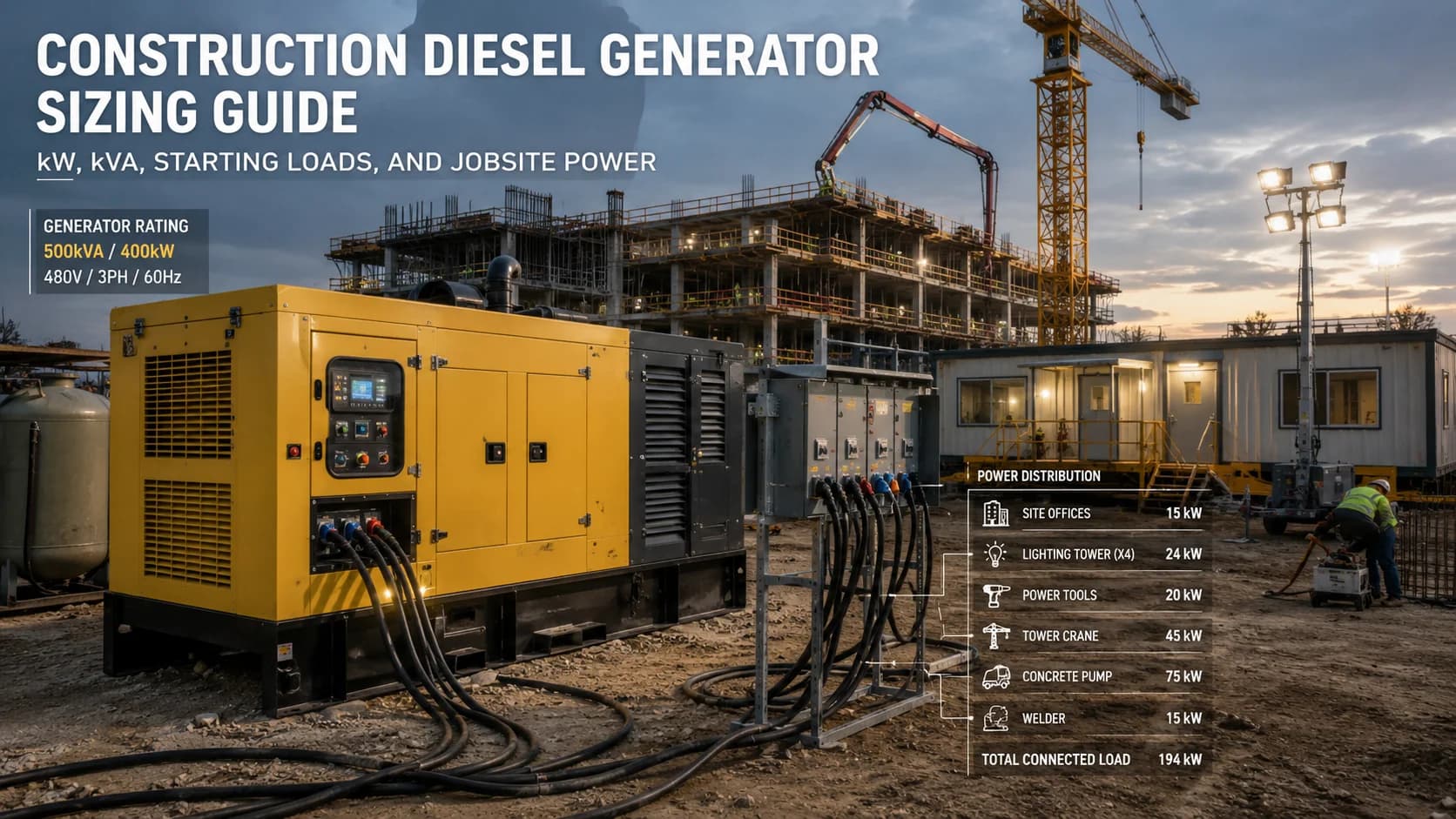
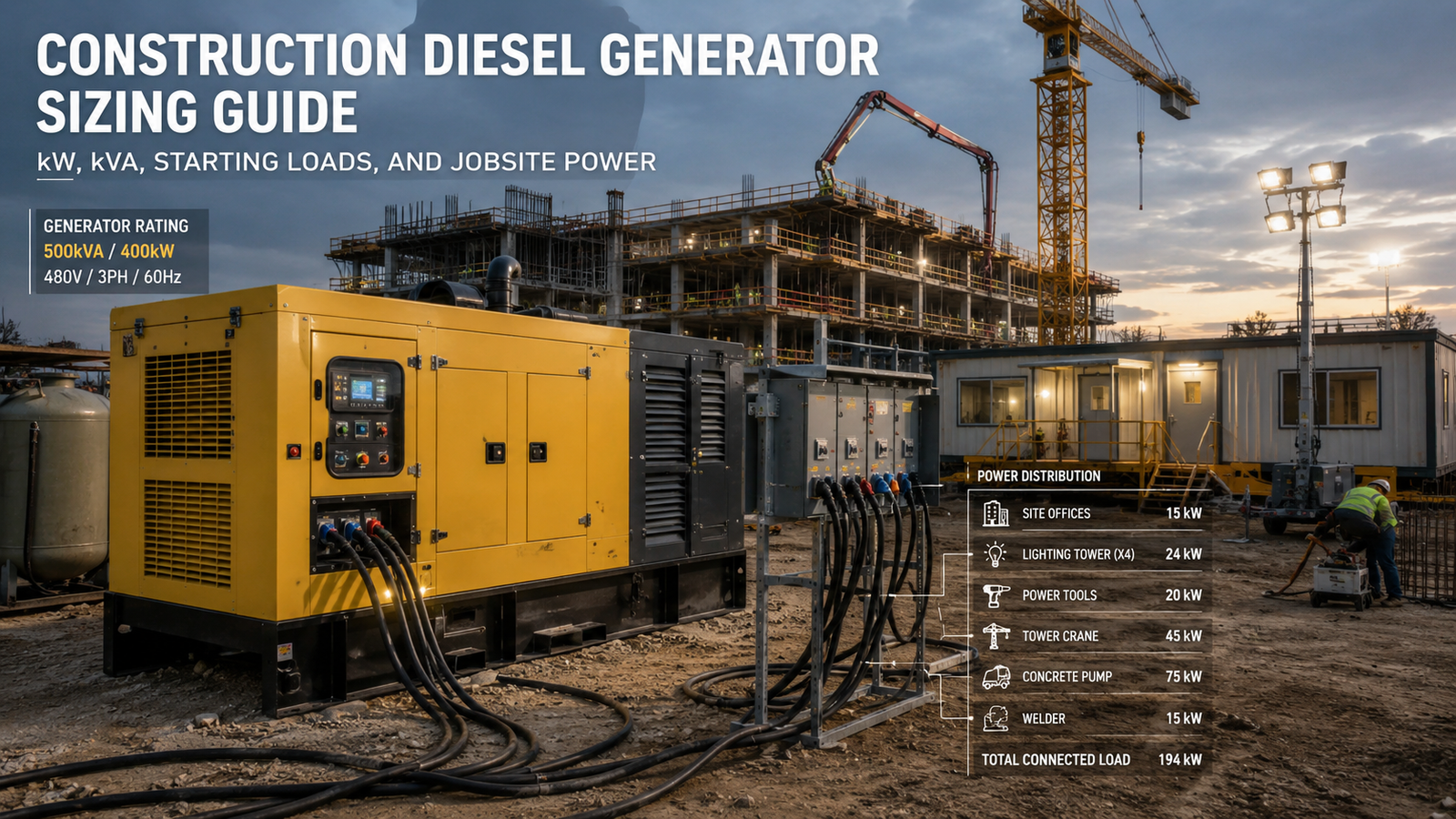
Construction sites need temporary power for lighting, offices, pumps, welders, cranes, concrete equipment, compressors, chargers, heaters, and many other loads. Choosing a diesel generator by simply adding nameplate kilowatts can lead to voltage dips, nuisance trips, excessive fuel use, or a machine that spends most of its life lightly loaded. Correct sizing requires understanding the difference between kW and kVA, continuous and standby ratings, power factor, motor starting current, load sequencing, voltage, phase, frequency, and expected future expansion. A generator is part of a power system, not just an engine connected to outlets.
kW and kVA
Kilowatts measure real power that performs useful work. Kilovolt-amperes measure apparent power, which includes the effect of reactive current. The relationship is commonly expressed as kW = kVA × power factor for balanced AC loads. Many three-phase generators are rated in kVA with an assumed power factor, often around 0.8 for general industrial duty, though the actual generator data must be checked. Resistive loads may have power factor close to 1.0, while motors and electronic equipment can behave differently.
Prime, Standby, and Continuous Ratings
Generator sets may have multiple power ratings. Standby rating is typically intended for emergency operation for limited annual hours and varying load. Prime rating is intended for variable-load applications where the generator is the primary source. Some sets also have continuous or data-center style ratings for defined duty. The exact definitions depend on standards and manufacturer documentation. Construction sites using a generator every day should select a rating appropriate for prime power rather than assuming the largest printed number applies indefinitely.
Inventorying Jobsite Loads
Start by listing every expected load: site offices, lighting, tower cranes, hoists, pumps, welders, concrete vibrators, compressors, saws, battery chargers, HVAC, dewatering equipment, and temporary receptacles. Record voltage, phase, full-load current or kW, power factor if known, motor size, and whether the load starts automatically. Separate loads that run continuously from intermittent equipment. A load schedule is more useful than a single total because it reveals what may run at the same time.
Motor Starting Loads
Electric motors can draw several times their running current during starting. Across-the-line starting of pumps, fans, compressors, and hoists can therefore cause a generator voltage and frequency dip even when the running kW appears modest. Soft starters and variable-frequency drives can reduce starting demand, although they introduce harmonic and control considerations. Generator sizing should evaluate the largest motor start while other expected loads remain online. OEM sizing software is often used because alternator response, engine step-load capability, voltage regulation, and motor characteristics interact.
Load Sequencing
Not every load needs to start at once. Sequencing can dramatically reduce required generator size. For example, dewatering pumps can start one at a time, HVAC compressors can delay after power restoration, and large hoists can be interlocked with other temporary loads. A load-management plan may allow a smaller generator to serve the same jobsite reliably. However, the sequence must be automatic or operationally realistic; a plan that depends on workers remembering to switch off unrelated equipment before every motor start will eventually fail.
Three-Phase Balance
Three-phase generators perform best when single-phase loads are distributed reasonably across phases. Heavy imbalance can overheat windings, reduce usable capacity, and create voltage differences. Temporary site panels often accumulate new single-phase loads over time, so periodic current checks are valuable. Electricians should review phase allocation when adding offices, heaters, chargers, or receptacle circuits. Balancing does not increase the generator’s total kW rating, but it allows the available capacity to be used more effectively.
Voltage, Frequency, and Connections
The generator must match jobsite voltage, phase, and frequency requirements. Construction equipment may use several voltages, requiring transformers or distribution panels. Connection methods must be rated for current, environment, and fault duty. Long temporary feeder runs create voltage drop, especially at high current, so cable size is part of the power-system design. Improvised adapters and undersized extension cords can create overheating and poor equipment performance even when the generator itself is correctly sized.
Power Factor and Harmonics
Motors, welders, LED drivers, battery chargers, variable-frequency drives, and electronic power supplies can create low power factor or harmonics. These loads may increase current without a proportional increase in useful kW. Alternators and distribution components must handle that current. Highly nonlinear loads can also affect voltage waveform and sensitive equipment. When a site includes large UPS systems, VFDs, rectifiers, or sophisticated electronics, generator and alternator selection should be reviewed with the equipment supplier or electrical engineer.
Sizing Margin
A reasonable spare margin accommodates normal uncertainty, future temporary loads, and changing site phases. Oversizing excessively, however, can keep a diesel engine at very low load for long periods, reducing fuel efficiency and potentially contributing to deposits or wet stacking in some operating patterns. Modular multiple-generator systems can provide flexibility by bringing sets online as demand changes. The best margin is enough for credible growth and transients without turning the generator into an oversized lightly loaded asset.
Fuel Consumption and Runtime
Fuel tanks should be sized around expected load, runtime, refueling access, and site rules. Published fuel consumption is usually provided at several load percentages. Actual consumption changes with loading, temperature, altitude, and engine condition. Long unattended runs require careful fuel-quality management, leak prevention, and monitoring. A generator sized too large may consume unnecessary fuel at light load, while one sized too small may run near maximum continuously and have little reserve for starts or future equipment.
Distribution and Protection
A reliable jobsite system includes main breakers, earth or grounding arrangements as required by local practice, distribution boards, residual-current or ground-fault protection where applicable, cable management, isolation, and clearly labeled circuits. Short-circuit protection must coordinate with downstream devices. Generator neutral configuration and bonding need competent electrical design because requirements vary by system and jurisdiction. The generator alone does not make a safe power installation; distribution engineering is equally important.
Monitoring, Maintenance, and Safety
Construction generators work in dusty, wet, and changing environments. Daily checks include fuel, coolant, oil, leaks, battery condition, air intake, exhaust clearances, cables, and alarms. Load, voltage, frequency, and current should be monitored so emerging overload or imbalance is detected early. Generators must be located where exhaust cannot enter occupied spaces. Refueling, grounding, cable protection, lockout, and electrical work should follow site procedures and applicable electrical requirements. Only qualified personnel should modify temporary distribution systems.
Practical Planning Notes
Planning note 1. Build a real load schedule by project phase; the loads during foundation work may be very different from the loads during fit-out. In practical terms, this should be converted into a written field decision rather than left as an informal expectation. The crew should know what will be checked, who is responsible, what condition triggers a change, and how that change affects the rest of the diesel generator sizing guide operation. Good planning also uses observable data such as cycle time, machine loading, ground response, component temperature, fuel use, wear, or finished-work quality. When these observations are recorded consistently, supervisors can separate normal variation from a developing problem and make adjustments before production is lost. The most effective jobsites treat these checks as part of normal production management, not as paperwork added after the work is complete.
Planning note 2. Identify the largest motor or transformer energization event and evaluate that step load while normal background loads remain connected. In practical terms, this should be converted into a written field decision rather than left as an informal expectation. The crew should know what will be checked, who is responsible, what condition triggers a change, and how that change affects the rest of the diesel generator sizing guide operation. Good planning also uses observable data such as cycle time, machine loading, ground response, component temperature, fuel use, wear, or finished-work quality. When these observations are recorded consistently, supervisors can separate normal variation from a developing problem and make adjustments before production is lost. The most effective jobsites treat these checks as part of normal production management, not as paperwork added after the work is complete.
Planning note 3. Use automatic start delays or load sequencing when several pumps, HVAC units, or hoists would otherwise energize at the same time. In practical terms, this should be converted into a written field decision rather than left as an informal expectation. The crew should know what will be checked, who is responsible, what condition triggers a change, and how that change affects the rest of the diesel generator sizing guide operation. Good planning also uses observable data such as cycle time, machine loading, ground response, component temperature, fuel use, wear, or finished-work quality. When these observations are recorded consistently, supervisors can separate normal variation from a developing problem and make adjustments before production is lost. The most effective jobsites treat these checks as part of normal production management, not as paperwork added after the work is complete.
Planning note 4. Measure phase currents after the site is operating because temporary single-phase loads often accumulate unevenly. In practical terms, this should be converted into a written field decision rather than left as an informal expectation. The crew should know what will be checked, who is responsible, what condition triggers a change, and how that change affects the rest of the diesel generator sizing guide operation. Good planning also uses observable data such as cycle time, machine loading, ground response, component temperature, fuel use, wear, or finished-work quality. When these observations are recorded consistently, supervisors can separate normal variation from a developing problem and make adjustments before production is lost. The most effective jobsites treat these checks as part of normal production management, not as paperwork added after the work is complete.
Planning note 5. Allow realistic spare capacity for growth, but avoid doubling generator size without a technical reason. In practical terms, this should be converted into a written field decision rather than left as an informal expectation. The crew should know what will be checked, who is responsible, what condition triggers a change, and how that change affects the rest of the diesel generator sizing guide operation. Good planning also uses observable data such as cycle time, machine loading, ground response, component temperature, fuel use, wear, or finished-work quality. When these observations are recorded consistently, supervisors can separate normal variation from a developing problem and make adjustments before production is lost. The most effective jobsites treat these checks as part of normal production management, not as paperwork added after the work is complete.
Planning note 6. Include feeder voltage drop and transformer losses in the system calculation, especially where the generator is far from the equipment. In practical terms, this should be converted into a written field decision rather than left as an informal expectation. The crew should know what will be checked, who is responsible, what condition triggers a change, and how that change affects the rest of the diesel generator sizing guide operation. Good planning also uses observable data such as cycle time, machine loading, ground response, component temperature, fuel use, wear, or finished-work quality. When these observations are recorded consistently, supervisors can separate normal variation from a developing problem and make adjustments before production is lost. The most effective jobsites treat these checks as part of normal production management, not as paperwork added after the work is complete.
Planning note 7. Plan refueling around actual fuel use at expected load and maintain adequate access for service vehicles without creating traffic conflicts. In practical terms, this should be converted into a written field decision rather than left as an informal expectation. The crew should know what will be checked, who is responsible, what condition triggers a change, and how that change affects the rest of the diesel generator sizing guide operation. Good planning also uses observable data such as cycle time, machine loading, ground response, component temperature, fuel use, wear, or finished-work quality. When these observations are recorded consistently, supervisors can separate normal variation from a developing problem and make adjustments before production is lost. The most effective jobsites treat these checks as part of normal production management, not as paperwork added after the work is complete.
Planning note 8. Review the power plan whenever a large new crane, pump, compressor, welder bank, or site facility is added instead of assuming the original generator has enough reserve. In practical terms, this should be converted into a written field decision rather than left as an informal expectation. The crew should know what will be checked, who is responsible, what condition triggers a change, and how that change affects the rest of the diesel generator sizing guide operation. Good planning also uses observable data such as cycle time, machine loading, ground response, component temperature, fuel use, wear, or finished-work quality. When these observations are recorded consistently, supervisors can separate normal variation from a developing problem and make adjustments before production is lost. The most effective jobsites treat these checks as part of normal production management, not as paperwork added after the work is complete.
Common Mistakes to Avoid
- Selecting equipment from nominal capacity alone without checking the actual site, material, access, duty cycle, or support requirements of the diesel generator sizing guide.
- Allowing production pressure to override inspection, setup, or maintenance checks that protect the machine and finished work.
- Using average conditions for planning when one steep grade, weak area, hard layer, narrow access point, or large starting load can control the whole operation.
- Failing to record operating data, which makes it difficult to identify whether a problem comes from the machine, material, road, tooling, operator technique, or maintenance condition.
- Changing several variables at once when troubleshooting, which makes it impossible to know which adjustment actually improved or worsened performance.
A useful way to think about diesel generator sizing guide is as a system rather than a single machine or component. Equipment selection, site conditions, operator technique, maintenance, logistics, and quality requirements interact continuously. Improving only one element can move the bottleneck somewhere else. For example, a faster machine may create queues at loading, dumping, servicing, or material handling if the rest of the process is not prepared. This systems view is especially important on large projects because small inefficiencies repeat over hundreds or thousands of cycles. Measuring the complete process and adjusting it deliberately is usually more valuable than chasing the highest theoretical machine specification.
Frequently Asked Questions
What is the difference between kW and kVA?
kW is real power, while kVA is apparent power. They are related by power factor: kW equals kVA multiplied by power factor for a balanced AC load.
Why can a motor trip a generator even if its running kW is small?
Starting current can be several times the running current, causing a temporary voltage and frequency dip. Generator sizing must consider the starting event.
Should I oversize a generator by 50 percent?
Not automatically. Some margin is useful, but excessive oversizing can reduce fuel efficiency and keep the engine lightly loaded. Size from a load schedule and transient analysis.
Can one generator power both three-phase and single-phase loads?
Often yes, if the generator and distribution system are designed for it. Single-phase loads should be distributed across phases as evenly as practical.
Final Takeaway
The best results with diesel generator sizing guide come from matching equipment capability to real working conditions and then managing the complete production system. Specifications provide the starting point, but field success depends on setup, material behavior, access, maintenance, operator decisions, and the way the machine interacts with the rest of the project. Before work begins, define the expected duty, identify the conditions most likely to reduce performance, and establish clear limits for when the crew should stop, inspect, or change the plan. During production, use simple measurable indicators such as cycle time, penetration, payload, fuel use, wear, temperature, quality, or electrical loading to confirm that the system is operating as intended. That disciplined approach improves productivity while protecting equipment, workers, and the finished construction work.
Get More Expert Guides & Updates
Subscribe for Machinery.org guide updates and product learning content.