
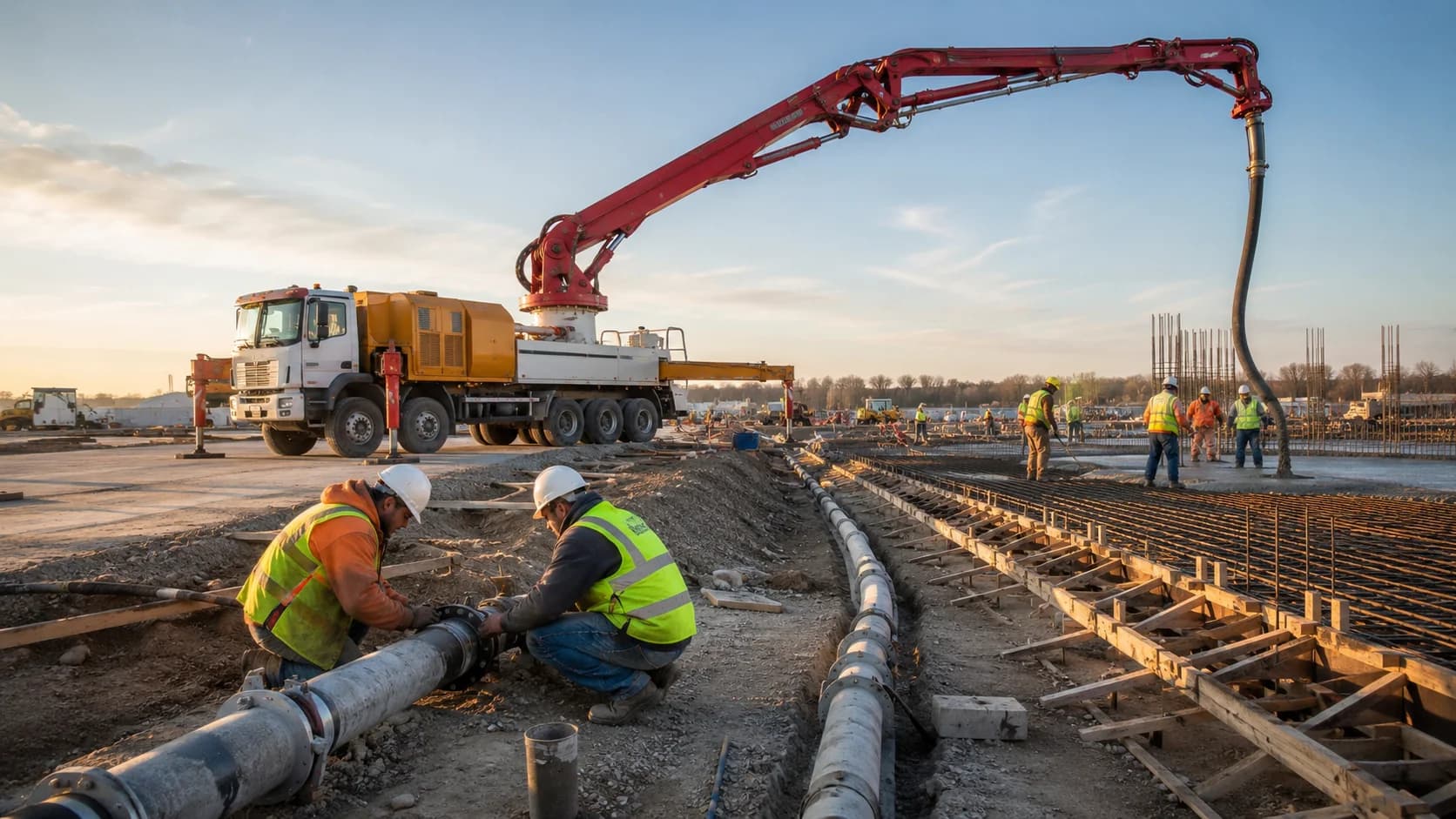
Concrete pumping can move large volumes quickly and place material where mixer trucks cannot reach, but the system depends on a continuous, pumpable flow through the hopper, cylinders, elbows, reducers, steel line, rubber hose, and end hose. A blockage turns that efficient process into a production interruption and can create serious hazards if pressure is handled incorrectly. This guide explains how blockages develop, how to reduce the probability of a plug before pumping begins, and how jobsite layout, mix consistency, line design, communication, and cleanup affect pumping reliability.
How a concrete pump blockage develops
Loss of lubrication
A delivery line needs a lubricating film before full production concrete is introduced. If dry pipe, poorly primed hose, or an insufficient grout or approved priming method is used, paste can be stripped from the leading concrete and coarse aggregate can bridge in reducers, elbows, or long horizontal sections. In practice, this point matters because loss of lubrication affects more than the immediate machine action. It influences crew timing, equipment loading, material behavior, and the amount of room available to recover if conditions begin to drift. A useful field procedure is to define the expected condition before production, assign who will monitor it, and establish what change will trigger a slowdown, inspection, adjustment, or stop. That approach reduces last-minute decisions and makes the process more repeatable from one shift or pour to the next.
Material segregation
Concrete that separates into coarse aggregate and mortar is difficult to move uniformly. Segregation can begin in the truck, hopper, or line when the mixture is discharged too fast, dropped excessively, allowed to sit, or subjected to unsuitable vibration. The result can be pockets of stone that behave like a mechanical plug. From a production standpoint, material segregation affects more than the immediate machine action. It influences crew timing, equipment loading, material behavior, and the amount of room available to recover if conditions begin to drift. A useful field procedure is to define the expected condition before production, assign who will monitor it, and establish what change will trigger a slowdown, inspection, adjustment, or stop. The crew should therefore verify the condition before work begins and continue watching it as equipment, weather, and material conditions change.
Interruption under pressure
Every stop increases risk because concrete is no longer moving and can stiffen, bleed, or settle. Short planned pauses may be manageable, but long delays caused by missing trucks, access conflicts, finishing problems, or poor coordination can let the material change inside the line while the pump remains loaded. On an active jobsite, interruption under pressure affects more than the immediate machine action. It influences crew timing, equipment loading, material behavior, and the amount of room available to recover if conditions begin to drift. A useful field procedure is to define the expected condition before production, assign who will monitor it, and establish what change will trigger a slowdown, inspection, adjustment, or stop. This is also useful for troubleshooting because changes in pressure, torque, output, or surface behavior can be tied to a specific operating condition.
Common causes on real jobsites
Unsuitable mix for pumping
Pumpability is not determined by slump alone. Aggregate grading, maximum stone size, fines content, paste volume, admixtures, temperature, air content, and water-cementitious ratio all influence how the mix travels through the line. A mixture can appear wet yet still be harsh and difficult to pump. For planning purposes, unsuitable mix for pumping affects more than the immediate machine action. It influences crew timing, equipment loading, material behavior, and the amount of room available to recover if conditions begin to drift. A useful field procedure is to define the expected condition before production, assign who will monitor it, and establish what change will trigger a slowdown, inspection, adjustment, or stop. That approach reduces last-minute decisions and makes the process more repeatable from one shift or pour to the next.
Restricted pipeline geometry
Tight-radius elbows, abrupt reducers, worn internal transitions, too many bends, undersized hose, and unnecessarily long line runs increase resistance. Each change of direction or diameter consumes pressure and creates a location where poorly lubricated concrete can hang up. Operationally, restricted pipeline geometry affects more than the immediate machine action. It influences crew timing, equipment loading, material behavior, and the amount of room available to recover if conditions begin to drift. A useful field procedure is to define the expected condition before production, assign who will monitor it, and establish what change will trigger a slowdown, inspection, adjustment, or stop. The crew should therefore verify the condition before work begins and continue watching it as equipment, weather, and material conditions change.
Contamination and foreign objects
Chunks of hardened concrete, cleaning balls, damaged gaskets, pieces of bag material, stones from an unclean hopper area, or debris left in a pipe section can become the nucleus of a blockage. Inspection and housekeeping therefore matter as much as pump capacity. The practical consequence is that contamination and foreign objects affects more than the immediate machine action. It influences crew timing, equipment loading, material behavior, and the amount of room available to recover if conditions begin to drift. A useful field procedure is to define the expected condition before production, assign who will monitor it, and establish what change will trigger a slowdown, inspection, adjustment, or stop. This is also useful for troubleshooting because changes in pressure, torque, output, or surface behavior can be tied to a specific operating condition.
Mix design and supply planning
Coordinate with the concrete supplier
The supplier should know that the concrete will be pumped, the planned line diameter and approximate distance, the placing rate, expected weather, and project specifications. That information helps the producer choose aggregate grading and admixture strategy that supports stable delivery rather than treating pumping as an afterthought. In practice, this point matters because coordinate with the concrete supplier affects more than the immediate machine action. It influences crew timing, equipment loading, material behavior, and the amount of room available to recover if conditions begin to drift. A useful field procedure is to define the expected condition before production, assign who will monitor it, and establish what change will trigger a slowdown, inspection, adjustment, or stop. That approach reduces last-minute decisions and makes the process more repeatable from one shift or pour to the next.
Protect consistency between loads
Large swings from one truck to the next make pump behavior unpredictable. Jobsite water additions, changing admixture dosages, inconsistent mixing time, and trucks waiting for different lengths of time can produce loads that look similar at discharge but generate very different pressure in the line. From a production standpoint, protect consistency between loads affects more than the immediate machine action. It influences crew timing, equipment loading, material behavior, and the amount of room available to recover if conditions begin to drift. A useful field procedure is to define the expected condition before production, assign who will monitor it, and establish what change will trigger a slowdown, inspection, adjustment, or stop. The crew should therefore verify the condition before work begins and continue watching it as equipment, weather, and material conditions change.
Build a delivery sequence
A pump works best when concrete arrives at a rate that matches placement. Too few trucks create long stops; too many create queues, increased drum time, access congestion, and pressure to accept material that has been waiting too long. Dispatch, travel time, unloading time, and washout should be treated as one production cycle. On an active jobsite, build a delivery sequence affects more than the immediate machine action. It influences crew timing, equipment loading, material behavior, and the amount of room available to recover if conditions begin to drift. A useful field procedure is to define the expected condition before production, assign who will monitor it, and establish what change will trigger a slowdown, inspection, adjustment, or stop. This is also useful for troubleshooting because changes in pressure, torque, output, or surface behavior can be tied to a specific operating condition.
Pipeline layout and priming strategy
Keep the route simple
Use the shortest practical line with gradual direction changes, proper support, and the fewest possible restrictions. A direct line usually pumps more predictably and is easier to inspect, clean, and troubleshoot than a route that snakes around obstacles simply because it was assembled without a layout plan. For planning purposes, keep the route simple affects more than the immediate machine action. It influences crew timing, equipment loading, material behavior, and the amount of room available to recover if conditions begin to drift. A useful field procedure is to define the expected condition before production, assign who will monitor it, and establish what change will trigger a slowdown, inspection, adjustment, or stop. That approach reduces last-minute decisions and makes the process more repeatable from one shift or pour to the next.
Support and secure the line
Delivery pipe can move, surge, and transmit reaction forces. Sections should be supported so joints are not carrying unintended bending loads and clamps are not being used as structural supports. Secure routing also reduces the chance of a hose being kinked or crushed by traffic. Operationally, support and secure the line affects more than the immediate machine action. It influences crew timing, equipment loading, material behavior, and the amount of room available to recover if conditions begin to drift. A useful field procedure is to define the expected condition before production, assign who will monitor it, and establish what change will trigger a slowdown, inspection, adjustment, or stop. The crew should therefore verify the condition before work begins and continue watching it as equipment, weather, and material conditions change.
Prime deliberately
Priming is a controlled transition from an empty line to a fully lubricated line. The crew should use the pump manufacturer's and project's accepted method, confirm the destination of the priming material, establish communication at the discharge end, and avoid introducing production concrete until the line is properly conditioned. The practical consequence is that prime deliberately affects more than the immediate machine action. It influences crew timing, equipment loading, material behavior, and the amount of room available to recover if conditions begin to drift. A useful field procedure is to define the expected condition before production, assign who will monitor it, and establish what change will trigger a slowdown, inspection, adjustment, or stop. This is also useful for troubleshooting because changes in pressure, torque, output, or surface behavior can be tied to a specific operating condition.
Operating practices that reduce blockage risk
Maintain a steady pumping rhythm
Smooth, continuous stroking generally creates fewer pressure spikes than repeated starts and stops. The operator should watch hopper level, pump pressure behavior, concrete response, and crew signals while the placing crew maintains a realistic discharge rate instead of asking for sudden large changes in output. In practice, this point matters because maintain a steady pumping rhythm affects more than the immediate machine action. It influences crew timing, equipment loading, material behavior, and the amount of room available to recover if conditions begin to drift. A useful field procedure is to define the expected condition before production, assign who will monitor it, and establish what change will trigger a slowdown, inspection, adjustment, or stop. That approach reduces last-minute decisions and makes the process more repeatable from one shift or pour to the next.
Keep the hopper charged
Allowing the hopper to run too low can introduce air into the material cylinders. Air pockets can interrupt the material column, contribute to erratic flow, and complicate troubleshooting. Truck changes should therefore be coordinated so the hopper remains at a safe working level. From a production standpoint, keep the hopper charged affects more than the immediate machine action. It influences crew timing, equipment loading, material behavior, and the amount of room available to recover if conditions begin to drift. A useful field procedure is to define the expected condition before production, assign who will monitor it, and establish what change will trigger a slowdown, inspection, adjustment, or stop. The crew should therefore verify the condition before work begins and continue watching it as equipment, weather, and material conditions change.
React early to abnormal pressure
An unexplained rise in pressure, slowing output, hose movement, uneven cylinder changeover, or loss of material at the discharge should be treated as a warning. Continuing to force the system can compact a developing obstruction and store more energy in the line. On an active jobsite, react early to abnormal pressure affects more than the immediate machine action. It influences crew timing, equipment loading, material behavior, and the amount of room available to recover if conditions begin to drift. A useful field procedure is to define the expected condition before production, assign who will monitor it, and establish what change will trigger a slowdown, inspection, adjustment, or stop. This is also useful for troubleshooting because changes in pressure, torque, output, or surface behavior can be tied to a specific operating condition.
What to do when a blockage is suspected
Stop uncontrolled escalation
The objective is not to overpower the plug. The operator should stop or reduce pumping in accordance with the equipment procedure, communicate clearly with the placing crew, isolate the area, and determine whether the problem is related to the pump, hopper, transition, steel line, or hose. For planning purposes, stop uncontrolled escalation affects more than the immediate machine action. It influences crew timing, equipment loading, material behavior, and the amount of room available to recover if conditions begin to drift. A useful field procedure is to define the expected condition before production, assign who will monitor it, and establish what change will trigger a slowdown, inspection, adjustment, or stop. That approach reduces last-minute decisions and makes the process more repeatable from one shift or pour to the next.
Never open a pressurized line casually
Concrete under pressure can eject violently when a clamp, hose, elbow, or coupling is opened. Pressure must be relieved using the pump manufacturer's approved procedure, and only trained personnel should work on the line. Nobody should stand in front of an outlet or in the possible path of released material. Operationally, never open a pressurized line casually affects more than the immediate machine action. It influences crew timing, equipment loading, material behavior, and the amount of room available to recover if conditions begin to drift. A useful field procedure is to define the expected condition before production, assign who will monitor it, and establish what change will trigger a slowdown, inspection, adjustment, or stop. The crew should therefore verify the condition before work begins and continue watching it as equipment, weather, and material conditions change.
Locate the restriction methodically
The crew can review where flow stopped, compare pressure response, inspect likely high-resistance locations, and consider recent events such as a truck change, long pause, mix variation, or hose kink. Methodical diagnosis is safer and faster than randomly opening multiple joints. The practical consequence is that locate the restriction methodically affects more than the immediate machine action. It influences crew timing, equipment loading, material behavior, and the amount of room available to recover if conditions begin to drift. A useful field procedure is to define the expected condition before production, assign who will monitor it, and establish what change will trigger a slowdown, inspection, adjustment, or stop. This is also useful for troubleshooting because changes in pressure, torque, output, or surface behavior can be tied to a specific operating condition.
Jobsite planning before the first truck
Plan pump position and line route together
The pump location determines line length, boom reach, truck access, outrigger setup, and emergency access. A good plan avoids crossing active haul roads, protects the line from other equipment, gives the operator visibility or reliable radio contact, and keeps washout away from sensitive areas. In practice, this point matters because plan pump position and line route together affects more than the immediate machine action. It influences crew timing, equipment loading, material behavior, and the amount of room available to recover if conditions begin to drift. A useful field procedure is to define the expected condition before production, assign who will monitor it, and establish what change will trigger a slowdown, inspection, adjustment, or stop. That approach reduces last-minute decisions and makes the process more repeatable from one shift or pour to the next.
Assign communication roles
The pump operator, hose handler, spotter, truck drivers, and pour supervisor need a common signal system. One designated person should control start, stop, speed, and emergency communication so multiple conflicting commands do not cause sudden pump changes. From a production standpoint, assign communication roles affects more than the immediate machine action. It influences crew timing, equipment loading, material behavior, and the amount of room available to recover if conditions begin to drift. A useful field procedure is to define the expected condition before production, assign who will monitor it, and establish what change will trigger a slowdown, inspection, adjustment, or stop. The crew should therefore verify the condition before work begins and continue watching it as equipment, weather, and material conditions change.
Prepare for delays
The crew should identify what happens if a truck is late, a form fails, reinforcement must be adjusted, weather changes, or a finishing operation falls behind. A pause plan may include reduced output, controlled recirculation where applicable, revised placement sequencing, or a decision point for cleaning the line. On an active jobsite, prepare for delays affects more than the immediate machine action. It influences crew timing, equipment loading, material behavior, and the amount of room available to recover if conditions begin to drift. A useful field procedure is to define the expected condition before production, assign who will monitor it, and establish what change will trigger a slowdown, inspection, adjustment, or stop. This is also useful for troubleshooting because changes in pressure, torque, output, or surface behavior can be tied to a specific operating condition.
Cleaning, inspection, and prevention after the pour
Clean before material hardens
Line cleaning should begin while concrete is still removable and must follow the approved procedure for the specific pump and pipeline. Cleaning water, air, sponge balls, and pressure systems can all create hazards if used incorrectly, so the crew should control discharge and exclusion zones. For planning purposes, clean before material hardens affects more than the immediate machine action. It influences crew timing, equipment loading, material behavior, and the amount of room available to recover if conditions begin to drift. A useful field procedure is to define the expected condition before production, assign who will monitor it, and establish what change will trigger a slowdown, inspection, adjustment, or stop. That approach reduces last-minute decisions and makes the process more repeatable from one shift or pour to the next.
Inspect wear points
Reducers, elbows, deck pipe, clamps, gaskets, and end hoses experience different wear rates. Thin wall, damaged couplings, distorted clamps, and internally rough pipe can increase pumping resistance and create future failure points even if the previous pour finished without a blockage. Operationally, inspect wear points affects more than the immediate machine action. It influences crew timing, equipment loading, material behavior, and the amount of room available to recover if conditions begin to drift. A useful field procedure is to define the expected condition before production, assign who will monitor it, and establish what change will trigger a slowdown, inspection, adjustment, or stop. The crew should therefore verify the condition before work begins and continue watching it as equipment, weather, and material conditions change.
Record what the pressure trend revealed
Useful post-pour notes include mix identification, line configuration, weather, output rate, pressure behavior, delays, and any location where flow became difficult. Over several pours, this turns operator memory into a repeatable planning tool for similar placements. The practical consequence is that record what the pressure trend revealed affects more than the immediate machine action. It influences crew timing, equipment loading, material behavior, and the amount of room available to recover if conditions begin to drift. A useful field procedure is to define the expected condition before production, assign who will monitor it, and establish what change will trigger a slowdown, inspection, adjustment, or stop. This is also useful for troubleshooting because changes in pressure, torque, output, or surface behavior can be tied to a specific operating condition.
Practical planning checklist
Before the work starts, convert the main technical ideas into a short field plan. Review the equipment manual and project requirements, confirm site access and support conditions, verify the material or drilling program, identify the people authorized to control the operation, and agree on communication signals. Confirm that inspection, maintenance, cleanup, environmental controls, and emergency access are not being left until the end of the shift. A checklist is most useful when it is specific to the actual machine, ground, mix, crew, and layout rather than copied without adaptation from a different project.
- Verify equipment configuration, wear condition, required tooling or delivery components, and all manufacturer limitations that apply to the planned work.
- Confirm that the work area, access route, traffic plan, supporting ground, and exclusion zones are ready before production equipment is committed.
- Review material properties or ground conditions and confirm that the selected operating method matches what the crew expects to encounter.
- Establish a realistic production rate that downstream operations can accept without creating long stops, uncontrolled queues, or rushed workmanship.
- Assign one clear communication chain for start, stop, speed changes, abnormal conditions, and emergency action.
- Prepare the cleanup, waste, washout, drilling-fluid, spoil, or residual-material plan before the operation begins.
- Record unusual pressure, torque, output, wear, delays, or quality observations so the next similar job can be planned with better information.
Final guidance
Concrete pump blockages are rarely caused by one isolated mistake. They usually develop from a chain of conditions: a marginal mix, a difficult pipeline, incomplete priming, inconsistent truck supply, long pauses, or late reaction to rising pressure. Reliable pumping comes from treating concrete, equipment, delivery logistics, line routing, placement rate, and crew communication as one connected system. Always follow the pump manufacturer's operating instructions, the concrete supplier's technical recommendations, and the project safety plan when troubleshooting or cleaning a delivery system.
Get More Expert Guides & Updates
Subscribe for Machinery.org guide updates and product learning content.