
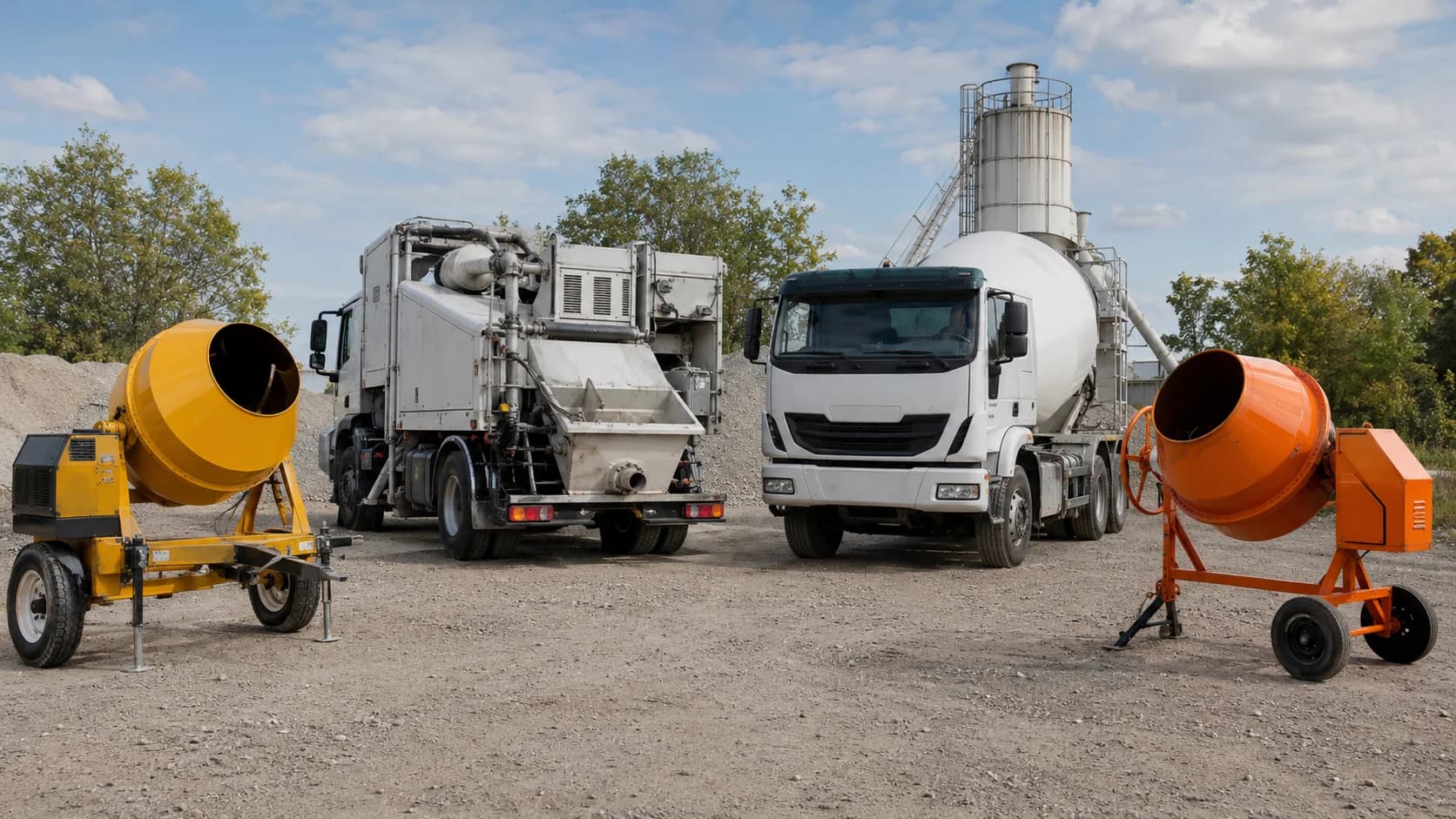
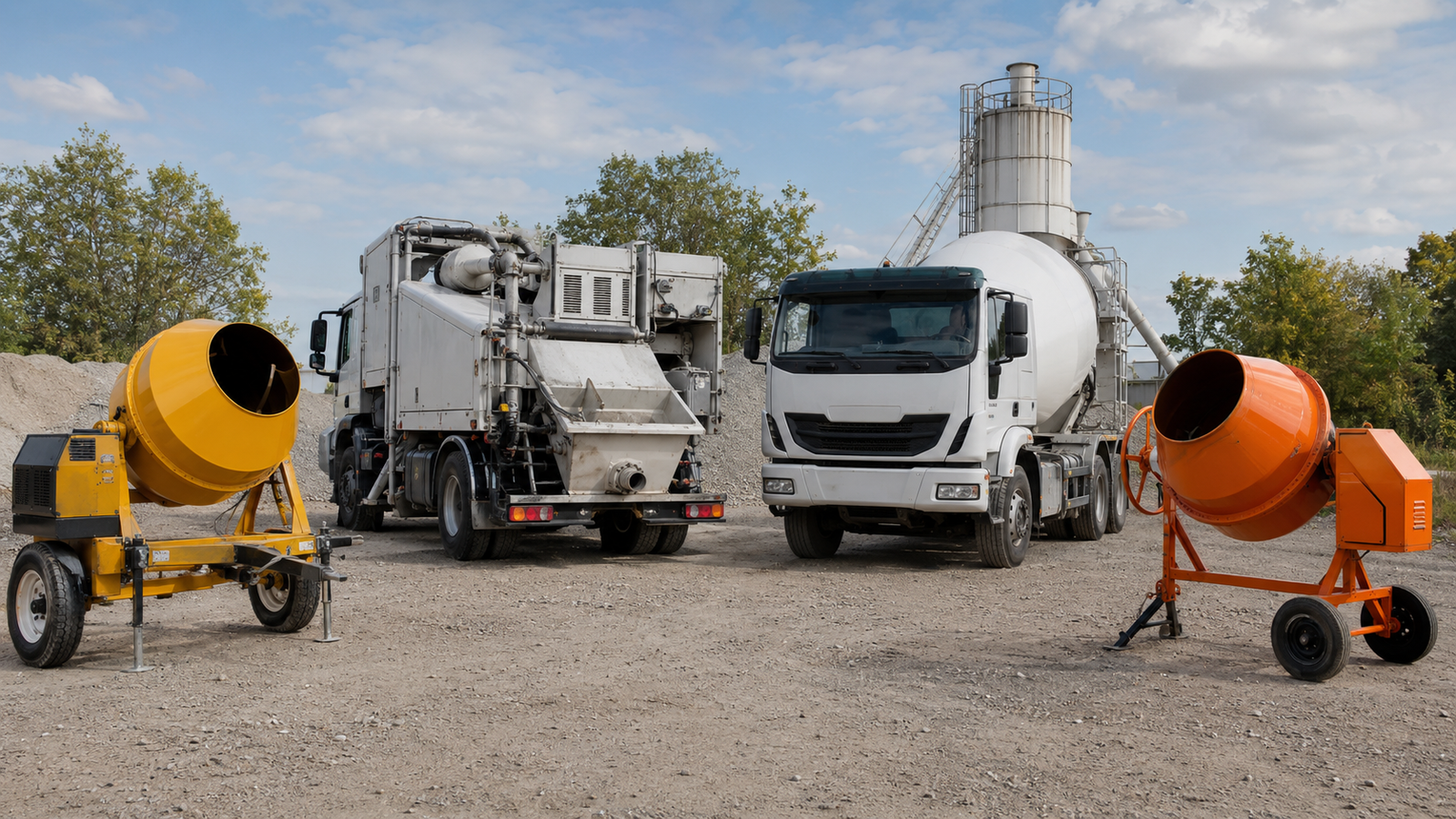
Concrete mixers range from small portable drums used for repair work to truck-mounted systems that carry or manufacture concrete for major projects. Choosing a mixer is not only a question of capacity. The right machine depends on where batching occurs, how far material must travel, how accurately proportions must be controlled, how many mix designs are required during the shift, how quickly concrete must be discharged, and how much mobility the job demands. This guide compares drum, volumetric, transit, and portable mixers and explains where each type fits in a practical concrete workflow.
The basic purpose of a concrete mixer
Coating and distribution
Mixing is intended to distribute cementitious paste around the aggregate, disperse water and admixtures, and create a uniform material. Good mixing reduces pockets of dry cement, uncoated aggregate, or excess water and helps the delivered concrete behave consistently during placement and finishing. In practice, this point matters because coating and distribution affects more than the immediate machine action. It influences crew timing, equipment loading, material behavior, and the amount of room available to recover if conditions begin to drift. A useful field procedure is to define the expected condition before production, assign who will monitor it, and establish what change will trigger a slowdown, inspection, adjustment, or stop. That approach reduces last-minute decisions and makes the process more repeatable from one shift or pour to the next.
Mixing versus transport
Some machines primarily mix, some primarily transport already batched concrete, and some do both. Understanding that distinction is essential because a mixer truck leaving a central plant operates differently from a volumetric unit that carries separate raw materials and creates concrete continuously at the jobsite. From a production standpoint, mixing versus transport affects more than the immediate machine action. It influences crew timing, equipment loading, material behavior, and the amount of room available to recover if conditions begin to drift. A useful field procedure is to define the expected condition before production, assign who will monitor it, and establish what change will trigger a slowdown, inspection, adjustment, or stop. The crew should therefore verify the condition before work begins and continue watching it as equipment, weather, and material conditions change.
Capacity is only one metric
Nominal drum or hopper volume does not tell the whole story. Useful production also depends on loading method, mixing time, discharge speed, cleaning time, material replenishment, site access, and whether the machine can keep the downstream placing crew continuously supplied. On an active jobsite, capacity is only one metric affects more than the immediate machine action. It influences crew timing, equipment loading, material behavior, and the amount of room available to recover if conditions begin to drift. A useful field procedure is to define the expected condition before production, assign who will monitor it, and establish what change will trigger a slowdown, inspection, adjustment, or stop. This is also useful for troubleshooting because changes in pressure, torque, output, or surface behavior can be tied to a specific operating condition.
Drum mixers
How a drum mixer works
A rotating drum uses internal blades or paddles to lift, tumble, fold, and discharge the ingredients. Depending on design, the drum may mix by rotating in one direction and discharge by reversing, or it may use a tilting or open-mouth arrangement. Drum geometry strongly influences mixing and emptying behavior. For planning purposes, how a drum mixer works affects more than the immediate machine action. It influences crew timing, equipment loading, material behavior, and the amount of room available to recover if conditions begin to drift. A useful field procedure is to define the expected condition before production, assign who will monitor it, and establish what change will trigger a slowdown, inspection, adjustment, or stop. That approach reduces last-minute decisions and makes the process more repeatable from one shift or pour to the next.
Where drum mixers fit
Drum mixers are common for small batch production, precast support, maintenance work, masonry-related concrete, remote jobs, and projects where the crew wants a simple mechanical system. They are available as electric, gasoline, diesel, towable, skid-mounted, and stationary units. Operationally, where drum mixers fit affects more than the immediate machine action. It influences crew timing, equipment loading, material behavior, and the amount of room available to recover if conditions begin to drift. A useful field procedure is to define the expected condition before production, assign who will monitor it, and establish what change will trigger a slowdown, inspection, adjustment, or stop. The crew should therefore verify the condition before work begins and continue watching it as equipment, weather, and material conditions change.
Strengths and limitations
The design is familiar, relatively easy to understand, and available in many sizes. However, batch-to-batch consistency depends on accurate measurement of ingredients and repeatable mixing time. Small drums also create labor if materials must be hand loaded and moved repeatedly. The practical consequence is that strengths and limitations affects more than the immediate machine action. It influences crew timing, equipment loading, material behavior, and the amount of room available to recover if conditions begin to drift. A useful field procedure is to define the expected condition before production, assign who will monitor it, and establish what change will trigger a slowdown, inspection, adjustment, or stop. This is also useful for troubleshooting because changes in pressure, torque, output, or surface behavior can be tied to a specific operating condition.
Transit mixer trucks
Central batching with mobile agitation
A transit mixer normally receives measured ingredients or mixed concrete from a batching plant and uses its rotating drum to maintain workability and continue mixing or agitation during travel. The truck is therefore part of a larger production system rather than an independent source of raw materials. In practice, this point matters because central batching with mobile agitation affects more than the immediate machine action. It influences crew timing, equipment loading, material behavior, and the amount of room available to recover if conditions begin to drift. A useful field procedure is to define the expected condition before production, assign who will monitor it, and establish what change will trigger a slowdown, inspection, adjustment, or stop. That approach reduces last-minute decisions and makes the process more repeatable from one shift or pour to the next.
Best use cases
Transit mixers are well suited to projects supplied by a ready-mix plant, especially when many cubic yards or cubic meters must be delivered at predictable intervals. Roads, foundations, slabs, commercial structures, and pumped concrete placements commonly rely on a fleet of these trucks. From a production standpoint, best use cases affects more than the immediate machine action. It influences crew timing, equipment loading, material behavior, and the amount of room available to recover if conditions begin to drift. A useful field procedure is to define the expected condition before production, assign who will monitor it, and establish what change will trigger a slowdown, inspection, adjustment, or stop. The crew should therefore verify the condition before work begins and continue watching it as equipment, weather, and material conditions change.
Operational constraints
Travel time, traffic, discharge delays, drum speed, ambient temperature, and site access all matter. A truck can carry excellent concrete from the plant and still arrive with altered workability if the delivery cycle is poorly managed or the jobsite keeps it waiting too long. On an active jobsite, operational constraints affects more than the immediate machine action. It influences crew timing, equipment loading, material behavior, and the amount of room available to recover if conditions begin to drift. A useful field procedure is to define the expected condition before production, assign who will monitor it, and establish what change will trigger a slowdown, inspection, adjustment, or stop. This is also useful for troubleshooting because changes in pressure, torque, output, or surface behavior can be tied to a specific operating condition.
Volumetric concrete mixers
Concrete made on demand
A volumetric mixer carries aggregate, cementitious material, water, and often admixtures in separate compartments. Metering systems proportion the ingredients and a mixing auger or chamber combines them as concrete is discharged, allowing the operator to start and stop production at the site. For planning purposes, concrete made on demand affects more than the immediate machine action. It influences crew timing, equipment loading, material behavior, and the amount of room available to recover if conditions begin to drift. A useful field procedure is to define the expected condition before production, assign who will monitor it, and establish what change will trigger a slowdown, inspection, adjustment, or stop. That approach reduces last-minute decisions and makes the process more repeatable from one shift or pour to the next.
Advantages for variable demand
This format is useful when exact final quantity is uncertain, multiple small pours are scheduled, different mix designs are needed during the day, or remote work makes return trips costly. Unmixed ingredients can provide flexibility that a full load of already mixed concrete cannot. Operationally, advantages for variable demand affects more than the immediate machine action. It influences crew timing, equipment loading, material behavior, and the amount of room available to recover if conditions begin to drift. A useful field procedure is to define the expected condition before production, assign who will monitor it, and establish what change will trigger a slowdown, inspection, adjustment, or stop. The crew should therefore verify the condition before work begins and continue watching it as equipment, weather, and material conditions change.
Calibration is critical
A volumetric system depends on calibrated gates, augers, belts, water meters, cement feeders, and control settings. The machine can only produce reliable concrete when the material properties and metering system are understood, maintained, and verified according to the producer's quality-control process. The practical consequence is that calibration is critical affects more than the immediate machine action. It influences crew timing, equipment loading, material behavior, and the amount of room available to recover if conditions begin to drift. A useful field procedure is to define the expected condition before production, assign who will monitor it, and establish what change will trigger a slowdown, inspection, adjustment, or stop. This is also useful for troubleshooting because changes in pressure, torque, output, or surface behavior can be tied to a specific operating condition.
Portable mixers
Designed for access and small quantities
Portable mixers include compact electric or engine-driven units that can be moved by hand, forklift, small trailer, or site vehicle. Their greatest advantage is proximity: concrete can be mixed close to the repair, footing, post, curb, landscape feature, or interior work area. In practice, this point matters because designed for access and small quantities affects more than the immediate machine action. It influences crew timing, equipment loading, material behavior, and the amount of room available to recover if conditions begin to drift. A useful field procedure is to define the expected condition before production, assign who will monitor it, and establish what change will trigger a slowdown, inspection, adjustment, or stop. That approach reduces last-minute decisions and makes the process more repeatable from one shift or pour to the next.
Labor and material handling
Small mixers often shift effort from transportation to loading. Cement, sand, stone, water, and admixtures must be measured and brought to the machine, and the finished concrete may still need wheelbarrows, buggies, buckets, or pumps to reach its final location. From a production standpoint, labor and material handling affects more than the immediate machine action. It influences crew timing, equipment loading, material behavior, and the amount of room available to recover if conditions begin to drift. A useful field procedure is to define the expected condition before production, assign who will monitor it, and establish what change will trigger a slowdown, inspection, adjustment, or stop. The crew should therefore verify the condition before work begins and continue watching it as equipment, weather, and material conditions change.
Quality depends on repeatability
When small batches are produced manually, consistency can vary because workers estimate shovels, buckets, water, and mixing time. A disciplined batching routine, consistent containers or scales, and a fixed mixing sequence are important when structural or appearance requirements matter. On an active jobsite, quality depends on repeatability affects more than the immediate machine action. It influences crew timing, equipment loading, material behavior, and the amount of room available to recover if conditions begin to drift. A useful field procedure is to define the expected condition before production, assign who will monitor it, and establish what change will trigger a slowdown, inspection, adjustment, or stop. This is also useful for troubleshooting because changes in pressure, torque, output, or surface behavior can be tied to a specific operating condition.
Comparing mixer selection by project type
Large continuous placements
High-volume slab, wall, foundation, and infrastructure pours usually favor central batching plus transit mixers because the plant can control materials and dispatch several trucks in sequence. The key is matching truck cycle time to pump or placement rate. For planning purposes, large continuous placements affects more than the immediate machine action. It influences crew timing, equipment loading, material behavior, and the amount of room available to recover if conditions begin to drift. A useful field procedure is to define the expected condition before production, assign who will monitor it, and establish what change will trigger a slowdown, inspection, adjustment, or stop. That approach reduces last-minute decisions and makes the process more repeatable from one shift or pour to the next.
Small scattered work
Utility repairs, fence bases, small equipment pads, remote maintenance, and several separate pours may favor volumetric or portable systems because the crew can make only what is needed and reduce unused returned concrete. Operationally, small scattered work affects more than the immediate machine action. It influences crew timing, equipment loading, material behavior, and the amount of room available to recover if conditions begin to drift. A useful field procedure is to define the expected condition before production, assign who will monitor it, and establish what change will trigger a slowdown, inspection, adjustment, or stop. The crew should therefore verify the condition before work begins and continue watching it as equipment, weather, and material conditions change.
Specialty or repeated small batches
Precast yards, laboratories, decorative concrete crews, and specialized contractors may choose drum or pan-type stationary equipment when they need close control over small batches, colors, fibers, or admixture sequencing. The practical consequence is that specialty or repeated small batches affects more than the immediate machine action. It influences crew timing, equipment loading, material behavior, and the amount of room available to recover if conditions begin to drift. A useful field procedure is to define the expected condition before production, assign who will monitor it, and establish what change will trigger a slowdown, inspection, adjustment, or stop. This is also useful for troubleshooting because changes in pressure, torque, output, or surface behavior can be tied to a specific operating condition.
Ownership, rental, and production economics
Look beyond purchase price
Mixer economics include operator labor, fuel or electricity, maintenance, cleanup, calibration, material waste, truck waiting, and downtime. A lower-cost mixer that doubles handling labor can be more expensive over the project than a higher-capacity system that keeps the crew productive. In practice, this point matters because look beyond purchase price affects more than the immediate machine action. It influences crew timing, equipment loading, material behavior, and the amount of room available to recover if conditions begin to drift. A useful field procedure is to define the expected condition before production, assign who will monitor it, and establish what change will trigger a slowdown, inspection, adjustment, or stop. That approach reduces last-minute decisions and makes the process more repeatable from one shift or pour to the next.
Utilization matters
A truck-mounted volumetric unit or large mixer can be difficult to justify if it sits idle most of the month. Rental, subcontracted ready-mix supply, or smaller equipment may be financially stronger for contractors whose concrete demand is intermittent. From a production standpoint, utilization matters affects more than the immediate machine action. It influences crew timing, equipment loading, material behavior, and the amount of room available to recover if conditions begin to drift. A useful field procedure is to define the expected condition before production, assign who will monitor it, and establish what change will trigger a slowdown, inspection, adjustment, or stop. The crew should therefore verify the condition before work begins and continue watching it as equipment, weather, and material conditions change.
Plan the entire cycle
The best equipment is the mixer that fits the upstream material supply and downstream placement operation. A fast mixer has little value if aggregate cannot be loaded quickly, and a large transit fleet has little value if the pour can accept only a small amount per hour. On an active jobsite, plan the entire cycle affects more than the immediate machine action. It influences crew timing, equipment loading, material behavior, and the amount of room available to recover if conditions begin to drift. A useful field procedure is to define the expected condition before production, assign who will monitor it, and establish what change will trigger a slowdown, inspection, adjustment, or stop. This is also useful for troubleshooting because changes in pressure, torque, output, or surface behavior can be tied to a specific operating condition.
Maintenance and cleaning principles
Concrete residue is the enemy
Hardened buildup changes drum volume, creates imbalance, increases power demand, contaminates future batches, and makes later cleaning more difficult. Daily washdown and controlled cleaning should be treated as production tasks rather than optional work at the end of a shift. For planning purposes, concrete residue is the enemy affects more than the immediate machine action. It influences crew timing, equipment loading, material behavior, and the amount of room available to recover if conditions begin to drift. A useful field procedure is to define the expected condition before production, assign who will monitor it, and establish what change will trigger a slowdown, inspection, adjustment, or stop. That approach reduces last-minute decisions and makes the process more repeatable from one shift or pour to the next.
Inspect drive and mixing components
Drum rollers, ring gears, hydraulic drives, belts, bearings, paddles, augers, seals, chutes, and water systems should be checked for wear and leakage. Small mechanical problems can quickly affect mixing quality or create a breakdown during a delivery. Operationally, inspect drive and mixing components affects more than the immediate machine action. It influences crew timing, equipment loading, material behavior, and the amount of room available to recover if conditions begin to drift. A useful field procedure is to define the expected condition before production, assign who will monitor it, and establish what change will trigger a slowdown, inspection, adjustment, or stop. The crew should therefore verify the condition before work begins and continue watching it as equipment, weather, and material conditions change.
Protect metering accuracy
On systems that meter materials, maintenance includes sensors and calibration as well as mechanical parts. A worn gate or inaccurate water meter may not stop the machine, but it can change concrete performance from batch to batch. The practical consequence is that protect metering accuracy affects more than the immediate machine action. It influences crew timing, equipment loading, material behavior, and the amount of room available to recover if conditions begin to drift. A useful field procedure is to define the expected condition before production, assign who will monitor it, and establish what change will trigger a slowdown, inspection, adjustment, or stop. This is also useful for troubleshooting because changes in pressure, torque, output, or surface behavior can be tied to a specific operating condition.
Practical planning checklist
Before the work starts, convert the main technical ideas into a short field plan. Review the equipment manual and project requirements, confirm site access and support conditions, verify the material or drilling program, identify the people authorized to control the operation, and agree on communication signals. Confirm that inspection, maintenance, cleanup, environmental controls, and emergency access are not being left until the end of the shift. A checklist is most useful when it is specific to the actual machine, ground, mix, crew, and layout rather than copied without adaptation from a different project.
- Verify equipment configuration, wear condition, required tooling or delivery components, and all manufacturer limitations that apply to the planned work.
- Confirm that the work area, access route, traffic plan, supporting ground, and exclusion zones are ready before production equipment is committed.
- Review material properties or ground conditions and confirm that the selected operating method matches what the crew expects to encounter.
- Establish a realistic production rate that downstream operations can accept without creating long stops, uncontrolled queues, or rushed workmanship.
- Assign one clear communication chain for start, stop, speed changes, abnormal conditions, and emergency action.
- Prepare the cleanup, waste, washout, drilling-fluid, spoil, or residual-material plan before the operation begins.
- Record unusual pressure, torque, output, wear, delays, or quality observations so the next similar job can be planned with better information.
Final guidance
Drum, volumetric, transit, and portable mixers solve different production problems. Transit mixers excel as part of a ready-mix delivery network, volumetric units provide on-demand flexibility, drum mixers offer a straightforward batch system in many capacities, and portable mixers bring production close to small or difficult-to-access work. The best choice comes from comparing required volume, quality-control needs, travel distance, crew size, access, mix variety, and the pace of placement rather than selecting by machine size alone.
Get More Expert Guides & Updates
Subscribe for Machinery.org guide updates and product learning content.