

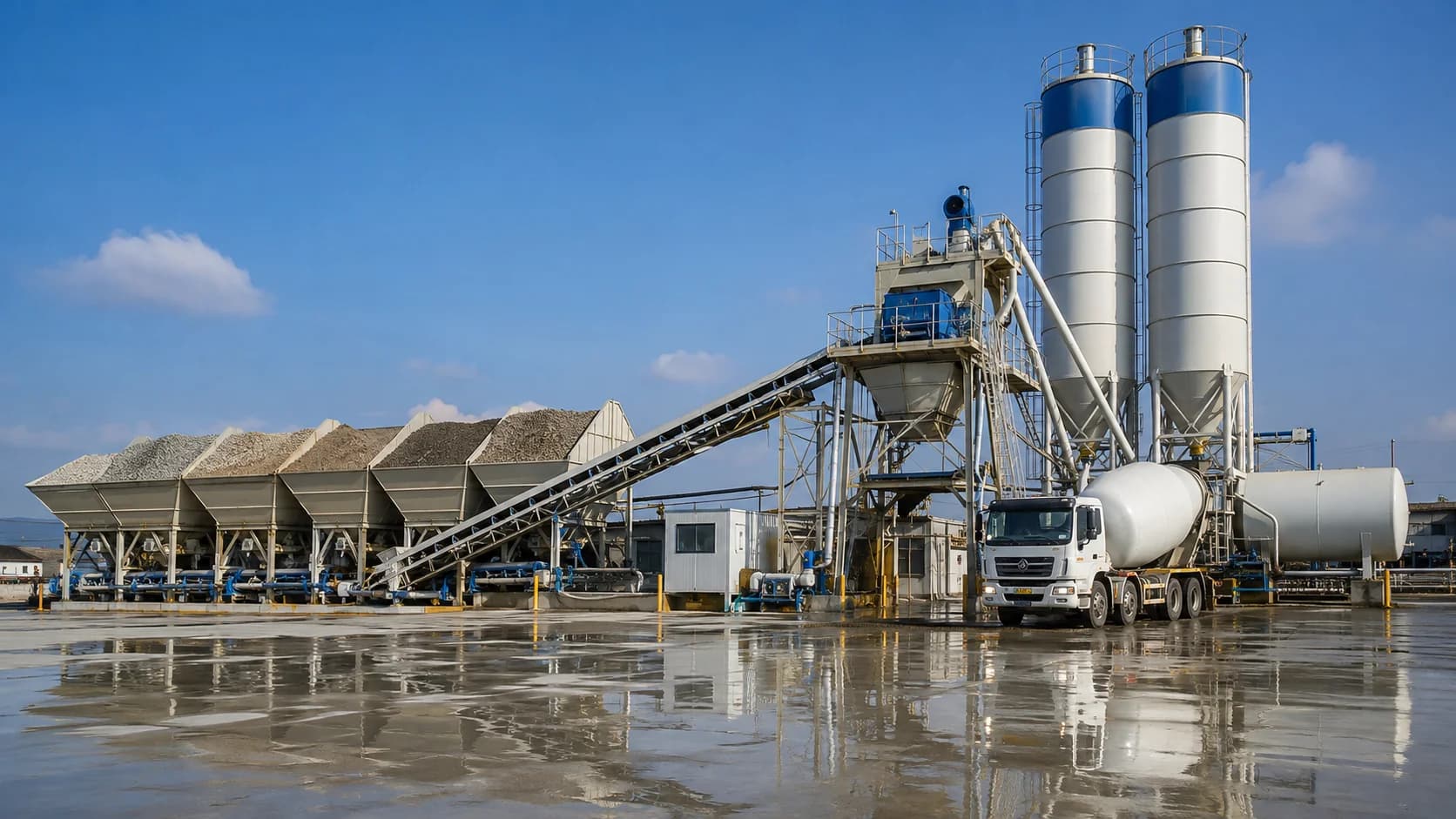
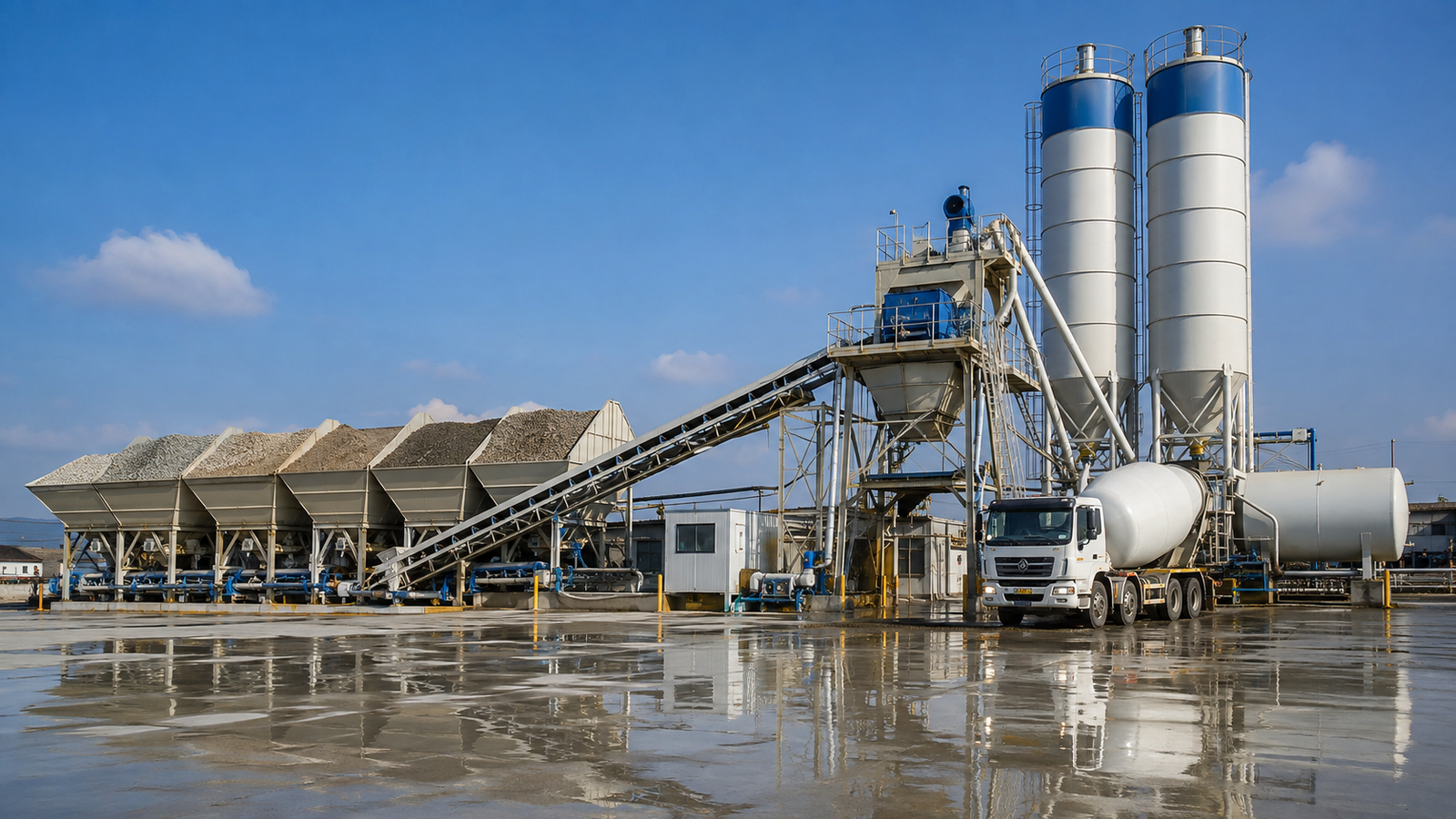
A concrete batching plant is the control center of concrete production. Its job is to receive raw materials, store them without contamination, measure each ingredient accurately, introduce the materials in a controlled sequence, mix them when the plant design requires central mixing, and discharge concrete at a rate that supports truck loading and jobsite demand. The major systems—aggregate storage and weighing, cementitious storage and feeding, water and admixture measurement, mixing equipment, controls, dust management, and material handling—must operate as a coordinated process rather than as separate machines.
Plant types and production philosophy
Dry-batch plants
A dry-batch or transit-mix plant weighs and loads the concrete ingredients into a truck mixer, where much of the mixing occurs. This layout can reduce central mixer complexity and is widely used for ready-mix production, but truck condition and mixing procedure become important parts of quality control. In practice, this point matters because dry-batch plants affects more than the immediate machine action. It influences crew timing, equipment loading, material behavior, and the amount of room available to recover if conditions begin to drift. A useful field procedure is to define the expected condition before production, assign who will monitor it, and establish what change will trigger a slowdown, inspection, adjustment, or stop. That approach reduces last-minute decisions and makes the process more repeatable from one shift or pour to the next.
Wet-batch plants
A wet-batch plant uses a central mixer to combine the ingredients before discharge into the delivery truck or other transport. Central mixing can provide highly controlled mixing energy and time, which is valuable for demanding production, precast work, and operations seeking tight consistency. From a production standpoint, wet-batch plants affects more than the immediate machine action. It influences crew timing, equipment loading, material behavior, and the amount of room available to recover if conditions begin to drift. A useful field procedure is to define the expected condition before production, assign who will monitor it, and establish what change will trigger a slowdown, inspection, adjustment, or stop. The crew should therefore verify the condition before work begins and continue watching it as equipment, weather, and material conditions change.
Mobile and compact plants
Mobile or modular plants are designed for faster relocation and reduced foundation requirements. They are useful for highway, remote infrastructure, and temporary projects, but they still need proper aggregate supply, cement delivery, drainage, electrical capacity, water storage, traffic flow, and environmental planning. On an active jobsite, mobile and compact plants affects more than the immediate machine action. It influences crew timing, equipment loading, material behavior, and the amount of room available to recover if conditions begin to drift. A useful field procedure is to define the expected condition before production, assign who will monitor it, and establish what change will trigger a slowdown, inspection, adjustment, or stop. This is also useful for troubleshooting because changes in pressure, torque, output, or surface behavior can be tied to a specific operating condition.
Aggregate receiving and storage
Separate material sizes
Coarse and fine aggregates are normally stored by size and source to preserve grading control. Cross-contamination between bins changes combined gradation and can affect water demand, pumpability, workability, finishability, and yield even when the scale readings remain accurate. For planning purposes, separate material sizes affects more than the immediate machine action. It influences crew timing, equipment loading, material behavior, and the amount of room available to recover if conditions begin to drift. A useful field procedure is to define the expected condition before production, assign who will monitor it, and establish what change will trigger a slowdown, inspection, adjustment, or stop. That approach reduces last-minute decisions and makes the process more repeatable from one shift or pour to the next.
Control moisture variability
Sand and other fine materials can hold significant moisture. Because that water becomes part of the concrete mixture, the plant must account for aggregate moisture when calculating batch water and dry aggregate mass. Rapid weather changes can make this one of the most important daily adjustments. Operationally, control moisture variability affects more than the immediate machine action. It influences crew timing, equipment loading, material behavior, and the amount of room available to recover if conditions begin to drift. A useful field procedure is to define the expected condition before production, assign who will monitor it, and establish what change will trigger a slowdown, inspection, adjustment, or stop. The crew should therefore verify the condition before work begins and continue watching it as equipment, weather, and material conditions change.
Design for reliable flow
Bins, gates, feeders, and conveyors must allow material to move without arching, segregation, or excessive spillage. Frozen aggregate, wet sand, oversized stones, or buildup at gate openings can slow production and produce inconsistent batch weights. The practical consequence is that design for reliable flow affects more than the immediate machine action. It influences crew timing, equipment loading, material behavior, and the amount of room available to recover if conditions begin to drift. A useful field procedure is to define the expected condition before production, assign who will monitor it, and establish what change will trigger a slowdown, inspection, adjustment, or stop. This is also useful for troubleshooting because changes in pressure, torque, output, or surface behavior can be tied to a specific operating condition.
Aggregate weighing and conveying
Accurate weighing
Aggregate can be weighed in individual scales, cumulative weigh hoppers, or belt systems depending on plant design. Scale accuracy matters because aggregate makes up most of the concrete volume, and even small percentage errors become large absolute changes in a full batch. In practice, this point matters because accurate weighing affects more than the immediate machine action. It influences crew timing, equipment loading, material behavior, and the amount of room available to recover if conditions begin to drift. A useful field procedure is to define the expected condition before production, assign who will monitor it, and establish what change will trigger a slowdown, inspection, adjustment, or stop. That approach reduces last-minute decisions and makes the process more repeatable from one shift or pour to the next.
Conveyor performance
Conveyors must handle the planned tonnage without belt slip, tracking problems, carryback, or material loss. Incline angle, belt speed, idler condition, transfer-point design, and skirt sealing all influence whether the batching cycle can keep up with demand. From a production standpoint, conveyor performance affects more than the immediate machine action. It influences crew timing, equipment loading, material behavior, and the amount of room available to recover if conditions begin to drift. A useful field procedure is to define the expected condition before production, assign who will monitor it, and establish what change will trigger a slowdown, inspection, adjustment, or stop. The crew should therefore verify the condition before work begins and continue watching it as equipment, weather, and material conditions change.
Prevent segregation at transfer points
Large drops and uncontrolled streams can separate coarse stone from fine material. Chutes and transfer points should keep the material stream controlled so the gradation delivered to the weigh hopper reflects the material that was originally stockpiled. On an active jobsite, prevent segregation at transfer points affects more than the immediate machine action. It influences crew timing, equipment loading, material behavior, and the amount of room available to recover if conditions begin to drift. A useful field procedure is to define the expected condition before production, assign who will monitor it, and establish what change will trigger a slowdown, inspection, adjustment, or stop. This is also useful for troubleshooting because changes in pressure, torque, output, or surface behavior can be tied to a specific operating condition.
Cement and supplementary cementitious systems
Silo storage
Cement, fly ash, slag, and other powder materials are stored in sealed silos or compartments. Each material needs identification, controlled filling, level monitoring, dust collection, and protection against moisture because a contaminated or incorrectly filled silo can disrupt many batches. For planning purposes, silo storage affects more than the immediate machine action. It influences crew timing, equipment loading, material behavior, and the amount of room available to recover if conditions begin to drift. A useful field procedure is to define the expected condition before production, assign who will monitor it, and establish what change will trigger a slowdown, inspection, adjustment, or stop. That approach reduces last-minute decisions and makes the process more repeatable from one shift or pour to the next.
Feeding cementitious material
Screw conveyors, air slides, rotary valves, or other feeders move powder from storage to the weigh system. The feeder must start and stop predictably because overshoot during weighing can affect the water-to-cementitious ratio and mixture proportions. Operationally, feeding cementitious material affects more than the immediate machine action. It influences crew timing, equipment loading, material behavior, and the amount of room available to recover if conditions begin to drift. A useful field procedure is to define the expected condition before production, assign who will monitor it, and establish what change will trigger a slowdown, inspection, adjustment, or stop. The crew should therefore verify the condition before work begins and continue watching it as equipment, weather, and material conditions change.
Dust and pressure control
Powder transfer creates dust and displaces air inside silos. Proper filters, relief devices, fill-pipe procedures, and maintenance reduce emissions and prevent excessive silo pressure during pneumatic delivery. The practical consequence is that dust and pressure control affects more than the immediate machine action. It influences crew timing, equipment loading, material behavior, and the amount of room available to recover if conditions begin to drift. A useful field procedure is to define the expected condition before production, assign who will monitor it, and establish what change will trigger a slowdown, inspection, adjustment, or stop. This is also useful for troubleshooting because changes in pressure, torque, output, or surface behavior can be tied to a specific operating condition.
Water and admixture measurement
Batch water is part of the mix design
Water is not simply added until the concrete looks right. The target quantity must account for aggregate moisture, any water already present in admixture solutions, wash water when permitted by the specification, and approved jobsite adjustments. In practice, this point matters because batch water is part of the mix design affects more than the immediate machine action. It influences crew timing, equipment loading, material behavior, and the amount of room available to recover if conditions begin to drift. A useful field procedure is to define the expected condition before production, assign who will monitor it, and establish what change will trigger a slowdown, inspection, adjustment, or stop. That approach reduces last-minute decisions and makes the process more repeatable from one shift or pour to the next.
Metering systems
Plants may use weigh tanks, flow meters, or volumetric systems to measure water. Regardless of method, valves must close accurately, meters must be calibrated, and the control system must prevent unintended water carryover between batches. From a production standpoint, metering systems affects more than the immediate machine action. It influences crew timing, equipment loading, material behavior, and the amount of room available to recover if conditions begin to drift. A useful field procedure is to define the expected condition before production, assign who will monitor it, and establish what change will trigger a slowdown, inspection, adjustment, or stop. The crew should therefore verify the condition before work begins and continue watching it as equipment, weather, and material conditions change.
Admixture sequencing
Water reducers, retarders, accelerators, air-entraining agents, viscosity modifiers, and other admixtures are highly concentrated compared with aggregate or cement. Correct dose, sequencing, and line flushing are important because a small measurement error can produce a noticeable change in concrete behavior. On an active jobsite, admixture sequencing affects more than the immediate machine action. It influences crew timing, equipment loading, material behavior, and the amount of room available to recover if conditions begin to drift. A useful field procedure is to define the expected condition before production, assign who will monitor it, and establish what change will trigger a slowdown, inspection, adjustment, or stop. This is also useful for troubleshooting because changes in pressure, torque, output, or surface behavior can be tied to a specific operating condition.
Central mixing systems
Mixer types
Twin-shaft, planetary, pan, and drum mixers apply different mixing actions. Selection depends on batch size, cycle time, concrete stiffness, aggregate size, wear expectations, and whether the plant produces conventional ready-mix, high-performance concrete, or precast mixtures. For planning purposes, mixer types affects more than the immediate machine action. It influences crew timing, equipment loading, material behavior, and the amount of room available to recover if conditions begin to drift. A useful field procedure is to define the expected condition before production, assign who will monitor it, and establish what change will trigger a slowdown, inspection, adjustment, or stop. That approach reduces last-minute decisions and makes the process more repeatable from one shift or pour to the next.
Mixing time and energy
Uniformity depends on more than time alone. Loading sequence, mixer fill level, blade condition, shaft speed, moisture distribution, and mixture type all influence the amount of mixing energy required. A fixed timer cannot compensate for worn mixing tools or incorrect loading. Operationally, mixing time and energy affects more than the immediate machine action. It influences crew timing, equipment loading, material behavior, and the amount of room available to recover if conditions begin to drift. A useful field procedure is to define the expected condition before production, assign who will monitor it, and establish what change will trigger a slowdown, inspection, adjustment, or stop. The crew should therefore verify the condition before work begins and continue watching it as equipment, weather, and material conditions change.
Discharge control
The mixer discharge gate must release concrete quickly but controllably into the truck, bucket, or transfer device. Slow or incomplete discharge lengthens the cycle, while an uncontrolled surge can overload receiving equipment or create segregation and spillage. The practical consequence is that discharge control affects more than the immediate machine action. It influences crew timing, equipment loading, material behavior, and the amount of room available to recover if conditions begin to drift. A useful field procedure is to define the expected condition before production, assign who will monitor it, and establish what change will trigger a slowdown, inspection, adjustment, or stop. This is also useful for troubleshooting because changes in pressure, torque, output, or surface behavior can be tied to a specific operating condition.
Automation and quality control
Recipe management
Modern controls store mix designs and coordinate scales, gates, conveyors, cement feeders, water, admixtures, mixers, and discharge. Access control and version management are important so approved recipes are not changed casually during production. In practice, this point matters because recipe management affects more than the immediate machine action. It influences crew timing, equipment loading, material behavior, and the amount of room available to recover if conditions begin to drift. A useful field procedure is to define the expected condition before production, assign who will monitor it, and establish what change will trigger a slowdown, inspection, adjustment, or stop. That approach reduces last-minute decisions and makes the process more repeatable from one shift or pour to the next.
Batch records
A useful batch ticket records target and actual ingredient weights, time, truck or load identification, and relevant adjustments. These records help verify compliance and also help troubleshoot complaints by showing whether the plant actually produced the intended proportions. From a production standpoint, batch records affects more than the immediate machine action. It influences crew timing, equipment loading, material behavior, and the amount of room available to recover if conditions begin to drift. A useful field procedure is to define the expected condition before production, assign who will monitor it, and establish what change will trigger a slowdown, inspection, adjustment, or stop. The crew should therefore verify the condition before work begins and continue watching it as equipment, weather, and material conditions change.
Calibration and verification
Scales, moisture probes, water meters, and admixture dispensers need routine verification. Calibration is not only a certification exercise; it is the basis for trusting the numbers displayed by the control system. On an active jobsite, calibration and verification affects more than the immediate machine action. It influences crew timing, equipment loading, material behavior, and the amount of room available to recover if conditions begin to drift. A useful field procedure is to define the expected condition before production, assign who will monitor it, and establish what change will trigger a slowdown, inspection, adjustment, or stop. This is also useful for troubleshooting because changes in pressure, torque, output, or surface behavior can be tied to a specific operating condition.
Plant layout, traffic, and maintenance
Separate traffic movements
Aggregate loaders, cement tankers, mixer trucks, service vehicles, and employees often share a busy plant. Clearly planned traffic lanes, loading positions, reversing controls, and pedestrian separation reduce delays and risk. For planning purposes, separate traffic movements affects more than the immediate machine action. It influences crew timing, equipment loading, material behavior, and the amount of room available to recover if conditions begin to drift. A useful field procedure is to define the expected condition before production, assign who will monitor it, and establish what change will trigger a slowdown, inspection, adjustment, or stop. That approach reduces last-minute decisions and makes the process more repeatable from one shift or pour to the next.
Design washout and drainage
Concrete plants generate wash water, returned concrete, slurry, and stormwater. The site should direct these materials to managed areas instead of allowing uncontrolled runoff to interfere with roads, scales, foundations, or neighboring property. Operationally, design washout and drainage affects more than the immediate machine action. It influences crew timing, equipment loading, material behavior, and the amount of room available to recover if conditions begin to drift. A useful field procedure is to define the expected condition before production, assign who will monitor it, and establish what change will trigger a slowdown, inspection, adjustment, or stop. The crew should therefore verify the condition before work begins and continue watching it as equipment, weather, and material conditions change.
Preventive maintenance protects quality
Worn mixer blades, leaking water valves, damaged gate seals, conveyor problems, clogged filters, and inaccurate scales can all change production before they cause a complete breakdown. Maintenance is therefore a quality-control function as well as a reliability function. The practical consequence is that preventive maintenance protects quality affects more than the immediate machine action. It influences crew timing, equipment loading, material behavior, and the amount of room available to recover if conditions begin to drift. A useful field procedure is to define the expected condition before production, assign who will monitor it, and establish what change will trigger a slowdown, inspection, adjustment, or stop. This is also useful for troubleshooting because changes in pressure, torque, output, or surface behavior can be tied to a specific operating condition.
Practical planning checklist
Before the work starts, convert the main technical ideas into a short field plan. Review the equipment manual and project requirements, confirm site access and support conditions, verify the material or drilling program, identify the people authorized to control the operation, and agree on communication signals. Confirm that inspection, maintenance, cleanup, environmental controls, and emergency access are not being left until the end of the shift. A checklist is most useful when it is specific to the actual machine, ground, mix, crew, and layout rather than copied without adaptation from a different project.
- Verify equipment configuration, wear condition, required tooling or delivery components, and all manufacturer limitations that apply to the planned work.
- Confirm that the work area, access route, traffic plan, supporting ground, and exclusion zones are ready before production equipment is committed.
- Review material properties or ground conditions and confirm that the selected operating method matches what the crew expects to encounter.
- Establish a realistic production rate that downstream operations can accept without creating long stops, uncontrolled queues, or rushed workmanship.
- Assign one clear communication chain for start, stop, speed changes, abnormal conditions, and emergency action.
- Prepare the cleanup, waste, washout, drilling-fluid, spoil, or residual-material plan before the operation begins.
- Record unusual pressure, torque, output, wear, delays, or quality observations so the next similar job can be planned with better information.
Final guidance
A batching plant produces consistent concrete when its material storage, weighing, conveying, water control, admixture dosing, mixing, automation, and dispatch systems work together. The most successful operations pay close attention to moisture correction, calibration, material identification, transfer-point cleanliness, mixer wear, traffic flow, and batch records. Plant capacity should always be evaluated as a complete cycle—from aggregate loading and cement delivery through truck departure—not as the rating of one mixer or conveyor.
Get More Expert Guides & Updates
Subscribe for Machinery.org guide updates and product learning content.