
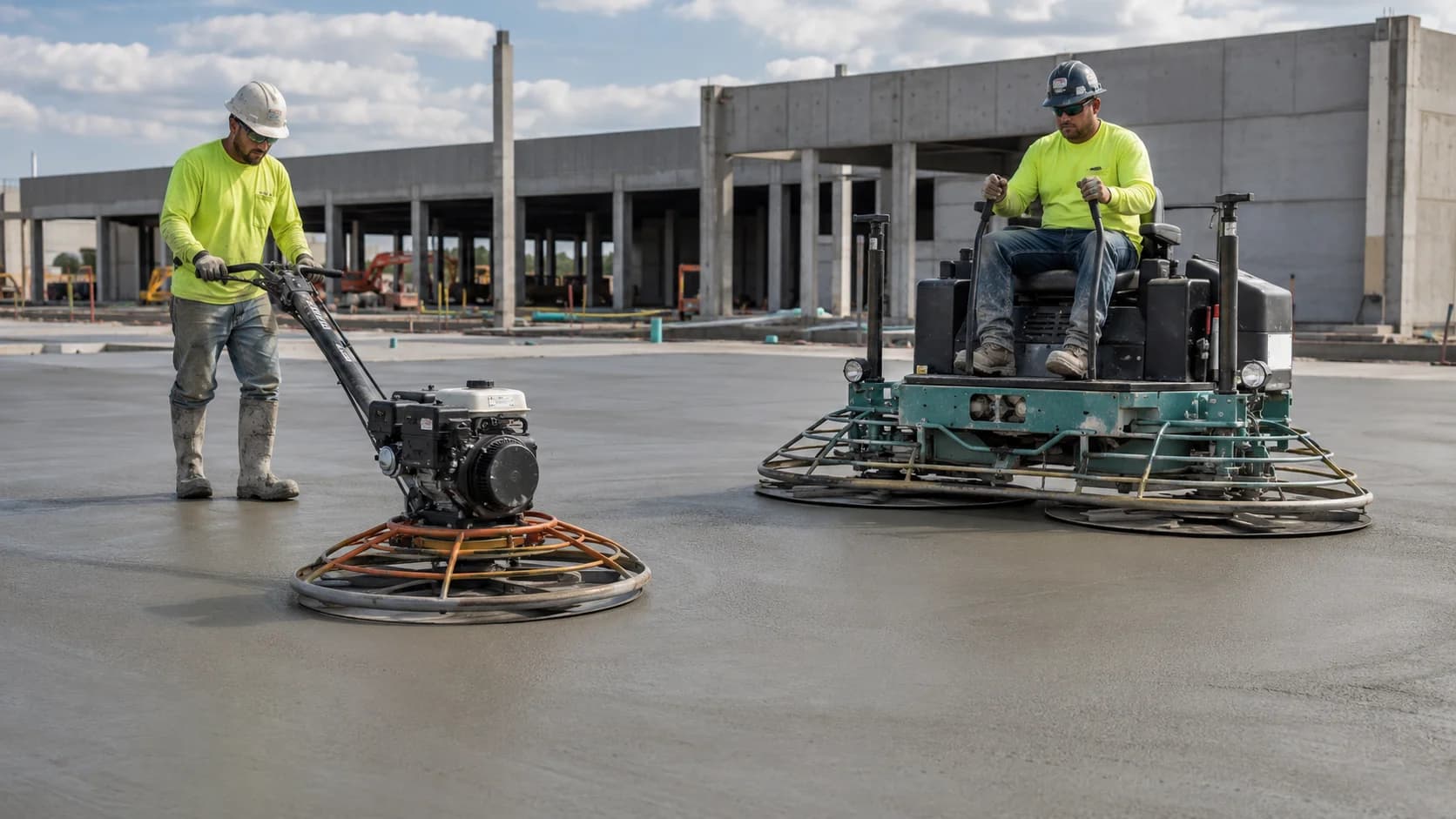
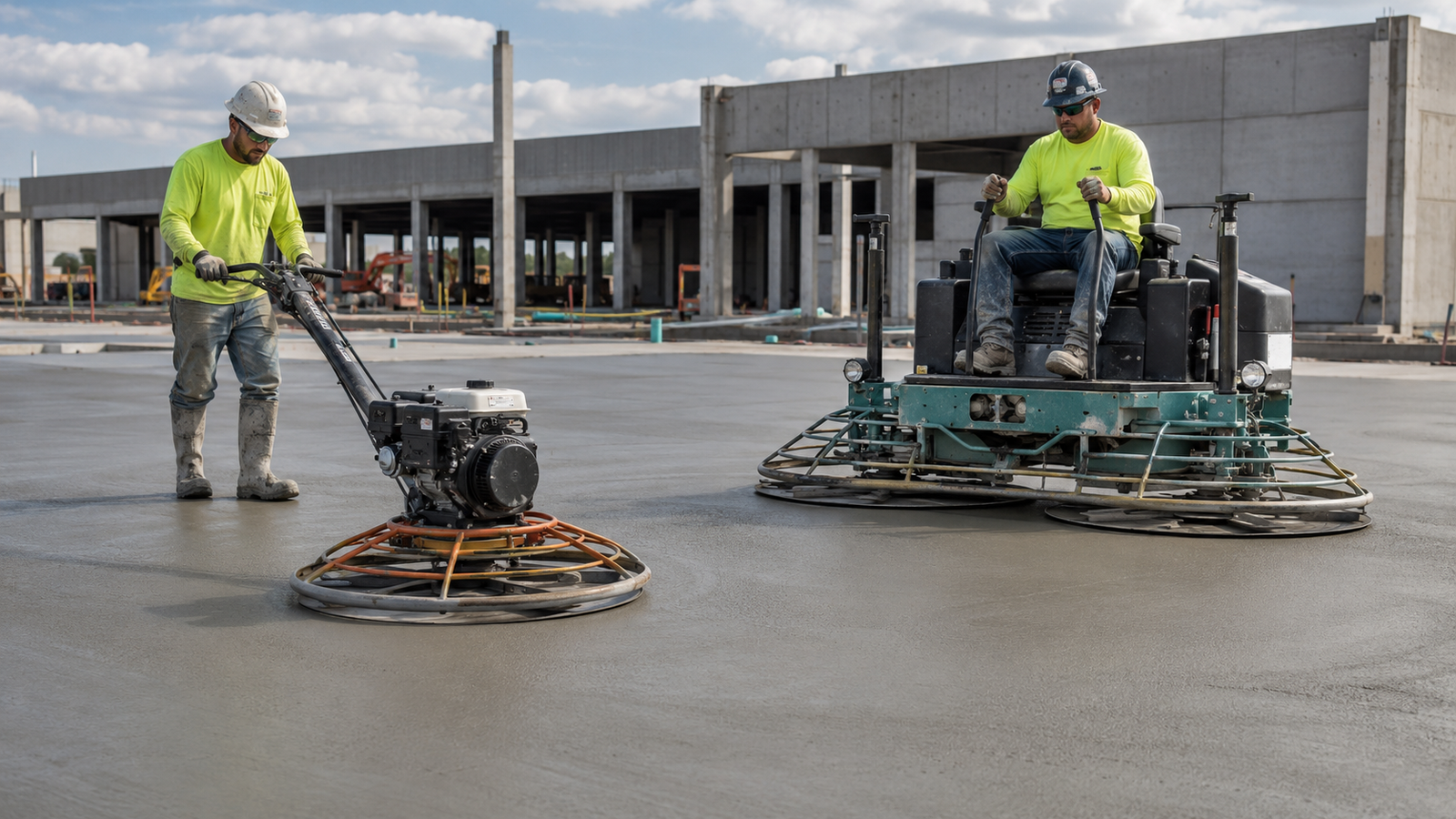
Power trowels are finishing machines used after concrete has been placed, struck off, and allowed to stiffen enough to support finishing equipment. Their rotating blades or pans help close, flatten, and densify the surface as the slab progresses through the finishing window. Walk-behind and ride-on trowels perform the same general task, but they differ greatly in coverage rate, maneuverability, operator position, edge access, transport needs, and suitability for large floor areas. This guide explains the machines, finishing sequence, blade setup, jobsite timing, and selection factors that influence final slab quality.
Where power troweling fits in slab finishing
Timing begins before the machine touches the slab
The concrete must first be placed to elevation, consolidated as required, struck off, and floated. Power troweling too early can trap bleed water or damage the surface; starting too late can make it difficult to remove imperfections. The correct timing depends on mixture, temperature, wind, slab thickness, base conditions, and finishing specification. In practice, this point matters because timing begins before the machine touches the slab affects more than the immediate machine action. It influences crew timing, equipment loading, material behavior, and the amount of room available to recover if conditions begin to drift. A useful field procedure is to define the expected condition before production, assign who will monitor it, and establish what change will trigger a slowdown, inspection, adjustment, or stop. That approach reduces last-minute decisions and makes the process more repeatable from one shift or pour to the next.
Floating and troweling are different stages
Floating uses pans or flatter blade settings to embed aggregate, remove ridges, and level small imperfections. Troweling generally follows with finish blades at progressively greater pitch to tighten and smooth the surface. Trying to skip directly to aggressive finishing can create uneven texture or surface defects. From a production standpoint, floating and troweling are different stages affects more than the immediate machine action. It influences crew timing, equipment loading, material behavior, and the amount of room available to recover if conditions begin to drift. A useful field procedure is to define the expected condition before production, assign who will monitor it, and establish what change will trigger a slowdown, inspection, adjustment, or stop. The crew should therefore verify the condition before work begins and continue watching it as equipment, weather, and material conditions change.
The finishing window moves across the slab
Large placements rarely become ready at exactly the same time. Areas near edges, columns, shade, sun, or different base conditions can stiffen at different rates. The finishing plan should follow the slab condition rather than a fixed clock schedule. On an active jobsite, the finishing window moves across the slab affects more than the immediate machine action. It influences crew timing, equipment loading, material behavior, and the amount of room available to recover if conditions begin to drift. A useful field procedure is to define the expected condition before production, assign who will monitor it, and establish what change will trigger a slowdown, inspection, adjustment, or stop. This is also useful for troubleshooting because changes in pressure, torque, output, or surface behavior can be tied to a specific operating condition.
Walk-behind power trowels
Maneuverability and edge work
Walk-behind machines are easier to position around columns, walls, penetrations, narrow bays, and irregular shapes. Smaller rotor diameters can reach areas that a ride-on unit cannot safely enter, making walk-behinds important even on projects that use large ride-on machines. For planning purposes, maneuverability and edge work affects more than the immediate machine action. It influences crew timing, equipment loading, material behavior, and the amount of room available to recover if conditions begin to drift. A useful field procedure is to define the expected condition before production, assign who will monitor it, and establish what change will trigger a slowdown, inspection, adjustment, or stop. That approach reduces last-minute decisions and makes the process more repeatable from one shift or pour to the next.
Operator control
The operator steers by changing handle pressure and machine balance while controlling throttle and, on many models, blade pitch. Good technique is learned through smooth inputs; forcing the handle can create rapid movement or operator fatigue. Operationally, operator control affects more than the immediate machine action. It influences crew timing, equipment loading, material behavior, and the amount of room available to recover if conditions begin to drift. A useful field procedure is to define the expected condition before production, assign who will monitor it, and establish what change will trigger a slowdown, inspection, adjustment, or stop. The crew should therefore verify the condition before work begins and continue watching it as equipment, weather, and material conditions change.
Typical applications
Walk-behind trowels are common on sidewalks, pads, residential slabs, small commercial floors, edges of large pours, and repair work. They are also useful as backup machines because they can be transported and deployed with less support equipment. The practical consequence is that typical applications affects more than the immediate machine action. It influences crew timing, equipment loading, material behavior, and the amount of room available to recover if conditions begin to drift. A useful field procedure is to define the expected condition before production, assign who will monitor it, and establish what change will trigger a slowdown, inspection, adjustment, or stop. This is also useful for troubleshooting because changes in pressure, torque, output, or surface behavior can be tied to a specific operating condition.
Ride-on power trowels
High production on large floors
Ride-on trowels use two or more rotors and allow the operator to sit above the finishing heads. They cover large areas quickly and reduce walking fatigue, which makes them valuable for warehouses, factories, distribution centers, and other broad slab-on-grade placements. In practice, this point matters because high production on large floors affects more than the immediate machine action. It influences crew timing, equipment loading, material behavior, and the amount of room available to recover if conditions begin to drift. A useful field procedure is to define the expected condition before production, assign who will monitor it, and establish what change will trigger a slowdown, inspection, adjustment, or stop. That approach reduces last-minute decisions and makes the process more repeatable from one shift or pour to the next.
Steering systems
Mechanical lever steering and hydraulic or power-assisted systems translate operator inputs into rotor tilt or frame movement. The operator must understand how the specific machine responds because control feel, turning radius, and correction speed differ between designs. From a production standpoint, steering systems affects more than the immediate machine action. It influences crew timing, equipment loading, material behavior, and the amount of room available to recover if conditions begin to drift. A useful field procedure is to define the expected condition before production, assign who will monitor it, and establish what change will trigger a slowdown, inspection, adjustment, or stop. The crew should therefore verify the condition before work begins and continue watching it as equipment, weather, and material conditions change.
Logistics and access
Ride-on machines are heavier and require transport, lifting, fueling or charging, and safe access onto the slab. Openings, trenches, slab edges, reinforcement projections, and weak early-age concrete can restrict where the machine can travel. On an active jobsite, logistics and access affects more than the immediate machine action. It influences crew timing, equipment loading, material behavior, and the amount of room available to recover if conditions begin to drift. A useful field procedure is to define the expected condition before production, assign who will monitor it, and establish what change will trigger a slowdown, inspection, adjustment, or stop. This is also useful for troubleshooting because changes in pressure, torque, output, or surface behavior can be tied to a specific operating condition.
Pans, combination blades, and finish blades
Float pans
Large circular pans attach to the rotor and spread machine weight over a greater area. They are commonly used early in the mechanical finishing process to flatten ridges and improve surface uniformity while the concrete is still relatively soft. For planning purposes, float pans affects more than the immediate machine action. It influences crew timing, equipment loading, material behavior, and the amount of room available to recover if conditions begin to drift. A useful field procedure is to define the expected condition before production, assign who will monitor it, and establish what change will trigger a slowdown, inspection, adjustment, or stop. That approach reduces last-minute decisions and makes the process more repeatable from one shift or pour to the next.
Combination blades
Combination blades are intended to provide some floating capability at low pitch and finishing capability at higher pitch. They can simplify machine setup on smaller projects, although dedicated pans and finish blades may provide more specialized performance on large flat-floor work. Operationally, combination blades affects more than the immediate machine action. It influences crew timing, equipment loading, material behavior, and the amount of room available to recover if conditions begin to drift. A useful field procedure is to define the expected condition before production, assign who will monitor it, and establish what change will trigger a slowdown, inspection, adjustment, or stop. The crew should therefore verify the condition before work begins and continue watching it as equipment, weather, and material conditions change.
Finish blades
Finish blades are used as the surface becomes harder. Increasing pitch raises contact pressure over a smaller blade area, helping close and polish the surface. Excessive pitch too early can tear the surface or create waviness, so adjustments should be gradual. The practical consequence is that finish blades affects more than the immediate machine action. It influences crew timing, equipment loading, material behavior, and the amount of room available to recover if conditions begin to drift. A useful field procedure is to define the expected condition before production, assign who will monitor it, and establish what change will trigger a slowdown, inspection, adjustment, or stop. This is also useful for troubleshooting because changes in pressure, torque, output, or surface behavior can be tied to a specific operating condition.
Selecting walk-behind versus ride-on equipment
Match machine size to open area
A large ride-on trowel can be extremely productive in a wide unobstructed bay but inefficient in a maze of columns and pits. The slab drawing should be reviewed for clear travel paths rather than choosing equipment based only on total square footage. In practice, this point matters because match machine size to open area affects more than the immediate machine action. It influences crew timing, equipment loading, material behavior, and the amount of room available to recover if conditions begin to drift. A useful field procedure is to define the expected condition before production, assign who will monitor it, and establish what change will trigger a slowdown, inspection, adjustment, or stop. That approach reduces last-minute decisions and makes the process more repeatable from one shift or pour to the next.
Plan edge finishing separately
Neither machine eliminates hand finishing, edge tools, or smaller equipment. Doorways, walls, forms, slab edges, drains, and penetrations need a specific finishing strategy so the large machine does not force the crew to ignore difficult locations until they become too hard. From a production standpoint, plan edge finishing separately affects more than the immediate machine action. It influences crew timing, equipment loading, material behavior, and the amount of room available to recover if conditions begin to drift. A useful field procedure is to define the expected condition before production, assign who will monitor it, and establish what change will trigger a slowdown, inspection, adjustment, or stop. The crew should therefore verify the condition before work begins and continue watching it as equipment, weather, and material conditions change.
Consider backup capacity
A finishing operation has a limited time window. If the only ride-on trowel fails on a large slab, the crew may not have enough manual or walk-behind capacity to recover. Critical pours often justify backup machines, spare blades, and a maintenance check before placement begins. On an active jobsite, consider backup capacity affects more than the immediate machine action. It influences crew timing, equipment loading, material behavior, and the amount of room available to recover if conditions begin to drift. A useful field procedure is to define the expected condition before production, assign who will monitor it, and establish what change will trigger a slowdown, inspection, adjustment, or stop. This is also useful for troubleshooting because changes in pressure, torque, output, or surface behavior can be tied to a specific operating condition.
Operating technique and surface quality
Use overlapping passes
Consistent overlap helps prevent ridges and differences in texture. The operator should vary travel direction between passes when practical and avoid repeatedly turning in the same location, which can create local depressions or marks. For planning purposes, use overlapping passes affects more than the immediate machine action. It influences crew timing, equipment loading, material behavior, and the amount of room available to recover if conditions begin to drift. A useful field procedure is to define the expected condition before production, assign who will monitor it, and establish what change will trigger a slowdown, inspection, adjustment, or stop. That approach reduces last-minute decisions and makes the process more repeatable from one shift or pour to the next.
Increase pitch progressively
Blade pitch, machine speed, and pass frequency should respond to concrete hardness. The objective is to apply increasing finishing pressure as the slab gains strength, not to reach maximum pitch as quickly as possible. Operationally, increase pitch progressively affects more than the immediate machine action. It influences crew timing, equipment loading, material behavior, and the amount of room available to recover if conditions begin to drift. A useful field procedure is to define the expected condition before production, assign who will monitor it, and establish what change will trigger a slowdown, inspection, adjustment, or stop. The crew should therefore verify the condition before work begins and continue watching it as equipment, weather, and material conditions change.
Watch the surface, not just the machine
Dark streaks, chatter marks, tearing, paste buildup on blades, sudden dusting, or a surface that moves under the machine are signs that timing or setup may be wrong. Skilled finishing requires constant visual feedback. The practical consequence is that watch the surface, not just the machine affects more than the immediate machine action. It influences crew timing, equipment loading, material behavior, and the amount of room available to recover if conditions begin to drift. A useful field procedure is to define the expected condition before production, assign who will monitor it, and establish what change will trigger a slowdown, inspection, adjustment, or stop. This is also useful for troubleshooting because changes in pressure, torque, output, or surface behavior can be tied to a specific operating condition.
Safety and jobsite coordination
Keep people out of rotor areas
Rotating blades and pans can cause severe injury. Guards should remain in place, shutdown systems should function, and operators should not attempt to clear debris or inspect the underside while the machine is running. In practice, this point matters because keep people out of rotor areas affects more than the immediate machine action. It influences crew timing, equipment loading, material behavior, and the amount of room available to recover if conditions begin to drift. A useful field procedure is to define the expected condition before production, assign who will monitor it, and establish what change will trigger a slowdown, inspection, adjustment, or stop. That approach reduces last-minute decisions and makes the process more repeatable from one shift or pour to the next.
Manage slab edges and openings
Ride-on trowels should not be operated near unprotected edges, openings, or areas that cannot support the machine. The finishing plan should identify these hazards before the slab becomes crowded with equipment. From a production standpoint, manage slab edges and openings affects more than the immediate machine action. It influences crew timing, equipment loading, material behavior, and the amount of room available to recover if conditions begin to drift. A useful field procedure is to define the expected condition before production, assign who will monitor it, and establish what change will trigger a slowdown, inspection, adjustment, or stop. The crew should therefore verify the condition before work begins and continue watching it as equipment, weather, and material conditions change.
Ventilation and power source matter
Engine-driven machines can create exhaust hazards in enclosed buildings. Electric or battery options may be appropriate in some environments, but the selected power source must match ventilation rules, runtime needs, charging access, and production rate. On an active jobsite, ventilation and power source matter affects more than the immediate machine action. It influences crew timing, equipment loading, material behavior, and the amount of room available to recover if conditions begin to drift. A useful field procedure is to define the expected condition before production, assign who will monitor it, and establish what change will trigger a slowdown, inspection, adjustment, or stop. This is also useful for troubleshooting because changes in pressure, torque, output, or surface behavior can be tied to a specific operating condition.
Maintenance and post-pour care
Clean concrete promptly
Fresh paste should be removed from cages, blades, pans, controls, and machine frames before it hardens. Buildup changes balance, adds weight, hides damage, and makes later blade replacement more difficult. For planning purposes, clean concrete promptly affects more than the immediate machine action. It influences crew timing, equipment loading, material behavior, and the amount of room available to recover if conditions begin to drift. A useful field procedure is to define the expected condition before production, assign who will monitor it, and establish what change will trigger a slowdown, inspection, adjustment, or stop. That approach reduces last-minute decisions and makes the process more repeatable from one shift or pour to the next.
Inspect blades and drive components
Bent blades, uneven wear, loose mounting hardware, damaged belts, gearboxes, clutches, bearings, and steering linkages can create vibration or poor finishing. A machine that still moves across the slab may nevertheless be producing an inferior surface. Operationally, inspect blades and drive components affects more than the immediate machine action. It influences crew timing, equipment loading, material behavior, and the amount of room available to recover if conditions begin to drift. A useful field procedure is to define the expected condition before production, assign who will monitor it, and establish what change will trigger a slowdown, inspection, adjustment, or stop. The crew should therefore verify the condition before work begins and continue watching it as equipment, weather, and material conditions change.
Store pans and blades correctly
Finishing tools should be cleaned, inspected, and stored where they will not warp or rust excessively. The next pour often starts before there is time to correct neglected equipment from the previous job. The practical consequence is that store pans and blades correctly affects more than the immediate machine action. It influences crew timing, equipment loading, material behavior, and the amount of room available to recover if conditions begin to drift. A useful field procedure is to define the expected condition before production, assign who will monitor it, and establish what change will trigger a slowdown, inspection, adjustment, or stop. This is also useful for troubleshooting because changes in pressure, torque, output, or surface behavior can be tied to a specific operating condition.
Practical planning checklist
Before the work starts, convert the main technical ideas into a short field plan. Review the equipment manual and project requirements, confirm site access and support conditions, verify the material or drilling program, identify the people authorized to control the operation, and agree on communication signals. Confirm that inspection, maintenance, cleanup, environmental controls, and emergency access are not being left until the end of the shift. A checklist is most useful when it is specific to the actual machine, ground, mix, crew, and layout rather than copied without adaptation from a different project.
- Verify equipment configuration, wear condition, required tooling or delivery components, and all manufacturer limitations that apply to the planned work.
- Confirm that the work area, access route, traffic plan, supporting ground, and exclusion zones are ready before production equipment is committed.
- Review material properties or ground conditions and confirm that the selected operating method matches what the crew expects to encounter.
- Establish a realistic production rate that downstream operations can accept without creating long stops, uncontrolled queues, or rushed workmanship.
- Assign one clear communication chain for start, stop, speed changes, abnormal conditions, and emergency action.
- Prepare the cleanup, waste, washout, drilling-fluid, spoil, or residual-material plan before the operation begins.
- Record unusual pressure, torque, output, wear, delays, or quality observations so the next similar job can be planned with better information.
Final guidance
Walk-behind and ride-on power trowels are complementary rather than competing tools. Walk-behinds provide control in tight spaces and around edges, while ride-on machines deliver the production rate needed for large open floors. Final quality depends on timing, blade or pan selection, progressive pitch adjustment, overlapping passes, crew coordination, and equipment reliability. The finishing plan should be developed before concrete placement so machine access, backups, edge work, lighting, ventilation, and the expected finishing window are already understood.
Get More Expert Guides & Updates
Subscribe for Machinery.org guide updates and product learning content.