
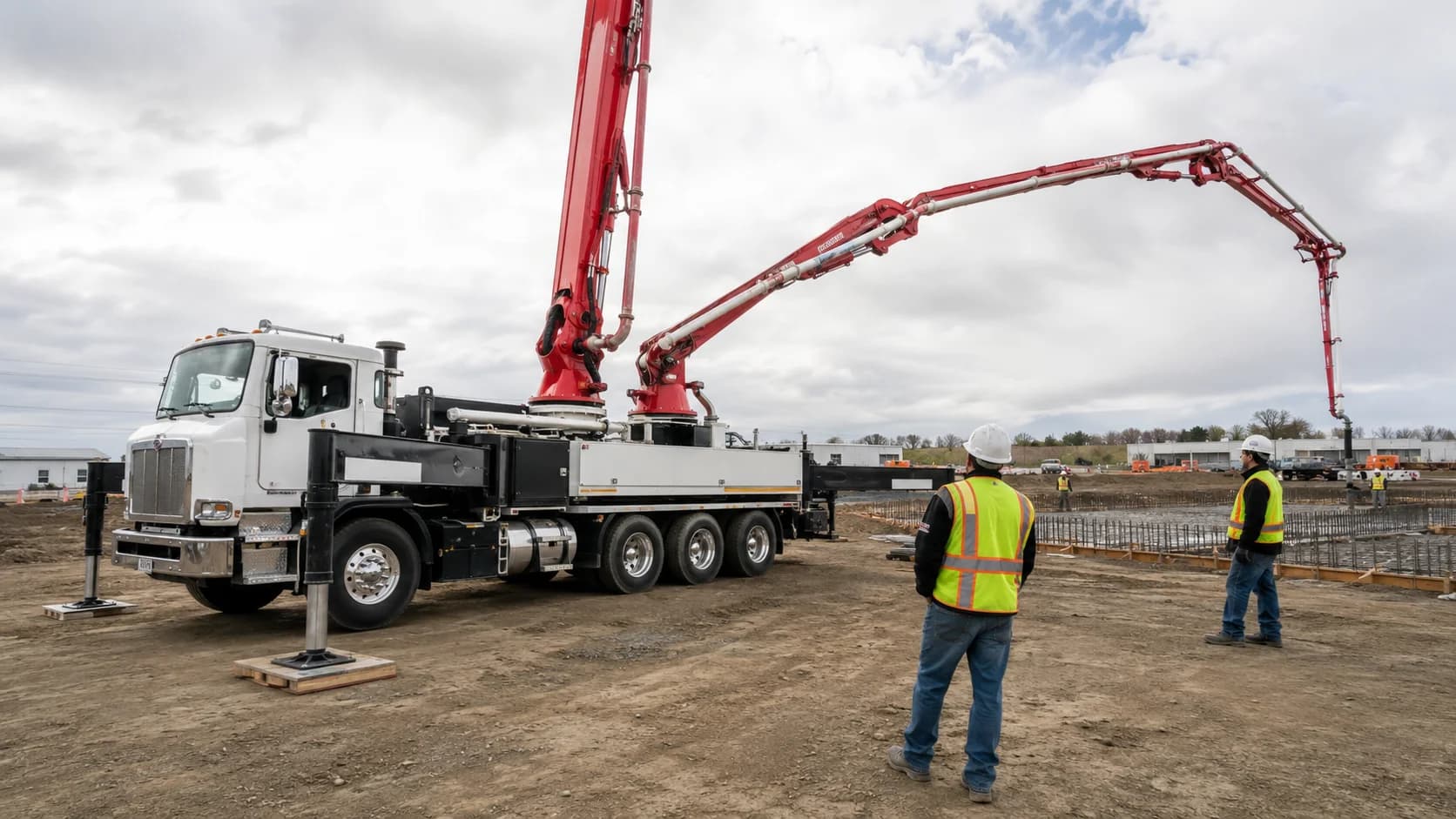
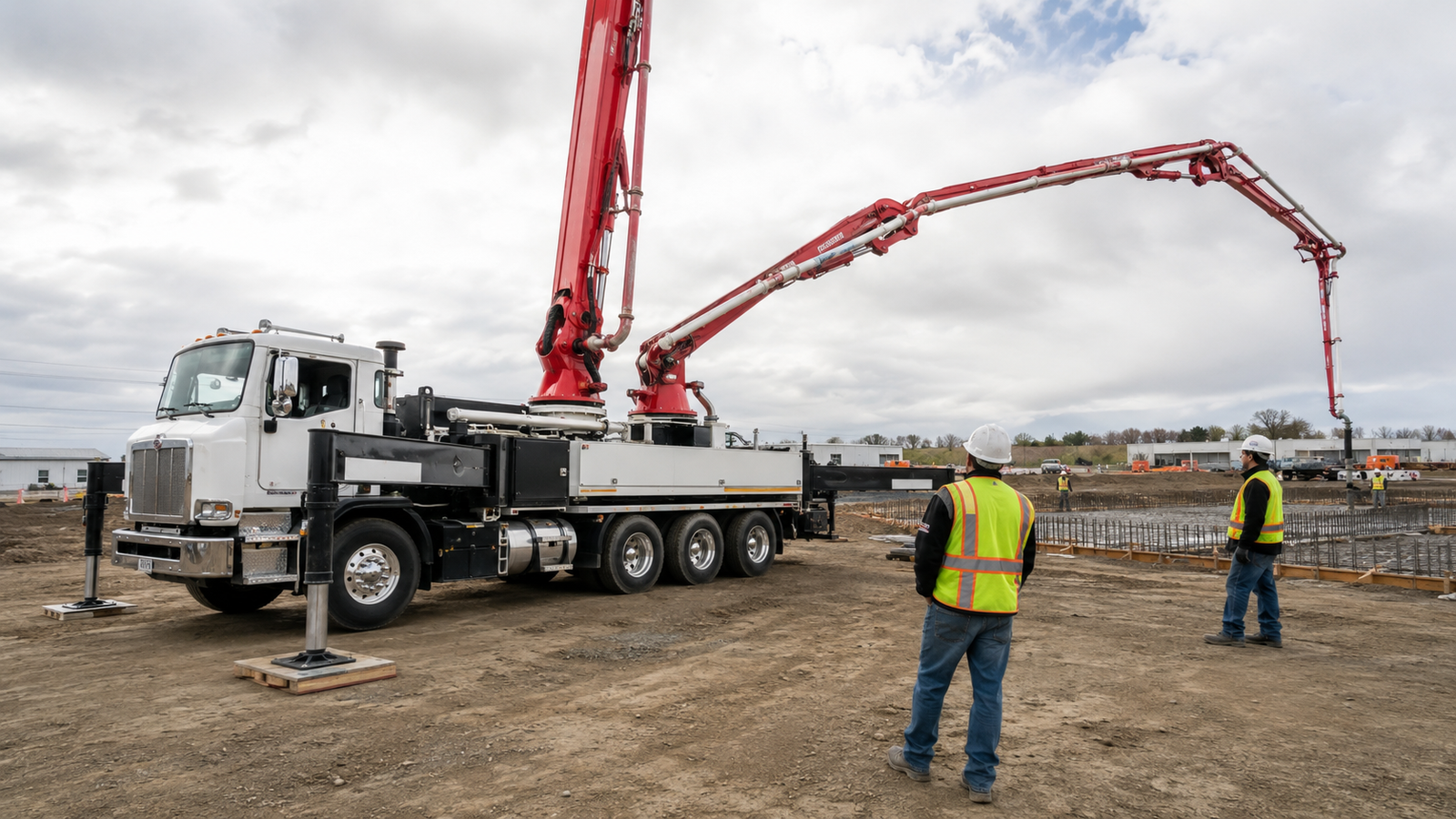
A concrete boom pump can place material rapidly at significant horizontal and vertical reach, but that reach creates large overturning forces at the truck. Outriggers transfer those forces into the ground, making setup condition one of the most important parts of a pumping operation. A pump should never be positioned simply where the boom looks convenient. The crew must evaluate soil, underground services, slopes, excavations, access, overhead hazards, outrigger loading, support pads, traffic, mixer approach, boom path, and emergency clearance before pumping begins. This guide explains the planning logic behind a stable and efficient setup.
Why outriggers matter
Stability changes as the boom moves
The load on each outrigger is not constant. As boom sections unfold, rotate, extend, and carry the weight of the delivery system and concrete, the reaction at the supports changes. A setup that appears stable with the boom folded may be highly loaded once the boom is working over one side. In practice, this point matters because stability changes as the boom moves affects more than the immediate machine action. It influences crew timing, equipment loading, material behavior, and the amount of room available to recover if conditions begin to drift. A useful field procedure is to define the expected condition before production, assign who will monitor it, and establish what change will trigger a slowdown, inspection, adjustment, or stop. That approach reduces last-minute decisions and makes the process more repeatable from one shift or pour to the next.
The truck chassis is only part of the system
During pumping, the machine relies on its outrigger structure and the supporting ground. Tires may carry little or no operational load depending on the design. The condition of the surface under each outrigger therefore becomes part of the pump's structural support system. From a production standpoint, the truck chassis is only part of the system affects more than the immediate machine action. It influences crew timing, equipment loading, material behavior, and the amount of room available to recover if conditions begin to drift. A useful field procedure is to define the expected condition before production, assign who will monitor it, and establish what change will trigger a slowdown, inspection, adjustment, or stop. The crew should therefore verify the condition before work begins and continue watching it as equipment, weather, and material conditions change.
Manufacturer setup limits control the operation
Outrigger extension, short-rigging provisions when equipped, boom working zones, slope limits, pad requirements, and setup sequence are machine-specific. The operator must use the manufacturer's instructions and machine safety systems rather than assuming that one pump behaves like another. On an active jobsite, manufacturer setup limits control the operation affects more than the immediate machine action. It influences crew timing, equipment loading, material behavior, and the amount of room available to recover if conditions begin to drift. A useful field procedure is to define the expected condition before production, assign who will monitor it, and establish what change will trigger a slowdown, inspection, adjustment, or stop. This is also useful for troubleshooting because changes in pressure, torque, output, or surface behavior can be tied to a specific operating condition.
Ground assessment
Surface appearance can be misleading
Asphalt, compacted gravel, concrete pavement, or apparently firm soil may hide soft fill, utility trenches, voids, culverts, basements, vaults, or saturated subgrade. The pump plan should consider what is below the surface, not only what the outrigger foot can see. For planning purposes, surface appearance can be misleading affects more than the immediate machine action. It influences crew timing, equipment loading, material behavior, and the amount of room available to recover if conditions begin to drift. A useful field procedure is to define the expected condition before production, assign who will monitor it, and establish what change will trigger a slowdown, inspection, adjustment, or stop. That approach reduces last-minute decisions and makes the process more repeatable from one shift or pour to the next.
Excavations create influence zones
Setting an outrigger near a trench, basement, retaining wall excavation, or recently backfilled area can overload the edge and cause settlement or collapse. Required setbacks depend on site conditions and competent engineering or project guidance, not a universal rule of thumb. Operationally, excavations create influence zones affects more than the immediate machine action. It influences crew timing, equipment loading, material behavior, and the amount of room available to recover if conditions begin to drift. A useful field procedure is to define the expected condition before production, assign who will monitor it, and establish what change will trigger a slowdown, inspection, adjustment, or stop. The crew should therefore verify the condition before work begins and continue watching it as equipment, weather, and material conditions change.
Weather can change bearing conditions
Rain, thawing, groundwater, snowmelt, and repeated truck traffic can reduce support capacity quickly. A location that was acceptable during a morning inspection may require reevaluation after weather or site conditions change. The practical consequence is that weather can change bearing conditions affects more than the immediate machine action. It influences crew timing, equipment loading, material behavior, and the amount of room available to recover if conditions begin to drift. A useful field procedure is to define the expected condition before production, assign who will monitor it, and establish what change will trigger a slowdown, inspection, adjustment, or stop. This is also useful for troubleshooting because changes in pressure, torque, output, or surface behavior can be tied to a specific operating condition.
Outrigger pads and load distribution
Pads reduce ground pressure
An outrigger foot concentrates load over a limited area. Proper mats or pads increase the bearing area and reduce pressure on the supporting surface. Pad selection must consider expected reaction forces, ground capacity, pad strength, and the way load is transferred across the pad. In practice, this point matters because pads reduce ground pressure affects more than the immediate machine action. It influences crew timing, equipment loading, material behavior, and the amount of room available to recover if conditions begin to drift. A useful field procedure is to define the expected condition before production, assign who will monitor it, and establish what change will trigger a slowdown, inspection, adjustment, or stop. That approach reduces last-minute decisions and makes the process more repeatable from one shift or pour to the next.
Pads must be fully supported
A strong mat can still fail functionally if it bridges a void, rests partly on a curb, sits on loose blocks, or is placed on uneven fill. The entire bearing surface should be stable and arranged according to the pump and site plan. From a production standpoint, pads must be fully supported affects more than the immediate machine action. It influences crew timing, equipment loading, material behavior, and the amount of room available to recover if conditions begin to drift. A useful field procedure is to define the expected condition before production, assign who will monitor it, and establish what change will trigger a slowdown, inspection, adjustment, or stop. The crew should therefore verify the condition before work begins and continue watching it as equipment, weather, and material conditions change.
Improvised materials are risky
Random lumber, broken concrete, stacked scraps, or unstable combinations can split, roll, crush, or create eccentric loading. Purpose-designed support materials or an engineered arrangement provide more predictable behavior. On an active jobsite, improvised materials are risky affects more than the immediate machine action. It influences crew timing, equipment loading, material behavior, and the amount of room available to recover if conditions begin to drift. A useful field procedure is to define the expected condition before production, assign who will monitor it, and establish what change will trigger a slowdown, inspection, adjustment, or stop. This is also useful for troubleshooting because changes in pressure, torque, output, or surface behavior can be tied to a specific operating condition.
Choosing the pump position
Balance reach and support quality
The closest position to the pour is not always the best position. Moving the pump slightly farther away may allow full outrigger extension on stronger ground, better truck access, or a safer boom path, which can be more valuable than reducing boom radius by a small amount. For planning purposes, balance reach and support quality affects more than the immediate machine action. It influences crew timing, equipment loading, material behavior, and the amount of room available to recover if conditions begin to drift. A useful field procedure is to define the expected condition before production, assign who will monitor it, and establish what change will trigger a slowdown, inspection, adjustment, or stop. That approach reduces last-minute decisions and makes the process more repeatable from one shift or pour to the next.
Protect mixer truck circulation
Mixer trucks need a predictable route to the hopper without crossing outrigger legs, pads, pump line, pedestrian zones, or other truck paths. Reversing distance should be minimized and a spotter used where visibility is restricted. Operationally, protect mixer truck circulation affects more than the immediate machine action. It influences crew timing, equipment loading, material behavior, and the amount of room available to recover if conditions begin to drift. A useful field procedure is to define the expected condition before production, assign who will monitor it, and establish what change will trigger a slowdown, inspection, adjustment, or stop. The crew should therefore verify the condition before work begins and continue watching it as equipment, weather, and material conditions change.
Preserve access for emergencies
The setup should not block fire routes, rescue access, critical building entrances, or the only route for other essential equipment. Once outriggers and boom are deployed, relocating the pump is time-consuming, so access conflicts should be resolved in the planning stage. The practical consequence is that preserve access for emergencies affects more than the immediate machine action. It influences crew timing, equipment loading, material behavior, and the amount of room available to recover if conditions begin to drift. A useful field procedure is to define the expected condition before production, assign who will monitor it, and establish what change will trigger a slowdown, inspection, adjustment, or stop. This is also useful for troubleshooting because changes in pressure, torque, output, or surface behavior can be tied to a specific operating condition.
Overhead and surrounding hazards
Power lines require specific control
A long boom can enter an electrical hazard area even when the truck is parked far from a line. The crew must identify overhead conductors, use the required clearances and controls, and plan boom movement so no part of the machine or delivery system creates an electrical contact risk. In practice, this point matters because power lines require specific control affects more than the immediate machine action. It influences crew timing, equipment loading, material behavior, and the amount of room available to recover if conditions begin to drift. A useful field procedure is to define the expected condition before production, assign who will monitor it, and establish what change will trigger a slowdown, inspection, adjustment, or stop. That approach reduces last-minute decisions and makes the process more repeatable from one shift or pour to the next.
Buildings and cranes affect boom path
Facades, scaffolding, tower cranes, mobile cranes, trees, lighting towers, and temporary structures can limit safe rotation. The full three-dimensional boom envelope should be considered, including the path used to unfold and refold the boom. From a production standpoint, buildings and cranes affect boom path affects more than the immediate machine action. It influences crew timing, equipment loading, material behavior, and the amount of room available to recover if conditions begin to drift. A useful field procedure is to define the expected condition before production, assign who will monitor it, and establish what change will trigger a slowdown, inspection, adjustment, or stop. The crew should therefore verify the condition before work begins and continue watching it as equipment, weather, and material conditions change.
Wind and visibility matter
Wind can affect boom control and suspended hose behavior, while darkness, fog, or blind placement zones reduce the operator's ability to judge clearances. Work should stay within the machine limits and site operating plan for environmental conditions. On an active jobsite, wind and visibility matter affects more than the immediate machine action. It influences crew timing, equipment loading, material behavior, and the amount of room available to recover if conditions begin to drift. A useful field procedure is to define the expected condition before production, assign who will monitor it, and establish what change will trigger a slowdown, inspection, adjustment, or stop. This is also useful for troubleshooting because changes in pressure, torque, output, or surface behavior can be tied to a specific operating condition.
Setup sequence and leveling
Establish the exclusion zone first
Before deploying outriggers, the crew should control the area so pedestrians and vehicles do not enter the path of moving beams or jack legs. The operator should have a clear view or a reliable spotter where components extend beyond direct visibility. For planning purposes, establish the exclusion zone first affects more than the immediate machine action. It influences crew timing, equipment loading, material behavior, and the amount of room available to recover if conditions begin to drift. A useful field procedure is to define the expected condition before production, assign who will monitor it, and establish what change will trigger a slowdown, inspection, adjustment, or stop. That approach reduces last-minute decisions and makes the process more repeatable from one shift or pour to the next.
Deploy according to the machine procedure
Outrigger beams, jack cylinders, pads, and leveling steps should be completed in the specified sequence. Shortcuts can create side loading, partial pad contact, or a false sense that the truck is ready before the support system is fully established. Operationally, deploy according to the machine procedure affects more than the immediate machine action. It influences crew timing, equipment loading, material behavior, and the amount of room available to recover if conditions begin to drift. A useful field procedure is to define the expected condition before production, assign who will monitor it, and establish what change will trigger a slowdown, inspection, adjustment, or stop. The crew should therefore verify the condition before work begins and continue watching it as equipment, weather, and material conditions change.
Verify level and monitor settlement
The pump must remain within permitted level tolerance. The operator should watch pads and ground during initial boom movement and throughout the pour for sinking, cracking, shifting, or other signs that support conditions are changing. The practical consequence is that verify level and monitor settlement affects more than the immediate machine action. It influences crew timing, equipment loading, material behavior, and the amount of room available to recover if conditions begin to drift. A useful field procedure is to define the expected condition before production, assign who will monitor it, and establish what change will trigger a slowdown, inspection, adjustment, or stop. This is also useful for troubleshooting because changes in pressure, torque, output, or surface behavior can be tied to a specific operating condition.
Pour planning after the machine is stable
Sequence the boom efficiently
A good pour sequence reduces unnecessary long-radius work and repeated boom repositioning. Starting in difficult or distant areas and working toward easier locations can reduce hose dragging and help the boom stay within a comfortable operating envelope. In practice, this point matters because sequence the boom efficiently affects more than the immediate machine action. It influences crew timing, equipment loading, material behavior, and the amount of room available to recover if conditions begin to drift. A useful field procedure is to define the expected condition before production, assign who will monitor it, and establish what change will trigger a slowdown, inspection, adjustment, or stop. That approach reduces last-minute decisions and makes the process more repeatable from one shift or pour to the next.
Coordinate placing rate and finishing
The pump can usually place concrete faster than a crew can level and finish it. Production should be matched to form capacity, reinforcement congestion, vibration, screeding, and finishing so speed does not create unsafe pressure to rush the work. From a production standpoint, coordinate placing rate and finishing affects more than the immediate machine action. It influences crew timing, equipment loading, material behavior, and the amount of room available to recover if conditions begin to drift. A useful field procedure is to define the expected condition before production, assign who will monitor it, and establish what change will trigger a slowdown, inspection, adjustment, or stop. The crew should therefore verify the condition before work begins and continue watching it as equipment, weather, and material conditions change.
Plan washout before pumping
Hopper wash, line cleanup, and residual concrete need a designated location and procedure. Washout should not require the truck to move while the boom is still deployed or force contaminated water into drainage systems or sensitive areas. On an active jobsite, plan washout before pumping affects more than the immediate machine action. It influences crew timing, equipment loading, material behavior, and the amount of room available to recover if conditions begin to drift. A useful field procedure is to define the expected condition before production, assign who will monitor it, and establish what change will trigger a slowdown, inspection, adjustment, or stop. This is also useful for troubleshooting because changes in pressure, torque, output, or surface behavior can be tied to a specific operating condition.
Daily setup checklist thinking
Reinspect after relocation
Every new setup is a new stability assessment, even if the pump moves only a short distance on the same site. Soil, utilities, slopes, and boom working direction can change within a few meters. For planning purposes, reinspect after relocation affects more than the immediate machine action. It influences crew timing, equipment loading, material behavior, and the amount of room available to recover if conditions begin to drift. A useful field procedure is to define the expected condition before production, assign who will monitor it, and establish what change will trigger a slowdown, inspection, adjustment, or stop. That approach reduces last-minute decisions and makes the process more repeatable from one shift or pour to the next.
Document special conditions
Where the setup relies on engineered mats, restricted outrigger configurations, unusual clearances, or specific working zones, the plan should be communicated to all relevant crew members and preserved in the project documentation. Operationally, document special conditions affects more than the immediate machine action. It influences crew timing, equipment loading, material behavior, and the amount of room available to recover if conditions begin to drift. A useful field procedure is to define the expected condition before production, assign who will monitor it, and establish what change will trigger a slowdown, inspection, adjustment, or stop. The crew should therefore verify the condition before work begins and continue watching it as equipment, weather, and material conditions change.
Stop when conditions change
A new excavation, parked vehicle, softening ground, rising wind, damaged pad, or unexpected overhead activity can invalidate the original plan. The crew should be prepared to stop and reassess instead of treating setup as complete once pumping has started. The practical consequence is that stop when conditions change affects more than the immediate machine action. It influences crew timing, equipment loading, material behavior, and the amount of room available to recover if conditions begin to drift. A useful field procedure is to define the expected condition before production, assign who will monitor it, and establish what change will trigger a slowdown, inspection, adjustment, or stop. This is also useful for troubleshooting because changes in pressure, torque, output, or surface behavior can be tied to a specific operating condition.
Practical planning checklist
Before the work starts, convert the main technical ideas into a short field plan. Review the equipment manual and project requirements, confirm site access and support conditions, verify the material or drilling program, identify the people authorized to control the operation, and agree on communication signals. Confirm that inspection, maintenance, cleanup, environmental controls, and emergency access are not being left until the end of the shift. A checklist is most useful when it is specific to the actual machine, ground, mix, crew, and layout rather than copied without adaptation from a different project.
- Verify equipment configuration, wear condition, required tooling or delivery components, and all manufacturer limitations that apply to the planned work.
- Confirm that the work area, access route, traffic plan, supporting ground, and exclusion zones are ready before production equipment is committed.
- Review material properties or ground conditions and confirm that the selected operating method matches what the crew expects to encounter.
- Establish a realistic production rate that downstream operations can accept without creating long stops, uncontrolled queues, or rushed workmanship.
- Assign one clear communication chain for start, stop, speed changes, abnormal conditions, and emergency action.
- Prepare the cleanup, waste, washout, drilling-fluid, spoil, or residual-material plan before the operation begins.
- Record unusual pressure, torque, output, wear, delays, or quality observations so the next similar job can be planned with better information.
Final guidance
Concrete pump setup is a stability and logistics problem before it becomes a concrete-placement problem. Outriggers, ground, pads, boom reach, mixer access, overhead hazards, and the pour sequence all influence one another. The safest and most productive setup is one that follows the specific pump manufacturer's instructions, uses competent site information, provides reliable bearing support, protects the boom envelope, and remains under observation as conditions change during the pour.
Get More Expert Guides & Updates
Subscribe for Machinery.org guide updates and product learning content.