

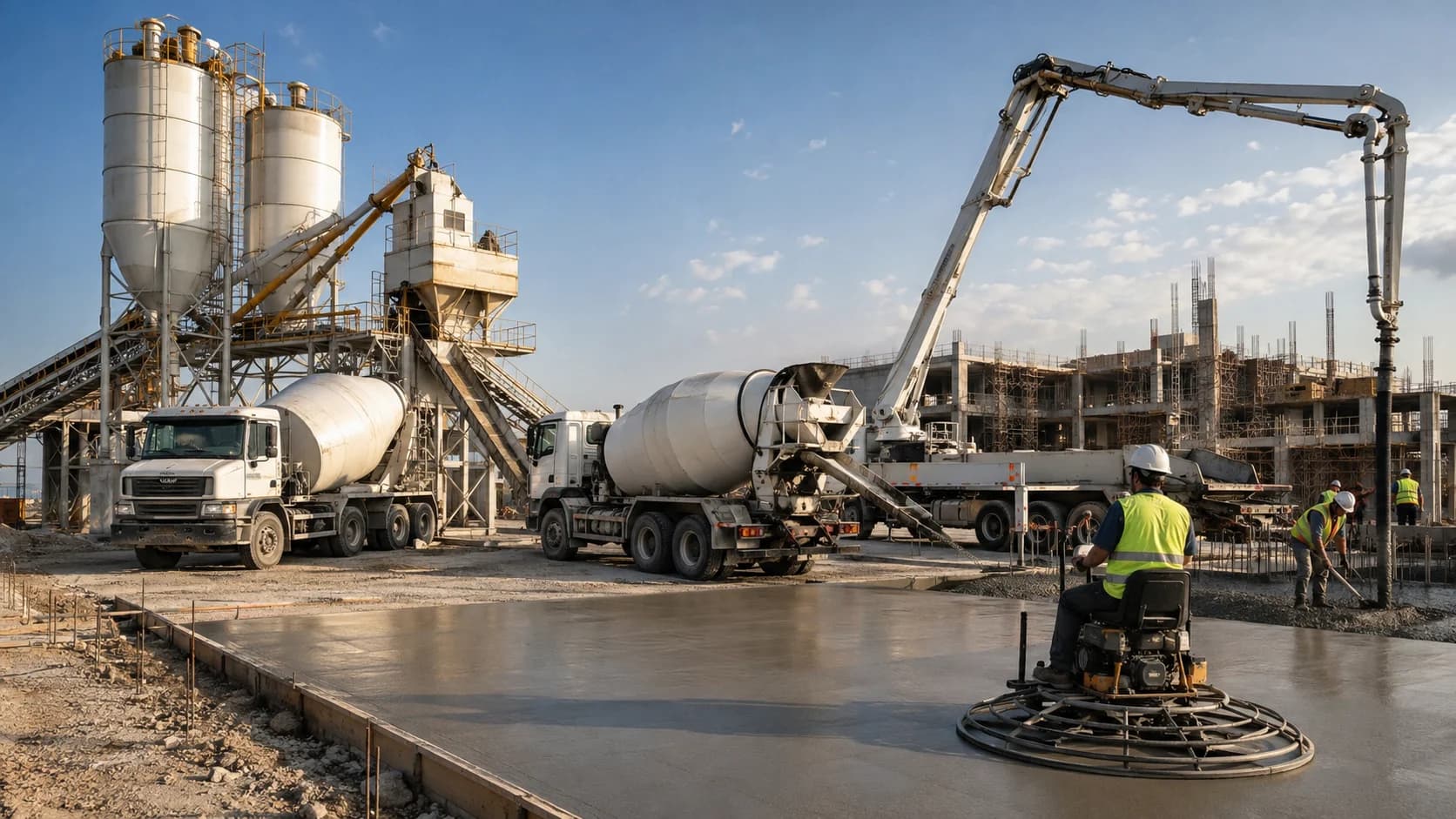

Concrete construction is often described as a series of separate operations—batching, trucking, pumping, placing, screeding, and finishing—but on a successful pour those operations behave like one production line. The batching plant must release concrete at a rate the truck fleet can carry. Trucks must arrive in a sequence the pump can accept. The pump must place at a rate the crew can consolidate, strike off, and finish. Finishing equipment must then follow the changing concrete surface without forcing the upstream operation into damaging starts and stops. This guide explains how the complete workflow is coordinated from raw materials to finished slab.
Start with the required placement rate
The slab or structure sets the demand
Area, thickness, lift height, form capacity, reinforcement congestion, joint plan, and finishing method determine how quickly concrete can realistically be placed. Production planning should begin with the receiving operation instead of assuming the plant or pump must run at maximum capacity. In practice, this point matters because the slab or structure sets the demand affects more than the immediate machine action. It influences crew timing, equipment loading, material behavior, and the amount of room available to recover if conditions begin to drift. A useful field procedure is to define the expected condition before production, assign who will monitor it, and establish what change will trigger a slowdown, inspection, adjustment, or stop. That approach reduces last-minute decisions and makes the process more repeatable from one shift or pour to the next.
Pump capacity is not the same as usable production
A pump may have a high rated output, but the actual job may be limited by hose handling, form pressure, crane interference, vibration, screeding, or finishing. The useful output is the rate the entire crew can sustain without sacrificing quality. From a production standpoint, pump capacity is not the same as usable production affects more than the immediate machine action. It influences crew timing, equipment loading, material behavior, and the amount of room available to recover if conditions begin to drift. A useful field procedure is to define the expected condition before production, assign who will monitor it, and establish what change will trigger a slowdown, inspection, adjustment, or stop. The crew should therefore verify the condition before work begins and continue watching it as equipment, weather, and material conditions change.
Create a target range, not one number
Traffic, weather, truck variation, and jobsite conditions make exact flow impossible. A practical plan defines a desired production range and identifies how the crew will respond when delivery temporarily rises or falls. On an active jobsite, create a target range, not one number affects more than the immediate machine action. It influences crew timing, equipment loading, material behavior, and the amount of room available to recover if conditions begin to drift. A useful field procedure is to define the expected condition before production, assign who will monitor it, and establish what change will trigger a slowdown, inspection, adjustment, or stop. This is also useful for troubleshooting because changes in pressure, torque, output, or surface behavior can be tied to a specific operating condition.
Batching plant responsibilities
Produce consistent material
The plant controls ingredient proportions, moisture corrections, mixing sequence, and batch records. Consistency is essential because changing workability or setting behavior affects truck unloading, pump pressure, screeding, and finishing timing downstream. For planning purposes, produce consistent material affects more than the immediate machine action. It influences crew timing, equipment loading, material behavior, and the amount of room available to recover if conditions begin to drift. A useful field procedure is to define the expected condition before production, assign who will monitor it, and establish what change will trigger a slowdown, inspection, adjustment, or stop. That approach reduces last-minute decisions and makes the process more repeatable from one shift or pour to the next.
Dispatch at the correct interval
Truck spacing should reflect loading time, travel time, unloading time, return travel, and available fleet size. Dispatching every truck immediately can create a queue at the jobsite, while dispatching too slowly creates pump stops. Operationally, dispatch at the correct interval affects more than the immediate machine action. It influences crew timing, equipment loading, material behavior, and the amount of room available to recover if conditions begin to drift. A useful field procedure is to define the expected condition before production, assign who will monitor it, and establish what change will trigger a slowdown, inspection, adjustment, or stop. The crew should therefore verify the condition before work begins and continue watching it as equipment, weather, and material conditions change.
Communicate changes quickly
If aggregate moisture, admixture demand, plant delay, or traffic interruption changes the production plan, the jobsite should know before the concrete arrives. Early communication allows the pour supervisor to adjust placement sequence and labor. The practical consequence is that communicate changes quickly affects more than the immediate machine action. It influences crew timing, equipment loading, material behavior, and the amount of room available to recover if conditions begin to drift. A useful field procedure is to define the expected condition before production, assign who will monitor it, and establish what change will trigger a slowdown, inspection, adjustment, or stop. This is also useful for troubleshooting because changes in pressure, torque, output, or surface behavior can be tied to a specific operating condition.
Mixer truck cycle
Loading and ticket verification
At the plant, the truck receives the specified mixture and documentation. The driver must know the destination, route, job instructions, and any restrictions. Errors at this stage travel with the load all the way to the pump. In practice, this point matters because loading and ticket verification affects more than the immediate machine action. It influences crew timing, equipment loading, material behavior, and the amount of room available to recover if conditions begin to drift. A useful field procedure is to define the expected condition before production, assign who will monitor it, and establish what change will trigger a slowdown, inspection, adjustment, or stop. That approach reduces last-minute decisions and makes the process more repeatable from one shift or pour to the next.
Transport and agitation
The drum maintains the concrete during travel. Excessive delay, unsuitable drum operation, hot weather, or long queues can change workability. Truck location and estimated arrival should therefore be part of the production picture. From a production standpoint, transport and agitation affects more than the immediate machine action. It influences crew timing, equipment loading, material behavior, and the amount of room available to recover if conditions begin to drift. A useful field procedure is to define the expected condition before production, assign who will monitor it, and establish what change will trigger a slowdown, inspection, adjustment, or stop. The crew should therefore verify the condition before work begins and continue watching it as equipment, weather, and material conditions change.
Jobsite approach and discharge
The pump hopper or placement point must be accessible without unsafe reversing or conflicts with outriggers and pedestrians. A spotter and clear truck queue reduce changeover time so the hopper remains supplied. On an active jobsite, jobsite approach and discharge affects more than the immediate machine action. It influences crew timing, equipment loading, material behavior, and the amount of room available to recover if conditions begin to drift. A useful field procedure is to define the expected condition before production, assign who will monitor it, and establish what change will trigger a slowdown, inspection, adjustment, or stop. This is also useful for troubleshooting because changes in pressure, torque, output, or surface behavior can be tied to a specific operating condition.
Pump and placement operation
Keep the hopper and pipeline stable
A continuously supplied hopper and steady pump rhythm reduce the chance of air entry, segregation, and line blockage. Truck changes should be coordinated so the pump does not repeatedly run empty or stop for long periods. For planning purposes, keep the hopper and pipeline stable affects more than the immediate machine action. It influences crew timing, equipment loading, material behavior, and the amount of room available to recover if conditions begin to drift. A useful field procedure is to define the expected condition before production, assign who will monitor it, and establish what change will trigger a slowdown, inspection, adjustment, or stop. That approach reduces last-minute decisions and makes the process more repeatable from one shift or pour to the next.
Place in a planned sequence
The boom or line should deliver concrete where the crew can immediately spread, consolidate, and strike it off. Random placement creates deep piles, long hose drags, uneven load on forms, and unnecessary movement of workers and equipment. Operationally, place in a planned sequence affects more than the immediate machine action. It influences crew timing, equipment loading, material behavior, and the amount of room available to recover if conditions begin to drift. A useful field procedure is to define the expected condition before production, assign who will monitor it, and establish what change will trigger a slowdown, inspection, adjustment, or stop. The crew should therefore verify the condition before work begins and continue watching it as equipment, weather, and material conditions change.
Use communication hierarchy
The pump operator needs one reliable source for start, stop, and speed commands. The placing foreman, hose handler, and finishing supervisor should coordinate through an agreed communication chain to prevent contradictory signals. The practical consequence is that use communication hierarchy affects more than the immediate machine action. It influences crew timing, equipment loading, material behavior, and the amount of room available to recover if conditions begin to drift. A useful field procedure is to define the expected condition before production, assign who will monitor it, and establish what change will trigger a slowdown, inspection, adjustment, or stop. This is also useful for troubleshooting because changes in pressure, torque, output, or surface behavior can be tied to a specific operating condition.
Screeding and consolidation
Consolidate while the concrete is workable
Internal or external vibration must follow placement closely enough to remove entrapped air and fill around reinforcement without allowing the concrete to stiffen. The method should suit member thickness and reinforcement density. In practice, this point matters because consolidate while the concrete is workable affects more than the immediate machine action. It influences crew timing, equipment loading, material behavior, and the amount of room available to recover if conditions begin to drift. A useful field procedure is to define the expected condition before production, assign who will monitor it, and establish what change will trigger a slowdown, inspection, adjustment, or stop. That approach reduces last-minute decisions and makes the process more repeatable from one shift or pour to the next.
Strike off to the planned elevation
Screeds establish the basic plane of a slab. Manual straightedges, vibrating screeds, truss screeds, laser screeds, and other systems have different production rates. Their capacity often determines how fast the pump can feed a slab. From a production standpoint, strike off to the planned elevation affects more than the immediate machine action. It influences crew timing, equipment loading, material behavior, and the amount of room available to recover if conditions begin to drift. A useful field procedure is to define the expected condition before production, assign who will monitor it, and establish what change will trigger a slowdown, inspection, adjustment, or stop. The crew should therefore verify the condition before work begins and continue watching it as equipment, weather, and material conditions change.
Avoid burying the finishing crew
If fresh concrete is placed faster than it can be screeded, the crew begins managing piles instead of controlling elevation. Slowing the pump is usually better than creating an oversized wet edge that becomes difficult to recover. On an active jobsite, avoid burying the finishing crew affects more than the immediate machine action. It influences crew timing, equipment loading, material behavior, and the amount of room available to recover if conditions begin to drift. A useful field procedure is to define the expected condition before production, assign who will monitor it, and establish what change will trigger a slowdown, inspection, adjustment, or stop. This is also useful for troubleshooting because changes in pressure, torque, output, or surface behavior can be tied to a specific operating condition.
Transition to finishing equipment
Bleed and stiffening period
After strikeoff and initial floating, the surface needs time before power finishing. Water should not be trapped by premature troweling. The finishing team monitors footprint depth, surface sheen, edge condition, and local setting differences. For planning purposes, bleed and stiffening period affects more than the immediate machine action. It influences crew timing, equipment loading, material behavior, and the amount of room available to recover if conditions begin to drift. A useful field procedure is to define the expected condition before production, assign who will monitor it, and establish what change will trigger a slowdown, inspection, adjustment, or stop. That approach reduces last-minute decisions and makes the process more repeatable from one shift or pour to the next.
Float first, finish later
Pans or float blades help flatten and prepare the surface. Finish blades are introduced as the slab hardens. The number of machines and their working width should match the slab area and expected rate of set. Operationally, float first, finish later affects more than the immediate machine action. It influences crew timing, equipment loading, material behavior, and the amount of room available to recover if conditions begin to drift. A useful field procedure is to define the expected condition before production, assign who will monitor it, and establish what change will trigger a slowdown, inspection, adjustment, or stop. The crew should therefore verify the condition before work begins and continue watching it as equipment, weather, and material conditions change.
Finishing capacity feeds back into delivery
On hot, dry, or windy days, the finishers may need concrete placed in smaller panels so they can keep up. In cool conditions, a large placement may remain open longer. Dispatch and pump rate should respond to that reality. The practical consequence is that finishing capacity feeds back into delivery affects more than the immediate machine action. It influences crew timing, equipment loading, material behavior, and the amount of room available to recover if conditions begin to drift. A useful field procedure is to define the expected condition before production, assign who will monitor it, and establish what change will trigger a slowdown, inspection, adjustment, or stop. This is also useful for troubleshooting because changes in pressure, torque, output, or surface behavior can be tied to a specific operating condition.
Managing interruptions
Traffic delays
When trucks are late, the pump operator, plant dispatcher, and pour supervisor should share updated arrival information. The crew may reduce output, change placement sequence, or prepare for a controlled pause rather than continuing until the hopper runs empty. In practice, this point matters because traffic delays affects more than the immediate machine action. It influences crew timing, equipment loading, material behavior, and the amount of room available to recover if conditions begin to drift. A useful field procedure is to define the expected condition before production, assign who will monitor it, and establish what change will trigger a slowdown, inspection, adjustment, or stop. That approach reduces last-minute decisions and makes the process more repeatable from one shift or pour to the next.
Equipment failure
Backup plans should identify what happens if the pump, screed, trowel, batching plant, or truck fleet loses capacity. Critical pours may require standby equipment, spare finishing machines, service support, or a planned construction-joint location. From a production standpoint, equipment failure affects more than the immediate machine action. It influences crew timing, equipment loading, material behavior, and the amount of room available to recover if conditions begin to drift. A useful field procedure is to define the expected condition before production, assign who will monitor it, and establish what change will trigger a slowdown, inspection, adjustment, or stop. The crew should therefore verify the condition before work begins and continue watching it as equipment, weather, and material conditions change.
Weather changes
Temperature, wind, rain, and sun can affect both concrete behavior and crew productivity. The best plans include lighting, evaporation control, protection, curing materials, and the ability to adjust placement size or timing. On an active jobsite, weather changes affects more than the immediate machine action. It influences crew timing, equipment loading, material behavior, and the amount of room available to recover if conditions begin to drift. A useful field procedure is to define the expected condition before production, assign who will monitor it, and establish what change will trigger a slowdown, inspection, adjustment, or stop. This is also useful for troubleshooting because changes in pressure, torque, output, or surface behavior can be tied to a specific operating condition.
Quality control across the workflow
Sampling represents a production moment
Slump, air, temperature, density, and strength specimens are meaningful only when they are linked to a specific load and placement location. Testing should be coordinated so it does not unnecessarily delay truck discharge while still representing the delivered concrete. For planning purposes, sampling represents a production moment affects more than the immediate machine action. It influences crew timing, equipment loading, material behavior, and the amount of room available to recover if conditions begin to drift. A useful field procedure is to define the expected condition before production, assign who will monitor it, and establish what change will trigger a slowdown, inspection, adjustment, or stop. That approach reduces last-minute decisions and makes the process more repeatable from one shift or pour to the next.
Traceability helps troubleshooting
Batch tickets, truck times, pump logs, weather records, and placement maps can connect a later surface issue or test result to the production conditions that existed at the time. This is more useful than relying on memory after the pour. Operationally, traceability helps troubleshooting affects more than the immediate machine action. It influences crew timing, equipment loading, material behavior, and the amount of room available to recover if conditions begin to drift. A useful field procedure is to define the expected condition before production, assign who will monitor it, and establish what change will trigger a slowdown, inspection, adjustment, or stop. The crew should therefore verify the condition before work begins and continue watching it as equipment, weather, and material conditions change.
Curing completes the process
Finishing is not the end. The slab or structural element needs the specified curing method, protection from early damage, and controlled access. Good upstream production cannot compensate for poor curing after placement. The practical consequence is that curing completes the process affects more than the immediate machine action. It influences crew timing, equipment loading, material behavior, and the amount of room available to recover if conditions begin to drift. A useful field procedure is to define the expected condition before production, assign who will monitor it, and establish what change will trigger a slowdown, inspection, adjustment, or stop. This is also useful for troubleshooting because changes in pressure, torque, output, or surface behavior can be tied to a specific operating condition.
Practical planning checklist
Before the work starts, convert the main technical ideas into a short field plan. Review the equipment manual and project requirements, confirm site access and support conditions, verify the material or drilling program, identify the people authorized to control the operation, and agree on communication signals. Confirm that inspection, maintenance, cleanup, environmental controls, and emergency access are not being left until the end of the shift. A checklist is most useful when it is specific to the actual machine, ground, mix, crew, and layout rather than copied without adaptation from a different project.
- Verify equipment configuration, wear condition, required tooling or delivery components, and all manufacturer limitations that apply to the planned work.
- Confirm that the work area, access route, traffic plan, supporting ground, and exclusion zones are ready before production equipment is committed.
- Review material properties or ground conditions and confirm that the selected operating method matches what the crew expects to encounter.
- Establish a realistic production rate that downstream operations can accept without creating long stops, uncontrolled queues, or rushed workmanship.
- Assign one clear communication chain for start, stop, speed changes, abnormal conditions, and emergency action.
- Prepare the cleanup, waste, washout, drilling-fluid, spoil, or residual-material plan before the operation begins.
- Record unusual pressure, torque, output, wear, delays, or quality observations so the next similar job can be planned with better information.
Final guidance
Concrete production and placement is a synchronized chain. The batching plant controls consistency and release rate, mixer trucks provide the moving buffer between plant and site, the pump converts deliveries into controlled placement, and screeding and finishing equipment transform fresh concrete into the required geometry and surface. Productivity improves when the entire chain is sized to the same realistic output and when plant, drivers, pump operator, placing crew, and finishers share information continuously.
Get More Expert Guides & Updates
Subscribe for Machinery.org guide updates and product learning content.