
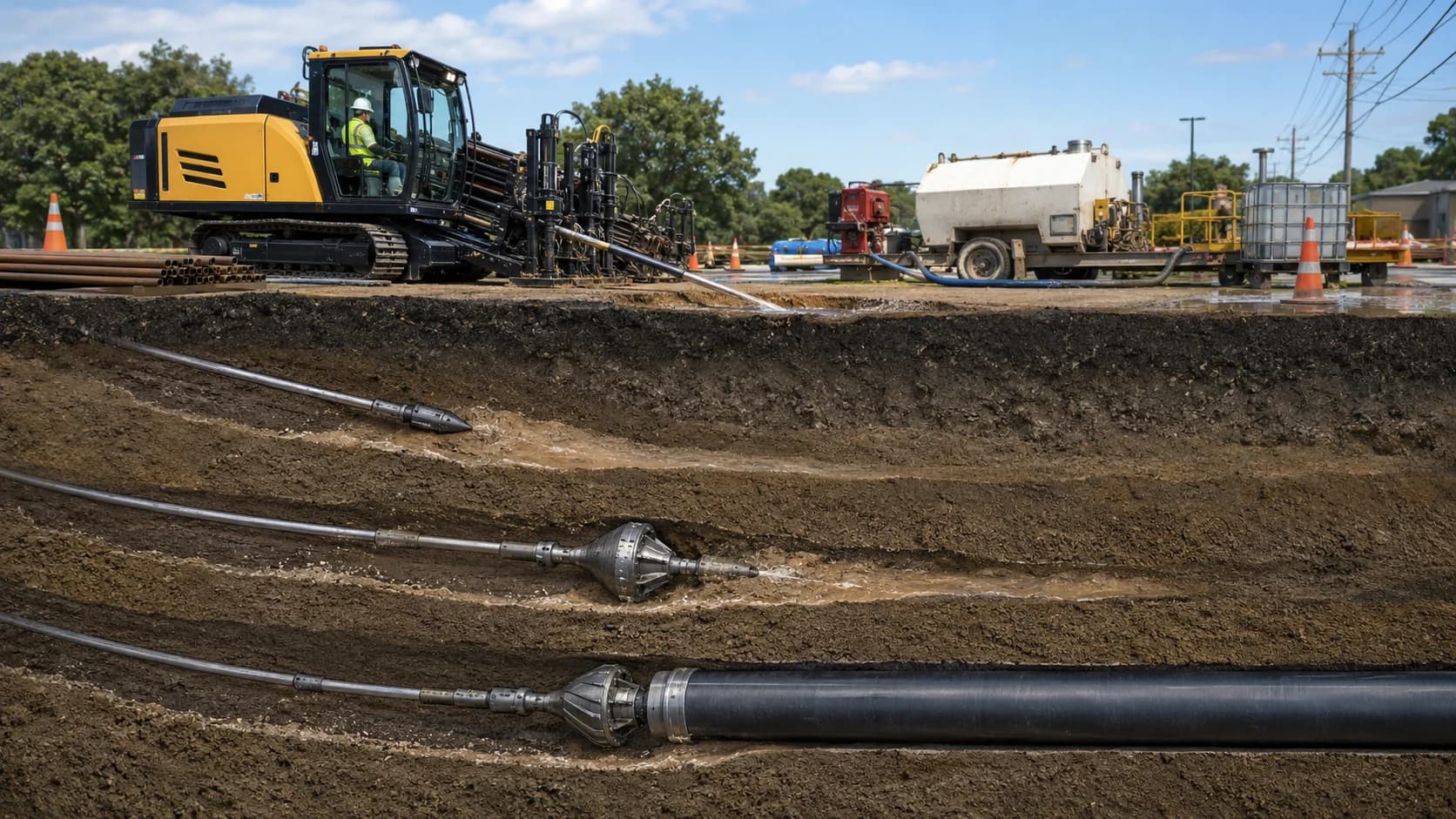
Horizontal directional drilling, usually called HDD, installs pipe or conduit along a planned underground path without excavating a continuous open trench. The method is widely used to cross roads, railways, rivers, landscaped areas, and developed corridors where surface disruption must be limited. A typical installation has three major stages: drilling a steerable pilot bore, enlarging the bore with one or more reaming passes, and pulling the product pipe back through the prepared hole. Each stage depends on bore planning, locating, tooling, drilling fluid, rig capability, ground conditions, and controlled construction practices.
How HDD works as a system
A guided underground path
The drill rig advances a string of rods from an entry pit or surface setup. A steerable drill head creates the pilot hole while a locating system helps the crew track position, depth, orientation, and direction. Small steering changes over distance create the designed curve. In practice, this point matters because a guided underground path affects more than the immediate machine action. It influences crew timing, equipment loading, material behavior, and the amount of room available to recover if conditions begin to drift. A useful field procedure is to define the expected condition before production, assign who will monitor it, and establish what change will trigger a slowdown, inspection, adjustment, or stop. That approach reduces last-minute decisions and makes the process more repeatable from one shift or pour to the next.
Fluid supports the bore
Drilling fluid is pumped through the drill string to the tool. It helps carry cuttings, cool and lubricate tooling, stabilize the hole, and reduce friction. Fluid properties must suit the ground because too little carrying capacity or uncontrolled pressure can cause problems. From a production standpoint, fluid supports the bore affects more than the immediate machine action. It influences crew timing, equipment loading, material behavior, and the amount of room available to recover if conditions begin to drift. A useful field procedure is to define the expected condition before production, assign who will monitor it, and establish what change will trigger a slowdown, inspection, adjustment, or stop. The crew should therefore verify the condition before work begins and continue watching it as equipment, weather, and material conditions change.
The bore must fit the product
The final hole is normally larger than the product pipe so the pipe can move through the bore with drilling fluid around it. The amount of overcut and the number of reaming passes depend on pipe diameter, soil, length, bend radius, and contractor methodology. On an active jobsite, the bore must fit the product affects more than the immediate machine action. It influences crew timing, equipment loading, material behavior, and the amount of room available to recover if conditions begin to drift. A useful field procedure is to define the expected condition before production, assign who will monitor it, and establish what change will trigger a slowdown, inspection, adjustment, or stop. This is also useful for troubleshooting because changes in pressure, torque, output, or surface behavior can be tied to a specific operating condition.
Planning the bore path
Survey surface and underground constraints
The crew needs accurate entry and exit locations, elevations, crossing limits, existing utility information, environmental constraints, and workspace dimensions. The planned path should provide sufficient cover while avoiding known infrastructure and unsuitable geology. For planning purposes, survey surface and underground constraints affects more than the immediate machine action. It influences crew timing, equipment loading, material behavior, and the amount of room available to recover if conditions begin to drift. A useful field procedure is to define the expected condition before production, assign who will monitor it, and establish what change will trigger a slowdown, inspection, adjustment, or stop. That approach reduces last-minute decisions and makes the process more repeatable from one shift or pour to the next.
Respect bend radius
Drill rods and product pipe can bend only within allowable limits. A path that changes depth too sharply may be impossible to drill accurately or may overstress the product during pullback. Entry angle, exit angle, and vertical curve should be coordinated with material limits. Operationally, respect bend radius affects more than the immediate machine action. It influences crew timing, equipment loading, material behavior, and the amount of room available to recover if conditions begin to drift. A useful field procedure is to define the expected condition before production, assign who will monitor it, and establish what change will trigger a slowdown, inspection, adjustment, or stop. The crew should therefore verify the condition before work begins and continue watching it as equipment, weather, and material conditions change.
Investigate ground conditions
Soil borings, historical information, test pits, geophysical data, or other site investigation can reveal sand, clay, cobbles, rock, fill, groundwater, or mixed conditions. Tooling and fluid plans should be based on expected ground rather than chosen after problems begin. The practical consequence is that investigate ground conditions affects more than the immediate machine action. It influences crew timing, equipment loading, material behavior, and the amount of room available to recover if conditions begin to drift. A useful field procedure is to define the expected condition before production, assign who will monitor it, and establish what change will trigger a slowdown, inspection, adjustment, or stop. This is also useful for troubleshooting because changes in pressure, torque, output, or surface behavior can be tied to a specific operating condition.
Pilot bore stage
Steering mechanism
Many soil tools steer because the head has an angled face. When the drill string rotates, the tool tends to advance straight; when rotation is stopped and the face is oriented in a selected direction, controlled thrust can deflect the path. Rock systems may use different steering technology. In practice, this point matters because steering mechanism affects more than the immediate machine action. It influences crew timing, equipment loading, material behavior, and the amount of room available to recover if conditions begin to drift. A useful field procedure is to define the expected condition before production, assign who will monitor it, and establish what change will trigger a slowdown, inspection, adjustment, or stop. That approach reduces last-minute decisions and makes the process more repeatable from one shift or pour to the next.
Locate and verify frequently
The locating crew tracks the head and communicates corrections to the drill operator. Frequency of readings depends on risk and geometry, but long unverified advances make it harder to correct an error without exceeding bend limits. From a production standpoint, locate and verify frequently affects more than the immediate machine action. It influences crew timing, equipment loading, material behavior, and the amount of room available to recover if conditions begin to drift. A useful field procedure is to define the expected condition before production, assign who will monitor it, and establish what change will trigger a slowdown, inspection, adjustment, or stop. The crew should therefore verify the condition before work begins and continue watching it as equipment, weather, and material conditions change.
Control thrust and rotation
High thrust is not automatically productive. The operator balances thrust, rotation, fluid flow, and rate of penetration so the tool cuts effectively without packing the hole, stalling, damaging rods, or creating excessive fluid pressure. On an active jobsite, control thrust and rotation affects more than the immediate machine action. It influences crew timing, equipment loading, material behavior, and the amount of room available to recover if conditions begin to drift. A useful field procedure is to define the expected condition before production, assign who will monitor it, and establish what change will trigger a slowdown, inspection, adjustment, or stop. This is also useful for troubleshooting because changes in pressure, torque, output, or surface behavior can be tied to a specific operating condition.
Reaming the bore
Why reaming is required
The pilot hole is usually too small for the final product. Reamers cut and displace additional material as they are pulled or pushed through the alignment. Large installations may use several progressively larger reamers rather than one aggressive enlargement. For planning purposes, why reaming is required affects more than the immediate machine action. It influences crew timing, equipment loading, material behavior, and the amount of room available to recover if conditions begin to drift. A useful field procedure is to define the expected condition before production, assign who will monitor it, and establish what change will trigger a slowdown, inspection, adjustment, or stop. That approach reduces last-minute decisions and makes the process more repeatable from one shift or pour to the next.
Match reamer to formation
Fly cutters, fluted reamers, barrel reamers, compaction-style tools, hole openers, and rock reamers interact with soil differently. A tool that is efficient in cohesive clay may perform poorly in loose sand or cobble-rich ground. Operationally, match reamer to formation affects more than the immediate machine action. It influences crew timing, equipment loading, material behavior, and the amount of room available to recover if conditions begin to drift. A useful field procedure is to define the expected condition before production, assign who will monitor it, and establish what change will trigger a slowdown, inspection, adjustment, or stop. The crew should therefore verify the condition before work begins and continue watching it as equipment, weather, and material conditions change.
Manage cuttings and fluid volume
As the hole grows, the amount of removed material increases significantly. Fluid flow and returns must be adequate to transport cuttings and maintain an open annulus. Reaming too quickly can overload the bore with solids and increase pullback resistance. The practical consequence is that manage cuttings and fluid volume affects more than the immediate machine action. It influences crew timing, equipment loading, material behavior, and the amount of room available to recover if conditions begin to drift. A useful field procedure is to define the expected condition before production, assign who will monitor it, and establish what change will trigger a slowdown, inspection, adjustment, or stop. This is also useful for troubleshooting because changes in pressure, torque, output, or surface behavior can be tied to a specific operating condition.
Swabbing and conditioning
Bore cleaning can be a separate operation
A conditioning pass may be used after reaming to remove excess cuttings, verify the opening, and improve fluid distribution before product installation. This can reduce uncertainty during the final pullback. In practice, this point matters because bore cleaning can be a separate operation affects more than the immediate machine action. It influences crew timing, equipment loading, material behavior, and the amount of room available to recover if conditions begin to drift. A useful field procedure is to define the expected condition before production, assign who will monitor it, and establish what change will trigger a slowdown, inspection, adjustment, or stop. That approach reduces last-minute decisions and makes the process more repeatable from one shift or pour to the next.
Monitor returns
Fluid returning to entry or exit areas provides information about bore condition. A sudden loss or change in returns may indicate fluid migration, a plugged annulus, a change in ground, or other condition that deserves attention. From a production standpoint, monitor returns affects more than the immediate machine action. It influences crew timing, equipment loading, material behavior, and the amount of room available to recover if conditions begin to drift. A useful field procedure is to define the expected condition before production, assign who will monitor it, and establish what change will trigger a slowdown, inspection, adjustment, or stop. The crew should therefore verify the condition before work begins and continue watching it as equipment, weather, and material conditions change.
Keep the bore active
Long delays can allow solids to settle or unstable formations to tighten around the hole. Scheduling should minimize unnecessary time between final conditioning and pullback, especially in difficult ground. On an active jobsite, keep the bore active affects more than the immediate machine action. It influences crew timing, equipment loading, material behavior, and the amount of room available to recover if conditions begin to drift. A useful field procedure is to define the expected condition before production, assign who will monitor it, and establish what change will trigger a slowdown, inspection, adjustment, or stop. This is also useful for troubleshooting because changes in pressure, torque, output, or surface behavior can be tied to a specific operating condition.
Pullback stage
Connect product correctly
The product pipe is typically attached behind a reamer or pull head using a swivel so rotation from the drill string is not transferred directly into the pipe. Pull head, swivel, reamer, and connection capacity must exceed expected loads with appropriate project factors. For planning purposes, connect product correctly affects more than the immediate machine action. It influences crew timing, equipment loading, material behavior, and the amount of room available to recover if conditions begin to drift. A useful field procedure is to define the expected condition before production, assign who will monitor it, and establish what change will trigger a slowdown, inspection, adjustment, or stop. That approach reduces last-minute decisions and makes the process more repeatable from one shift or pour to the next.
Support the pipe at the exit side
Pipe rollers, cradles, excavators, or handling equipment may be used to align the product with the bore and maintain an acceptable bend. Dragging pipe over sharp ground or allowing excessive bending can damage the product before it enters the hole. Operationally, support the pipe at the exit side affects more than the immediate machine action. It influences crew timing, equipment loading, material behavior, and the amount of room available to recover if conditions begin to drift. A useful field procedure is to define the expected condition before production, assign who will monitor it, and establish what change will trigger a slowdown, inspection, adjustment, or stop. The crew should therefore verify the condition before work begins and continue watching it as equipment, weather, and material conditions change.
Monitor pull force
Pullback load should be observed and compared with allowable pipe and connection limits. A rising trend can indicate poor bore cleaning, excessive friction, an obstruction, a tight radius, or insufficient drilling fluid around the product. The practical consequence is that monitor pull force affects more than the immediate machine action. It influences crew timing, equipment loading, material behavior, and the amount of room available to recover if conditions begin to drift. A useful field procedure is to define the expected condition before production, assign who will monitor it, and establish what change will trigger a slowdown, inspection, adjustment, or stop. This is also useful for troubleshooting because changes in pressure, torque, output, or surface behavior can be tied to a specific operating condition.
Drilling fluid and spoil management
Fluid is a designed material
Water mixed with bentonite and polymers can be adjusted for viscosity, filtration, gel strength, lubrication, and inhibition. The recipe should respond to soil and water chemistry rather than being treated as a fixed mixture for every job. In practice, this point matters because fluid is a designed material affects more than the immediate machine action. It influences crew timing, equipment loading, material behavior, and the amount of room available to recover if conditions begin to drift. A useful field procedure is to define the expected condition before production, assign who will monitor it, and establish what change will trigger a slowdown, inspection, adjustment, or stop. That approach reduces last-minute decisions and makes the process more repeatable from one shift or pour to the next.
Recycle when practical
Larger HDD projects often use reclaimers that remove coarse and fine solids so fluid can be conditioned and reused. Recycling can reduce water demand, disposal volume, and material cost when the system is properly operated. From a production standpoint, recycle when practical affects more than the immediate machine action. It influences crew timing, equipment loading, material behavior, and the amount of room available to recover if conditions begin to drift. A useful field procedure is to define the expected condition before production, assign who will monitor it, and establish what change will trigger a slowdown, inspection, adjustment, or stop. The crew should therefore verify the condition before work begins and continue watching it as equipment, weather, and material conditions change.
Plan containment
Entry and exit pits, vacuum equipment, tanks, berms, and monitoring help control drilling returns. The project should also have a response plan for inadvertent fluid migration to the surface or sensitive areas. On an active jobsite, plan containment affects more than the immediate machine action. It influences crew timing, equipment loading, material behavior, and the amount of room available to recover if conditions begin to drift. A useful field procedure is to define the expected condition before production, assign who will monitor it, and establish what change will trigger a slowdown, inspection, adjustment, or stop. This is also useful for troubleshooting because changes in pressure, torque, output, or surface behavior can be tied to a specific operating condition.
Quality and completion
Record the installed alignment
As-built information may include final bore path, depths, utility clearances, pipe data, and pullback records. Accurate records are valuable for the owner and for future excavations or crossings in the same corridor. For planning purposes, record the installed alignment affects more than the immediate machine action. It influences crew timing, equipment loading, material behavior, and the amount of room available to recover if conditions begin to drift. A useful field procedure is to define the expected condition before production, assign who will monitor it, and establish what change will trigger a slowdown, inspection, adjustment, or stop. That approach reduces last-minute decisions and makes the process more repeatable from one shift or pour to the next.
Inspect the product
Depending on pipe type and project requirements, the crew may perform pressure testing, continuity testing, mandrel testing, coating inspection, or other acceptance checks. The installation is not complete merely because the pipe emerges at the rig. Operationally, inspect the product affects more than the immediate machine action. It influences crew timing, equipment loading, material behavior, and the amount of room available to recover if conditions begin to drift. A useful field procedure is to define the expected condition before production, assign who will monitor it, and establish what change will trigger a slowdown, inspection, adjustment, or stop. The crew should therefore verify the condition before work begins and continue watching it as equipment, weather, and material conditions change.
Restore work areas
HDD reduces surface excavation but still requires entry and exit workspaces, fluid handling, pipe staging, and traffic control. Restoration should address pits, pavement, landscaping, spoil, and any disturbed drainage or access areas. The practical consequence is that restore work areas affects more than the immediate machine action. It influences crew timing, equipment loading, material behavior, and the amount of room available to recover if conditions begin to drift. A useful field procedure is to define the expected condition before production, assign who will monitor it, and establish what change will trigger a slowdown, inspection, adjustment, or stop. This is also useful for troubleshooting because changes in pressure, torque, output, or surface behavior can be tied to a specific operating condition.
Practical planning checklist
Before the work starts, convert the main technical ideas into a short field plan. Review the equipment manual and project requirements, confirm site access and support conditions, verify the material or drilling program, identify the people authorized to control the operation, and agree on communication signals. Confirm that inspection, maintenance, cleanup, environmental controls, and emergency access are not being left until the end of the shift. A checklist is most useful when it is specific to the actual machine, ground, mix, crew, and layout rather than copied without adaptation from a different project.
- Verify equipment configuration, wear condition, required tooling or delivery components, and all manufacturer limitations that apply to the planned work.
- Confirm that the work area, access route, traffic plan, supporting ground, and exclusion zones are ready before production equipment is committed.
- Review material properties or ground conditions and confirm that the selected operating method matches what the crew expects to encounter.
- Establish a realistic production rate that downstream operations can accept without creating long stops, uncontrolled queues, or rushed workmanship.
- Assign one clear communication chain for start, stop, speed changes, abnormal conditions, and emergency action.
- Prepare the cleanup, waste, washout, drilling-fluid, spoil, or residual-material plan before the operation begins.
- Record unusual pressure, torque, output, wear, delays, or quality observations so the next similar job can be planned with better information.
Final guidance
HDD succeeds when pilot drilling, reaming, conditioning, and pullback are treated as connected stages of one underground construction process. Accurate locating cannot compensate for unsuitable tooling, and a large reamer cannot compensate for poor fluid circulation. The best results come from a realistic bore profile, verified ground information, suitable rig capacity, matched tools, controlled drilling fluid, disciplined communication, and continuous monitoring of thrust, torque, returns, and pullback load.
Get More Expert Guides & Updates
Subscribe for Machinery.org guide updates and product learning content.