
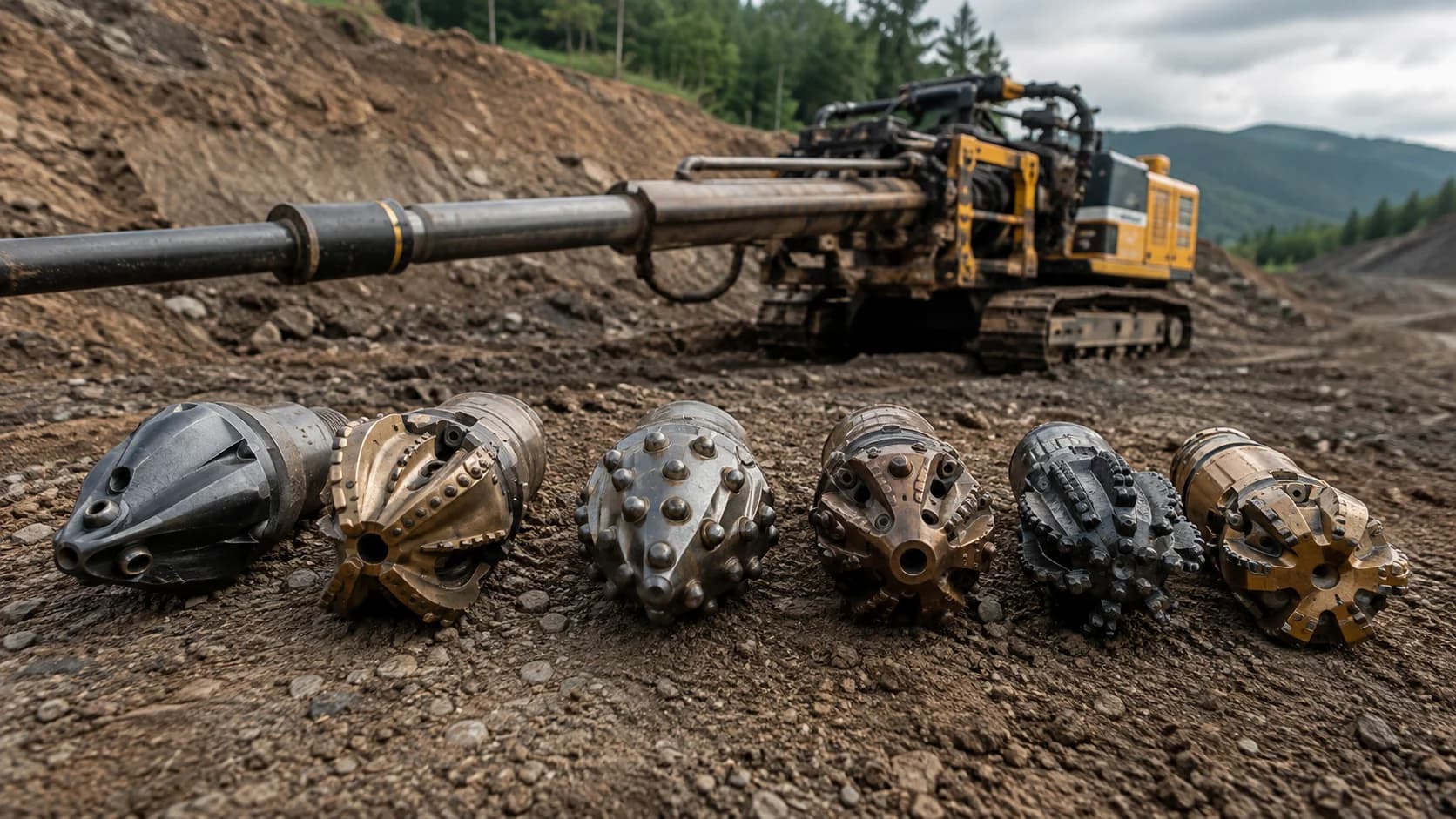
The drill head and reamer are the components that physically interact with the formation during horizontal directional drilling. Their geometry determines how efficiently the rig converts thrust and torque into cutting, steering, soil displacement, and hole enlargement. There is no universal tool that performs best in every formation. Soft clay, loose sand, stiff soil, gravel, cobbles, weathered rock, and competent rock create different requirements for cutting structure, fluid ports, face shape, carbide protection, bearing design, and reamer profile. Tool selection should begin with the ground model and the planned bore geometry rather than with whatever tool is already on the trailer.
Start with a ground-condition model
Cohesive soils
Clay and silt can cut relatively easily but may become sticky, ball around the tool, or swell when exposed to water. Tooling needs open flow paths and enough agitation to keep cuttings moving instead of forming a packed mass around the drill head or reamer. In practice, this point matters because cohesive soils affects more than the immediate machine action. It influences crew timing, equipment loading, material behavior, and the amount of room available to recover if conditions begin to drift. A useful field procedure is to define the expected condition before production, assign who will monitor it, and establish what change will trigger a slowdown, inspection, adjustment, or stop. That approach reduces last-minute decisions and makes the process more repeatable from one shift or pour to the next.
Granular soils
Sand and fine gravel do not hold an unsupported hole as well as cohesive material. Fluid quality, bore pressure, and a reamer that promotes controlled mixing and cuttings transport become especially important because the formation can collapse or flow into the annulus. From a production standpoint, granular soils affects more than the immediate machine action. It influences crew timing, equipment loading, material behavior, and the amount of room available to recover if conditions begin to drift. A useful field procedure is to define the expected condition before production, assign who will monitor it, and establish what change will trigger a slowdown, inspection, adjustment, or stop. The crew should therefore verify the condition before work begins and continue watching it as equipment, weather, and material conditions change.
Rock and mixed formations
Rock strength, abrasiveness, fractures, cobbles, and transitions between soil and rock can generate impact and vibration. Rock tooling often requires carbide cutters, roller cones, motors, or specialized heads, while mixed ground may require a compromise that can survive abrupt changes. On an active jobsite, rock and mixed formations affects more than the immediate machine action. It influences crew timing, equipment loading, material behavior, and the amount of room available to recover if conditions begin to drift. A useful field procedure is to define the expected condition before production, assign who will monitor it, and establish what change will trigger a slowdown, inspection, adjustment, or stop. This is also useful for troubleshooting because changes in pressure, torque, output, or surface behavior can be tied to a specific operating condition.
Pilot heads for soft and medium soil
Slant-face steering heads
A slanted or asymmetric head is common in steerable soil drilling. The operator rotates for straighter advancement and uses the face orientation to bias the tool when steering. Face size and cutting edges should match rig thrust and soil resistance. For planning purposes, slant-face steering heads affects more than the immediate machine action. It influences crew timing, equipment loading, material behavior, and the amount of room available to recover if conditions begin to drift. A useful field procedure is to define the expected condition before production, assign who will monitor it, and establish what change will trigger a slowdown, inspection, adjustment, or stop. That approach reduces last-minute decisions and makes the process more repeatable from one shift or pour to the next.
Carbide protection
Even soil bores can contain gravel, construction debris, or isolated rock. Carbide teeth and wear inserts protect high-contact areas and help the head maintain its steering geometry instead of becoming rounded through abrasion. Operationally, carbide protection affects more than the immediate machine action. It influences crew timing, equipment loading, material behavior, and the amount of room available to recover if conditions begin to drift. A useful field procedure is to define the expected condition before production, assign who will monitor it, and establish what change will trigger a slowdown, inspection, adjustment, or stop. The crew should therefore verify the condition before work begins and continue watching it as equipment, weather, and material conditions change.
Fluid port placement
Nozzles should deliver fluid where it assists cutting, cooling, and material transport without washing an unnecessarily large cavity. Blocked or damaged ports can change steering behavior and increase torque or pressure unexpectedly. The practical consequence is that fluid port placement affects more than the immediate machine action. It influences crew timing, equipment loading, material behavior, and the amount of room available to recover if conditions begin to drift. A useful field procedure is to define the expected condition before production, assign who will monitor it, and establish what change will trigger a slowdown, inspection, adjustment, or stop. This is also useful for troubleshooting because changes in pressure, torque, output, or surface behavior can be tied to a specific operating condition.
Pilot tooling for hard ground and rock
Rock-capable steering systems
Hard formations may require mud motors, air systems, rock heads, or specialized steerable assemblies rather than a simple soil blade. The chosen system must be compatible with locating method, rig hydraulic capacity, fluid or air supply, and expected rock strength. In practice, this point matters because rock-capable steering systems affects more than the immediate machine action. It influences crew timing, equipment loading, material behavior, and the amount of room available to recover if conditions begin to drift. A useful field procedure is to define the expected condition before production, assign who will monitor it, and establish what change will trigger a slowdown, inspection, adjustment, or stop. That approach reduces last-minute decisions and makes the process more repeatable from one shift or pour to the next.
Cutter style matters
Buttons, picks, carbide inserts, polycrystalline diamond components, and roller cones attack rock differently. Abrasive formations demand wear resistance, while hard massive rock may require a cutting structure capable of generating concentrated contact stress. From a production standpoint, cutter style matters affects more than the immediate machine action. It influences crew timing, equipment loading, material behavior, and the amount of room available to recover if conditions begin to drift. A useful field procedure is to define the expected condition before production, assign who will monitor it, and establish what change will trigger a slowdown, inspection, adjustment, or stop. The crew should therefore verify the condition before work begins and continue watching it as equipment, weather, and material conditions change.
Stability through transitions
Entering or leaving a rock seam can deflect the tool because one side cuts differently from the other. A stable assembly, conservative advance rate, frequent locating, and appropriate steering corrections help protect the planned profile. On an active jobsite, stability through transitions affects more than the immediate machine action. It influences crew timing, equipment loading, material behavior, and the amount of room available to recover if conditions begin to drift. A useful field procedure is to define the expected condition before production, assign who will monitor it, and establish what change will trigger a slowdown, inspection, adjustment, or stop. This is also useful for troubleshooting because changes in pressure, torque, output, or surface behavior can be tied to a specific operating condition.
Reamers for cohesive soils
Fluted reamers
Fluted and winged tools cut clay and move spoil while leaving relatively open passages for fluid. Large open areas can reduce balling, although tool shape and fluid chemistry still need to prevent sticky soil from accumulating. For planning purposes, fluted reamers affects more than the immediate machine action. It influences crew timing, equipment loading, material behavior, and the amount of room available to recover if conditions begin to drift. A useful field procedure is to define the expected condition before production, assign who will monitor it, and establish what change will trigger a slowdown, inspection, adjustment, or stop. That approach reduces last-minute decisions and makes the process more repeatable from one shift or pour to the next.
Barrel-style tools
Barrel reamers can provide a more stable, gauge-controlled hole and help centralize the assembly. They may be useful when maintaining a defined diameter is important, but the design must still provide enough flow area for cuttings to move. Operationally, barrel-style tools affects more than the immediate machine action. It influences crew timing, equipment loading, material behavior, and the amount of room available to recover if conditions begin to drift. A useful field procedure is to define the expected condition before production, assign who will monitor it, and establish what change will trigger a slowdown, inspection, adjustment, or stop. The crew should therefore verify the condition before work begins and continue watching it as equipment, weather, and material conditions change.
Compaction versus removal
Some soil tools displace or compact formation instead of aggressively excavating it. Whether that is appropriate depends on soil type, pipe diameter, cover, nearby utilities, and the risk that displacement pressure could affect surrounding ground. The practical consequence is that compaction versus removal affects more than the immediate machine action. It influences crew timing, equipment loading, material behavior, and the amount of room available to recover if conditions begin to drift. A useful field procedure is to define the expected condition before production, assign who will monitor it, and establish what change will trigger a slowdown, inspection, adjustment, or stop. This is also useful for troubleshooting because changes in pressure, torque, output, or surface behavior can be tied to a specific operating condition.
Reamers for sand, gravel, and cobbles
Maintain circulation area
Granular material needs a clear annulus and sufficient fluid velocity to transport solids. A heavily obstructed reamer body can restrict returns, while an extremely open tool may not stabilize the hole. The design must balance cutting, mixing, and circulation. In practice, this point matters because maintain circulation area affects more than the immediate machine action. It influences crew timing, equipment loading, material behavior, and the amount of room available to recover if conditions begin to drift. A useful field procedure is to define the expected condition before production, assign who will monitor it, and establish what change will trigger a slowdown, inspection, adjustment, or stop. That approach reduces last-minute decisions and makes the process more repeatable from one shift or pour to the next.
Cobbles create impact loading
Loose rounded rock can roll, jam, or become trapped between the reamer and bore wall. Rugged cutters, protected fluid ports, and staged hole enlargement can reduce shock loads compared with attempting an aggressive one-pass enlargement. From a production standpoint, cobbles create impact loading affects more than the immediate machine action. It influences crew timing, equipment loading, material behavior, and the amount of room available to recover if conditions begin to drift. A useful field procedure is to define the expected condition before production, assign who will monitor it, and establish what change will trigger a slowdown, inspection, adjustment, or stop. The crew should therefore verify the condition before work begins and continue watching it as equipment, weather, and material conditions change.
Avoid oversized jumps
Increasing diameter too quickly multiplies cuttings volume and can destabilize weak ground. Progressive reaming gives the fluid system time to carry solids and gives the crew information about torque, pull force, and returns before the final diameter is attempted. On an active jobsite, avoid oversized jumps affects more than the immediate machine action. It influences crew timing, equipment loading, material behavior, and the amount of room available to recover if conditions begin to drift. A useful field procedure is to define the expected condition before production, assign who will monitor it, and establish what change will trigger a slowdown, inspection, adjustment, or stop. This is also useful for troubleshooting because changes in pressure, torque, output, or surface behavior can be tied to a specific operating condition.
Rock reamers and hole openers
Roller cone tools
Roller cones use rotating cutters with teeth or inserts to crush and chip rock. They can be effective in competent formations but require attention to bearing condition, cutter wear, debris circulation, and the relation between weight, rotation speed, and rock strength. For planning purposes, roller cone tools affects more than the immediate machine action. It influences crew timing, equipment loading, material behavior, and the amount of room available to recover if conditions begin to drift. A useful field procedure is to define the expected condition before production, assign who will monitor it, and establish what change will trigger a slowdown, inspection, adjustment, or stop. That approach reduces last-minute decisions and makes the process more repeatable from one shift or pour to the next.
Fixed-cutter rock reamers
Fixed carbide or other hard cutters scrape or shear the formation. They can be mechanically simpler than cone systems but may produce high torque in certain rock and require careful inspection because uneven wear changes cutting balance. Operationally, fixed-cutter rock reamers affects more than the immediate machine action. It influences crew timing, equipment loading, material behavior, and the amount of room available to recover if conditions begin to drift. A useful field procedure is to define the expected condition before production, assign who will monitor it, and establish what change will trigger a slowdown, inspection, adjustment, or stop. The crew should therefore verify the condition before work begins and continue watching it as equipment, weather, and material conditions change.
Gauge protection
The outer diameter experiences heavy abrasion and determines finished hole size. Replaceable wear pads, hardfacing, and gauge cutters help preserve diameter and protect the structural body of the reamer during long pulls. The practical consequence is that gauge protection affects more than the immediate machine action. It influences crew timing, equipment loading, material behavior, and the amount of room available to recover if conditions begin to drift. A useful field procedure is to define the expected condition before production, assign who will monitor it, and establish what change will trigger a slowdown, inspection, adjustment, or stop. This is also useful for troubleshooting because changes in pressure, torque, output, or surface behavior can be tied to a specific operating condition.
Sizing and staging the ream
Product diameter and annular clearance
The final bore needs enough clearance for drilling fluid and product movement without creating an unnecessarily large unstable hole. Required overcut varies with product type, soil, alignment, and contractor procedure. In practice, this point matters because product diameter and annular clearance affects more than the immediate machine action. It influences crew timing, equipment loading, material behavior, and the amount of room available to recover if conditions begin to drift. A useful field procedure is to define the expected condition before production, assign who will monitor it, and establish what change will trigger a slowdown, inspection, adjustment, or stop. That approach reduces last-minute decisions and makes the process more repeatable from one shift or pour to the next.
Choose intermediate diameters logically
Large final holes are often created through several passes. Each step should remove a manageable amount of material while keeping torque and pull force within the rig and tooling limits. A smooth size progression is usually easier on the bore and equipment. From a production standpoint, choose intermediate diameters logically affects more than the immediate machine action. It influences crew timing, equipment loading, material behavior, and the amount of room available to recover if conditions begin to drift. A useful field procedure is to define the expected condition before production, assign who will monitor it, and establish what change will trigger a slowdown, inspection, adjustment, or stop. The crew should therefore verify the condition before work begins and continue watching it as equipment, weather, and material conditions change.
Match the rig to the tool
A large reamer that requires more torque and pullback than the rig can provide will not improve productivity. Tool size, drill rod connection, swivel capacity, and reamer strength must fit the machine's realistic operating envelope. On an active jobsite, match the rig to the tool affects more than the immediate machine action. It influences crew timing, equipment loading, material behavior, and the amount of room available to recover if conditions begin to drift. A useful field procedure is to define the expected condition before production, assign who will monitor it, and establish what change will trigger a slowdown, inspection, adjustment, or stop. This is also useful for troubleshooting because changes in pressure, torque, output, or surface behavior can be tied to a specific operating condition.
Inspecting and maintaining tooling
Wear tells a story
Uneven tooth wear, polished areas, damaged nozzles, bent blades, loose cones, cracked welds, or eroded body sections can reveal poor alignment, inadequate fluid, abrasive ground, or excessive operating load. Inspection should be part of every tool change. For planning purposes, wear tells a story affects more than the immediate machine action. It influences crew timing, equipment loading, material behavior, and the amount of room available to recover if conditions begin to drift. A useful field procedure is to define the expected condition before production, assign who will monitor it, and establish what change will trigger a slowdown, inspection, adjustment, or stop. That approach reduces last-minute decisions and makes the process more repeatable from one shift or pour to the next.
Replace wear parts before structural damage
Carbide teeth, cutters, nozzles, wear pads, and hardfacing are intended to protect more expensive components. Delaying replacement can allow the reamer body or drill head to wear beyond economical repair. Operationally, replace wear parts before structural damage affects more than the immediate machine action. It influences crew timing, equipment loading, material behavior, and the amount of room available to recover if conditions begin to drift. A useful field procedure is to define the expected condition before production, assign who will monitor it, and establish what change will trigger a slowdown, inspection, adjustment, or stop. The crew should therefore verify the condition before work begins and continue watching it as equipment, weather, and material conditions change.
Track performance by formation
Recording penetration rate, pressure, torque, pull force, fluid rate, and wear for each geology gives the contractor a practical tool-selection database. Over time, this is more valuable than relying only on catalog descriptions. The practical consequence is that track performance by formation affects more than the immediate machine action. It influences crew timing, equipment loading, material behavior, and the amount of room available to recover if conditions begin to drift. A useful field procedure is to define the expected condition before production, assign who will monitor it, and establish what change will trigger a slowdown, inspection, adjustment, or stop. This is also useful for troubleshooting because changes in pressure, torque, output, or surface behavior can be tied to a specific operating condition.
Practical planning checklist
Before the work starts, convert the main technical ideas into a short field plan. Review the equipment manual and project requirements, confirm site access and support conditions, verify the material or drilling program, identify the people authorized to control the operation, and agree on communication signals. Confirm that inspection, maintenance, cleanup, environmental controls, and emergency access are not being left until the end of the shift. A checklist is most useful when it is specific to the actual machine, ground, mix, crew, and layout rather than copied without adaptation from a different project.
- Verify equipment configuration, wear condition, required tooling or delivery components, and all manufacturer limitations that apply to the planned work.
- Confirm that the work area, access route, traffic plan, supporting ground, and exclusion zones are ready before production equipment is committed.
- Review material properties or ground conditions and confirm that the selected operating method matches what the crew expects to encounter.
- Establish a realistic production rate that downstream operations can accept without creating long stops, uncontrolled queues, or rushed workmanship.
- Assign one clear communication chain for start, stop, speed changes, abnormal conditions, and emergency action.
- Prepare the cleanup, waste, washout, drilling-fluid, spoil, or residual-material plan before the operation begins.
- Record unusual pressure, torque, output, wear, delays, or quality observations so the next similar job can be planned with better information.
Final guidance
HDD tooling should be selected from the ground outward. Cohesive soil needs anti-balling and cuttings flow, granular ground needs stable circulation, cobbles demand impact resistance, and rock requires cutting structures suited to strength and abrasiveness. Pilot head, reamer, fluid system, rod connection, and rig capacity must function as one package. The most productive tool is not necessarily the most aggressive tool; it is the one that maintains steerability, preserves the bore, controls loads, and reaches the required diameter with predictable wear.
Get More Expert Guides & Updates
Subscribe for Machinery.org guide updates and product learning content.