
Verified guide word count: 3,424 words
Introduction
A durable gravel road is a drainage structure as much as a driving surface, and the motor grader is the primary machine used to create and restore that structure.
The grader rebuilds crown, cuts high spots, fills wheel paths, recovers aggregate from shoulders, removes washboarding, spreads new gravel, and shapes ditches and shoulders so water can leave the road.
Routine grading that only smooths the top can make a road look better for a short time while leaving the causes of potholes and rutting untouched.
This guide focuses on building and maintaining a gravel road so the result lasts longer between maintenance cycles.
Reading the Road Before Grading
Inspect the road for potholes, washboarding, ruts, edge drop-off, high shoulders, soft spots, exposed stones, dust, loose aggregate, blocked ditches, and areas where water ponds. In practice, crews should verify this condition under the actual job environment rather than relying only on a display or a previous setting. Small changes in material, temperature, wear, or machine position can change the result, so measured checks and consistent observation are important.
Observe where vehicles accelerate, brake, climb, or turn because these areas often develop repeated corrugation and loose material. This point also affects productivity because the machine works best when the surrounding process is stable. When the condition begins to drift, the operator should identify the source, make one logical correction, and allow enough operating time to judge whether the correction worked.
Determine whether a defect is limited to the wearing course or whether deeper subgrade movement is causing the surface to fail. From a quality-control perspective, the result should be checked repeatedly at planned intervals instead of only after a visible defect appears. A sequence of measurements reveals trends early and gives supervisors time to correct the process before a long section or a large volume of material is affected.
Very dry material may separate and create dust during grading, while saturated material can smear, pump, and lose structure under the grader. Maintenance and operation are connected here. Wear, looseness, buildup, damaged sensors, or restricted flow can force the operator to compensate with controls, but compensation rarely produces the same consistency as restoring the component to proper condition.
Maintenance should begin with a diagnosis so the operator knows whether the road needs light reshaping, scarification, new aggregate, drainage work, or structural repair. The safest and most efficient approach is to include this item in the pre-shift plan and to define who is responsible for checking it during production. Clear communication between the main machine operator, ground crew, trucks, quality personnel, and support equipment reduces delays and prevents conflicting adjustments.
For a motor grader on gravel roads crew, the practical objective in this area is repeatability. Record the starting condition, observe how the machine and material respond, and use measured results to decide whether another adjustment is necessary. This disciplined method reduces rework, makes troubleshooting faster, and produces a process that can be repeated by the next shift.
Understanding Crown and Drainage
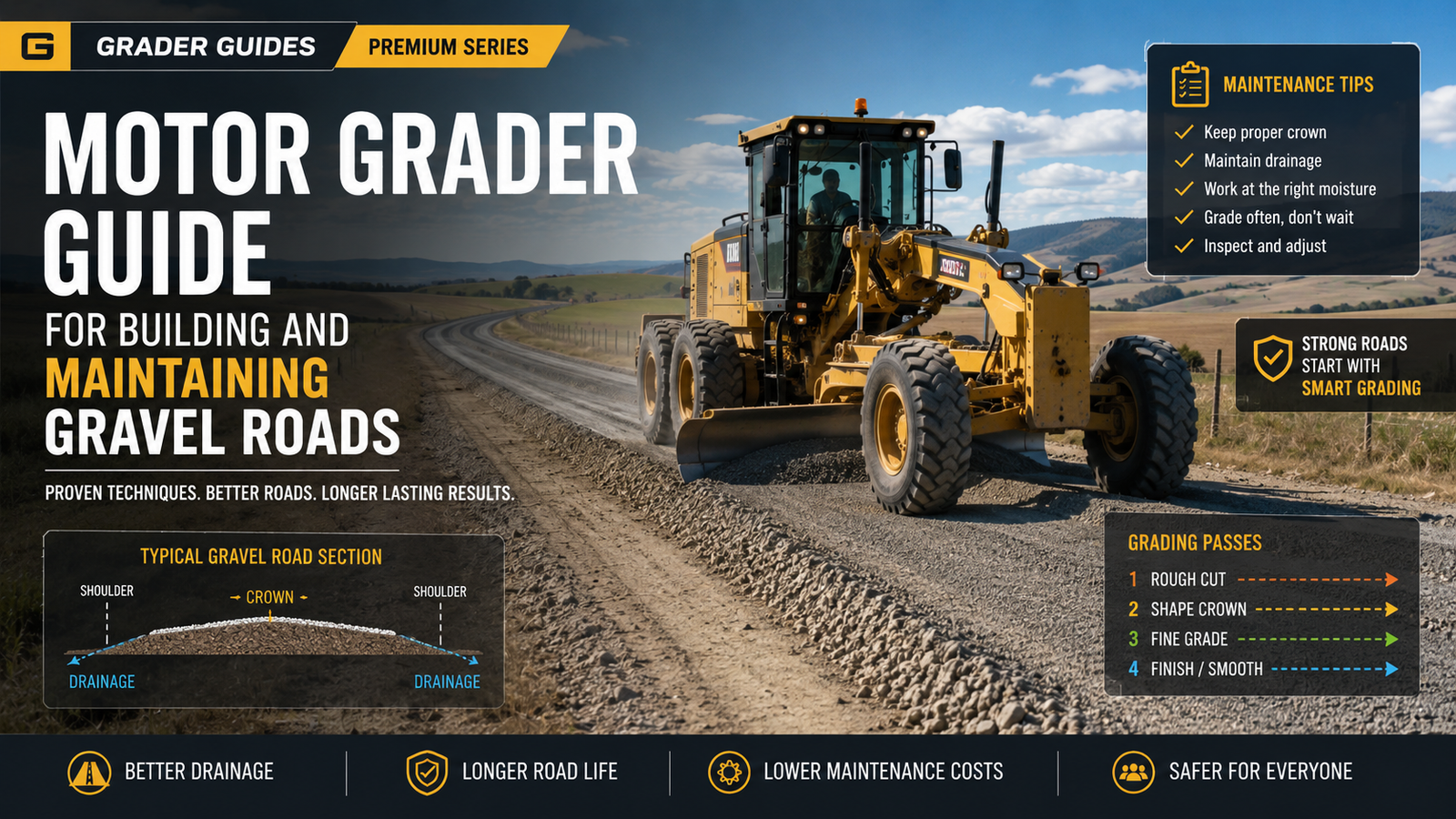
The crown or designed cross slope should move water from the travel lane toward the shoulders without creating a sharp center ridge or an uncomfortable driving surface. Experienced crews treat this as one variable in a larger system rather than an isolated setting. If performance changes, they compare material condition, machine speed, mechanical condition, and downstream capacity before assuming that one control must be adjusted.
Shoulders should be slightly lower than the road edge so runoff can reach side ditches instead of being trapped by a berm. In practice, crews should verify this condition under the actual job environment rather than relying only on a display or a previous setting. Small changes in material, temperature, wear, or machine position can change the result, so measured checks and consistent observation are important.
Ditches need a continuous fall toward an outlet; isolated deep pockets only collect water and can weaken the road edge. This point also affects productivity because the machine works best when the surrounding process is stable. When the condition begins to drift, the operator should identify the source, make one logical correction, and allow enough operating time to judge whether the correction worked.
Culvert inlets and outlets should remain open and should not be buried beneath windrows or shoulder material created by the grader. From a quality-control perspective, the result should be checked repeatedly at planned intervals instead of only after a visible defect appears. A sequence of measurements reveals trends early and gives supervisors time to correct the process before a long section or a large volume of material is affected.
The exact crown and ditch geometry should follow the road authority’s design or maintenance standard rather than a single universal slope. Maintenance and operation are connected here. Wear, looseness, buildup, damaged sensors, or restricted flow can force the operator to compensate with controls, but compensation rarely produces the same consistency as restoring the component to proper condition.
For a motor grader on gravel roads crew, the practical objective in this area is repeatability. Record the starting condition, observe how the machine and material respond, and use measured results to decide whether another adjustment is necessary. This disciplined method reduces rework, makes troubleshooting faster, and produces a process that can be repeated by the next shift.
Recovering Shoulder Material
Traffic and previous grading often push valuable aggregate toward the road edge, where vegetation and fines create a high shoulder. The safest and most efficient approach is to include this item in the pre-shift plan and to define who is responsible for checking it during production. Clear communication between the main machine operator, ground crew, trucks, quality personnel, and support equipment reduces delays and prevents conflicting adjustments.
The grader can cut and pull suitable shoulder material back toward the center using side shift, moldboard angle, and a controlled windrow. Experienced crews treat this as one variable in a larger system rather than an isolated setting. If performance changes, they compare material condition, machine speed, mechanical condition, and downstream capacity before assuming that one control must be adjusted.
Grass, topsoil, saturated ditch sediment, and organic debris should not be mixed into the wearing course simply because they are located near recoverable gravel. In practice, crews should verify this condition under the actual job environment rather than relying only on a display or a previous setting. Small changes in material, temperature, wear, or machine position can change the result, so measured checks and consistent observation are important.
After recovery, the shoulder should be reshaped to restore drainage rather than leaving a trench or ridge that channels water along the pavement edge. This point also affects productivity because the machine works best when the surrounding process is stable. When the condition begins to drift, the operator should identify the source, make one logical correction, and allow enough operating time to judge whether the correction worked.
Recovering existing aggregate can reduce the amount of imported gravel required while also correcting one of the main causes of water trapped in wheel paths. From a quality-control perspective, the result should be checked repeatedly at planned intervals instead of only after a visible defect appears. A sequence of measurements reveals trends early and gives supervisors time to correct the process before a long section or a large volume of material is affected.
For a motor grader on gravel roads crew, the practical objective in this area is repeatability. Record the starting condition, observe how the machine and material respond, and use measured results to decide whether another adjustment is necessary. This disciplined method reduces rework, makes troubleshooting faster, and produces a process that can be repeated by the next shift.
Repairing Washboarding
Washboarding appears as closely spaced ridges that commonly develop where vehicles brake, accelerate, climb, or travel on loose poorly bound aggregate. Maintenance and operation are connected here. Wear, looseness, buildup, damaged sensors, or restricted flow can force the operator to compensate with controls, but compensation rarely produces the same consistency as restoring the component to proper condition.
Shaving only the tops of the corrugations provides short-term smoothness because the low portions of the pattern remain in the road. The safest and most efficient approach is to include this item in the pre-shift plan and to define who is responsible for checking it during production. Clear communication between the main machine operator, ground crew, trucks, quality personnel, and support equipment reduces delays and prevents conflicting adjustments.
A more durable repair cuts or scarifies to the bottom of the corrugation, remixes the loosened material, restores moisture if necessary, reshapes, and compacts. Experienced crews treat this as one variable in a larger system rather than an isolated setting. If performance changes, they compare material condition, machine speed, mechanical condition, and downstream capacity before assuming that one control must be adjusted.
Travel speed should be slow enough that the grader does not bounce in rhythm with the existing washboard pattern. In practice, crews should verify this condition under the actual job environment rather than relying only on a display or a previous setting. Small changes in material, temperature, wear, or machine position can change the result, so measured checks and consistent observation are important.
If the same location corrugates repeatedly, investigate aggregate gradation, moisture, traffic action, and road geometry instead of increasing grading frequency indefinitely. This point also affects productivity because the machine works best when the surrounding process is stable. When the condition begins to drift, the operator should identify the source, make one logical correction, and allow enough operating time to judge whether the correction worked.
For a motor grader on gravel roads crew, the practical objective in this area is repeatability. Record the starting condition, observe how the machine and material respond, and use measured results to decide whether another adjustment is necessary. This disciplined method reduces rework, makes troubleshooting faster, and produces a process that can be repeated by the next shift.
Repairing Potholes and Ruts
A pothole often collects water and grows as traffic pumps wet material out of the depression, so filling the top with loose gravel rarely lasts. From a quality-control perspective, the result should be checked repeatedly at planned intervals instead of only after a visible defect appears. A sequence of measurements reveals trends early and gives supervisors time to correct the process before a long section or a large volume of material is affected.
The defect should be cut or scarified to its full depth so the edges are broken and the repaired material can be blended and compacted as one layer. Maintenance and operation are connected here. Wear, looseness, buildup, damaged sensors, or restricted flow can force the operator to compensate with controls, but compensation rarely produces the same consistency as restoring the component to proper condition.
Shallow ruts can often be corrected by redistributing wearing-course aggregate and rebuilding cross slope. The safest and most efficient approach is to include this item in the pre-shift plan and to define who is responsible for checking it during production. Clear communication between the main machine operator, ground crew, trucks, quality personnel, and support equipment reduces delays and prevents conflicting adjustments.
Deep ruts accompanied by pumping, saturated fines, or soft subgrade indicate a structural problem that may require drainage improvement, stabilization, undercutting, or stronger base material. Experienced crews treat this as one variable in a larger system rather than an isolated setting. If performance changes, they compare material condition, machine speed, mechanical condition, and downstream capacity before assuming that one control must be adjusted.
Operators should report recurring deep failures rather than repeatedly dragging surface gravel into them and hiding the evidence. In practice, crews should verify this condition under the actual job environment rather than relying only on a display or a previous setting. Small changes in material, temperature, wear, or machine position can change the result, so measured checks and consistent observation are important.
For a motor grader on gravel roads crew, the practical objective in this area is repeatability. Record the starting condition, observe how the machine and material respond, and use measured results to decide whether another adjustment is necessary. This disciplined method reduces rework, makes troubleshooting faster, and produces a process that can be repeated by the next shift.
Adding and Spreading New Gravel
Trucks should place new aggregate in controlled windrows or spaced loads that the grader can spread without making unnecessary heavy passes. This point also affects productivity because the machine works best when the surrounding process is stable. When the condition begins to drift, the operator should identify the source, make one logical correction, and allow enough operating time to judge whether the correction worked.
The first passes should distribute material near its final location, followed by blending, moisture conditioning, shaping, compaction, and final trimming. From a quality-control perspective, the result should be checked repeatedly at planned intervals instead of only after a visible defect appears. A sequence of measurements reveals trends early and gives supervisors time to correct the process before a long section or a large volume of material is affected.
Water improves grading and compaction when the existing material is too dry, but excessive water can create pumping and rutting. Maintenance and operation are connected here. Wear, looseness, buildup, damaged sensors, or restricted flow can force the operator to compensate with controls, but compensation rarely produces the same consistency as restoring the component to proper condition.
Several thinner spreading passes usually create a more uniform wearing course than trying to carry and level a very deep pile in one pass. The safest and most efficient approach is to include this item in the pre-shift plan and to define who is responsible for checking it during production. Clear communication between the main machine operator, ground crew, trucks, quality personnel, and support equipment reduces delays and prevents conflicting adjustments.
Compaction should follow before traffic scatters the material, using roller equipment and a pattern suited to the aggregate and layer thickness. Experienced crews treat this as one variable in a larger system rather than an isolated setting. If performance changes, they compare material condition, machine speed, mechanical condition, and downstream capacity before assuming that one control must be adjusted.
For a motor grader on gravel roads crew, the practical objective in this area is repeatability. Record the starting condition, observe how the machine and material respond, and use measured results to decide whether another adjustment is necessary. This disciplined method reduces rework, makes troubleshooting faster, and produces a process that can be repeated by the next shift.
Ditch, Shoulder, and Edge Work
Ditch cleaning often requires large blade angle, side shift, articulation, and wheel lean, which also increases side draft and makes tire support more important. In practice, crews should verify this condition under the actual job environment rather than relying only on a display or a previous setting. Small changes in material, temperature, wear, or machine position can change the result, so measured checks and consistent observation are important.
Keep ditch cuts light enough that the grader remains stable and does not slide toward a soft edge or steep side slope. This point also affects productivity because the machine works best when the surrounding process is stable. When the condition begins to drift, the operator should identify the source, make one logical correction, and allow enough operating time to judge whether the correction worked.
Material removed from ditches should be evaluated before it is placed on the roadway because wet organic fines can weaken the wearing course. From a quality-control perspective, the result should be checked repeatedly at planned intervals instead of only after a visible defect appears. A sequence of measurements reveals trends early and gives supervisors time to correct the process before a long section or a large volume of material is affected.
The finished ditch should carry water continuously to an outlet, and the shoulder should not contain ridges that send runoff back into the lane. Maintenance and operation are connected here. Wear, looseness, buildup, damaged sensors, or restricted flow can force the operator to compensate with controls, but compensation rarely produces the same consistency as restoring the component to proper condition.
Edge work should protect culverts, signs, utilities, driveways, and private access points while still restoring the drainage profile. The safest and most efficient approach is to include this item in the pre-shift plan and to define who is responsible for checking it during production. Clear communication between the main machine operator, ground crew, trucks, quality personnel, and support equipment reduces delays and prevents conflicting adjustments.
For a motor grader on gravel roads crew, the practical objective in this area is repeatability. Record the starting condition, observe how the machine and material respond, and use measured results to decide whether another adjustment is necessary. This disciplined method reduces rework, makes troubleshooting faster, and produces a process that can be repeated by the next shift.
Pass Planning, Moisture, Compaction, and Records
Grading productivity comes from efficient pass planning rather than high travel speed, and the operator should decide where each windrow will move before beginning. Experienced crews treat this as one variable in a larger system rather than an isolated setting. If performance changes, they compare material condition, machine speed, mechanical condition, and downstream capacity before assuming that one control must be adjusted.
Rough cutting, material recovery, spreading, crown building, and fine finishing may require different blade angles and speeds, so one setup should not be used for every pass. In practice, crews should verify this condition under the actual job environment rather than relying only on a display or a previous setting. Small changes in material, temperature, wear, or machine position can change the result, so measured checks and consistent observation are important.
Slightly moist aggregate usually cuts, blends, and compacts better than extremely dry or saturated material. This point also affects productivity because the machine works best when the surrounding process is stable. When the condition begins to drift, the operator should identify the source, make one logical correction, and allow enough operating time to judge whether the correction worked.
Maintenance records should identify recurring potholes, washboard zones, culvert problems, and locations where extra aggregate is repeatedly required. From a quality-control perspective, the result should be checked repeatedly at planned intervals instead of only after a visible defect appears. A sequence of measurements reveals trends early and gives supervisors time to correct the process before a long section or a large volume of material is affected.
The best performance measure is the time until the road needs major maintenance again, not simply the number of kilometers a grader can cover in one day. Maintenance and operation are connected here. Wear, looseness, buildup, damaged sensors, or restricted flow can force the operator to compensate with controls, but compensation rarely produces the same consistency as restoring the component to proper condition.
For a motor grader on gravel roads crew, the practical objective in this area is repeatability. Record the starting condition, observe how the machine and material respond, and use measured results to decide whether another adjustment is necessary. This disciplined method reduces rework, makes troubleshooting faster, and produces a process that can be repeated by the next shift.
Field Operating Checklist
Before work begins, review the job objective, material condition, planned production rate, machine configuration, inspection requirements, traffic or site movement, and the conditions that require the motor grader on gravel roads to stop. Confirm that high-wear components, sensors, guards, warning systems, fluid levels, and support equipment are ready. During production, watch for changes in sound, vibration, material flow, machine load, surface condition, and the distance between the main machine and support equipment. Measure quality early enough to identify trends. Record major setting changes, delays, unusual material, weather changes, and maintenance issues. At the end of the shift, clean and inspect the machine according to the manufacturer’s procedure, report defects while they are fresh in memory, and compare planned production with actual production. A short end-of-shift review helps the next crew begin from known conditions rather than repeating the same troubleshooting process.
Conclusion
The motor grader on gravel roads performs best when operators understand the physical process rather than treating the controls as isolated switches. Good production comes from correct setup, stable material flow, reasonable machine speed, mechanical condition, frequent measurement, and coordinated support equipment. The machine should be operated within the manufacturer’s requirements and the project specification, with changes made deliberately and verified from the result. When these habits become routine, quality becomes more consistent, wear is easier to manage, and the crew spends less time correcting preventable defects.
Get More Expert Guides & Updates
Subscribe for Machinery.org guide updates and product learning content.