

Buying heavy equipment is one of the largest financial decisions many contractors, rental businesses, farmers, and property operators make. The choice between new and used machinery affects cash flow, downtime risk, technology access, financing, warranty protection, and resale value. A new machine offers predictability and factory support, while a used machine can reduce the entry cost and place productive equipment into service quickly. Neither option is automatically better. The correct choice depends on the work, the business, and the buyer’s ability to evaluate risk.
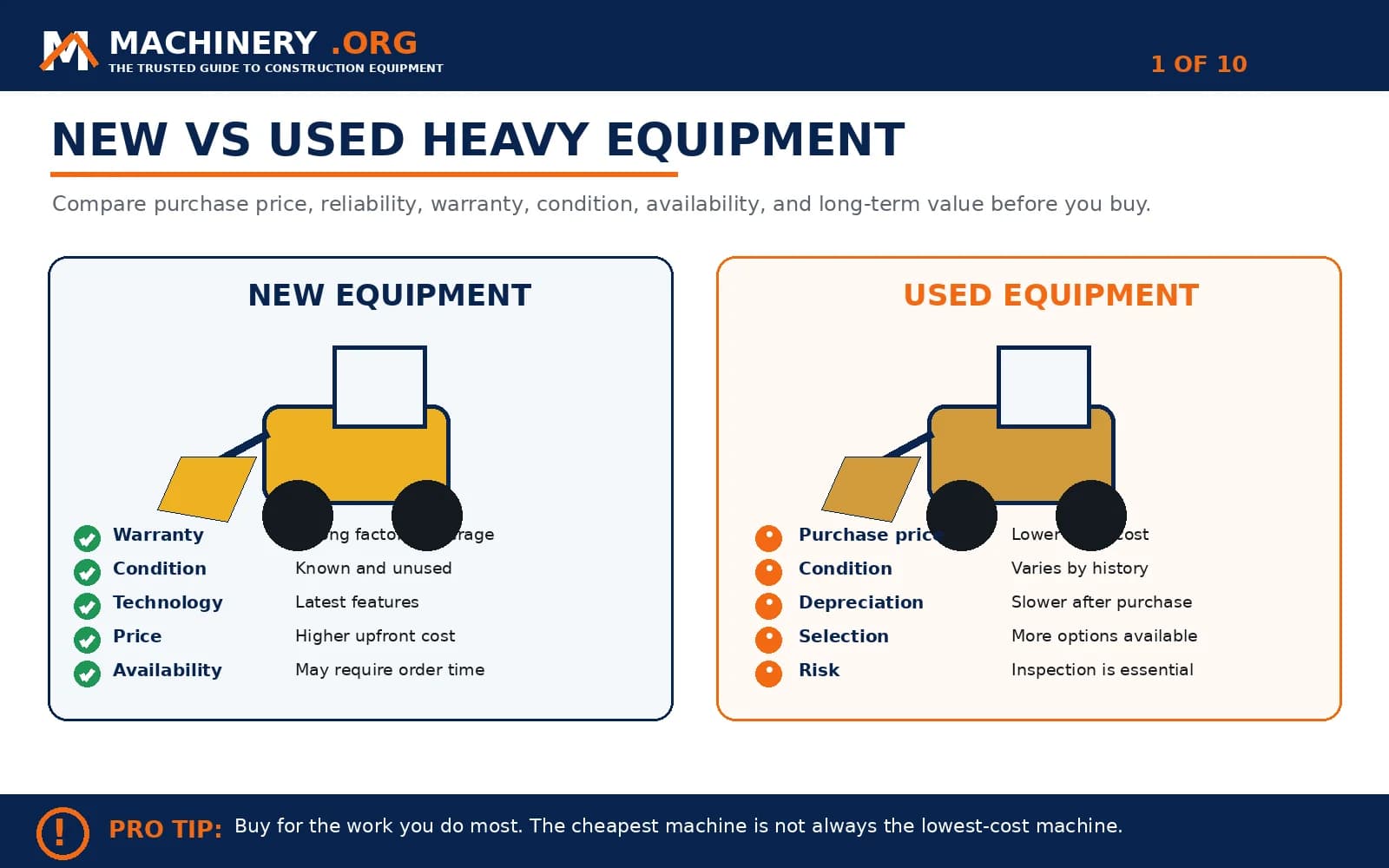
New equipment is attractive because its history is known. The buyer receives a machine with no prior operator damage, no hidden repair record, and usually a manufacturer warranty. Controls, safety systems, telematics, emissions technology, and operator comfort are generally current. The trade-off is a higher purchase price, greater early depreciation, and sometimes a wait for production or delivery.
Used equipment attracts buyers because the acquisition price can be significantly lower. The first owner has already absorbed part of the depreciation, and the market offers a broad range of sizes, models, and price levels. However, the used buyer must investigate condition, hours, maintenance, component life, and repair quality. A used machine is not cheap when it requires immediate hydraulic work, undercarriage replacement, or repeated downtime.

Figure 11.1. Custom Machinery.org infographic for New vs Used Heavy Equipment.
Why new equipment makes sense
New equipment is strongest when uptime is essential, the machine will work many hours, the business needs a predictable ownership plan, or the latest technology materially improves safety and productivity. Warranty coverage can protect the early years of ownership, while dealer support and parts planning are usually easier. New equipment is also easier to finance in many cases because the asset value and condition are clear.
Why used equipment makes sense
Used equipment is strongest when capital is limited, the machine will work fewer hours, the buyer can inspect and maintain it, or the business needs a specialized machine for occasional work. A carefully selected used machine can deliver excellent return because the purchase price is lower and depreciation is slower. The buyer must be willing to study service records, test the machine, and reserve money for repairs.
Depreciation and resale
New machinery normally loses value fastest in the early ownership period. That does not make it a bad purchase, but the buyer should understand how long the machine will be kept and how heavily it will be used. Used machinery may hold value more steadily after the early depreciation has already occurred. Condition, brand support, model reputation, and local demand all affect resale.
Warranty and support
Warranty protection reduces uncertainty, especially for engines, hydraulics, electronics, and emissions systems. Used machines may have no warranty or only limited dealer coverage. Support quality can matter as much as machine condition. A good dealer with parts and technicians can make a used machine easier to own than a new machine from a weak support network.
Technology and complexity
New equipment often includes better displays, telematics, safety cameras, fuel-management systems, and operator aids. These features can improve productivity, but they may also increase diagnostic complexity. Older used equipment may be simpler to repair and familiar to technicians, though it may lack modern safety and efficiency improvements.
How to make the decision
Start with the primary workload and expected annual hours. Estimate what downtime would cost. Compare financing payments, warranty coverage, maintenance, insurance, fuel, and likely resale. Then evaluate your organization’s repair capability. A business with strong technicians and flexible scheduling may manage used equipment very well. A business that depends on one critical machine every day may benefit from the predictability of new equipment.
Buying checklist
Define the job and required capacity before shopping.
Estimate annual hours and the financial cost of downtime.
Compare total ownership cost, not price alone.
For used equipment, inspect cold and review service records.
For new equipment, compare warranty details and dealer support.
Keep a repair reserve for any used purchase.

Figure 11.2. Custom Machinery.org decision or checklist graphic for New vs Used Heavy Equipment.
Cash flow, utilization, and business timing
Cash flow changes the practical answer. A new machine may preserve working capital when attractive financing spreads payments over productive years, but it can also create a fixed monthly obligation that remains during slow periods. A used machine may require more cash upfront or a larger repair reserve, yet it can reduce the total amount financed. Buyers should model both the monthly payment and the worst realistic repair event. A decision that looks comfortable in an average month may become difficult during seasonal downtime.
Utilization should guide the level of risk the business accepts. A machine expected to work forty hours every week on committed contracts must deliver dependable uptime. Warranty support, parts availability, replacement-machine access, and dealer response become financially important. A machine used for occasional property work or as a backup can tolerate more age and repair uncertainty. The same used loader may be a poor primary production machine but an excellent secondary unit.
Timing also matters. When work is already secured and a delayed machine would cost revenue, an available used unit can create value immediately. When the business can plan ahead and intends to keep the machine for many years, ordering a correctly configured new machine may be smarter. The purchase should solve an operational need at the right moment rather than simply satisfy a preference for newness or a desire to find the lowest advertised price.
Frequently Asked Questions
Is used equipment always more affordable?
It has a lower purchase price in many cases, but repairs, transport, and downtime can make total ownership more expensive.
When is new equipment worth the premium?
When uptime, warranty, technology, and predictable long-term use create measurable business value.
How old is too old for used equipment?
Age alone is not the answer. Condition, parts availability, hours, maintenance history, and the intended workload are more important.
Key Takeaway
The best choice is the machine that supports the business with acceptable risk. Buy new for predictability and support; buy used for value when inspection and maintenance capability are strong.
Get More Expert Guides & Updates
Subscribe for Machinery.org guide updates and product learning content.