

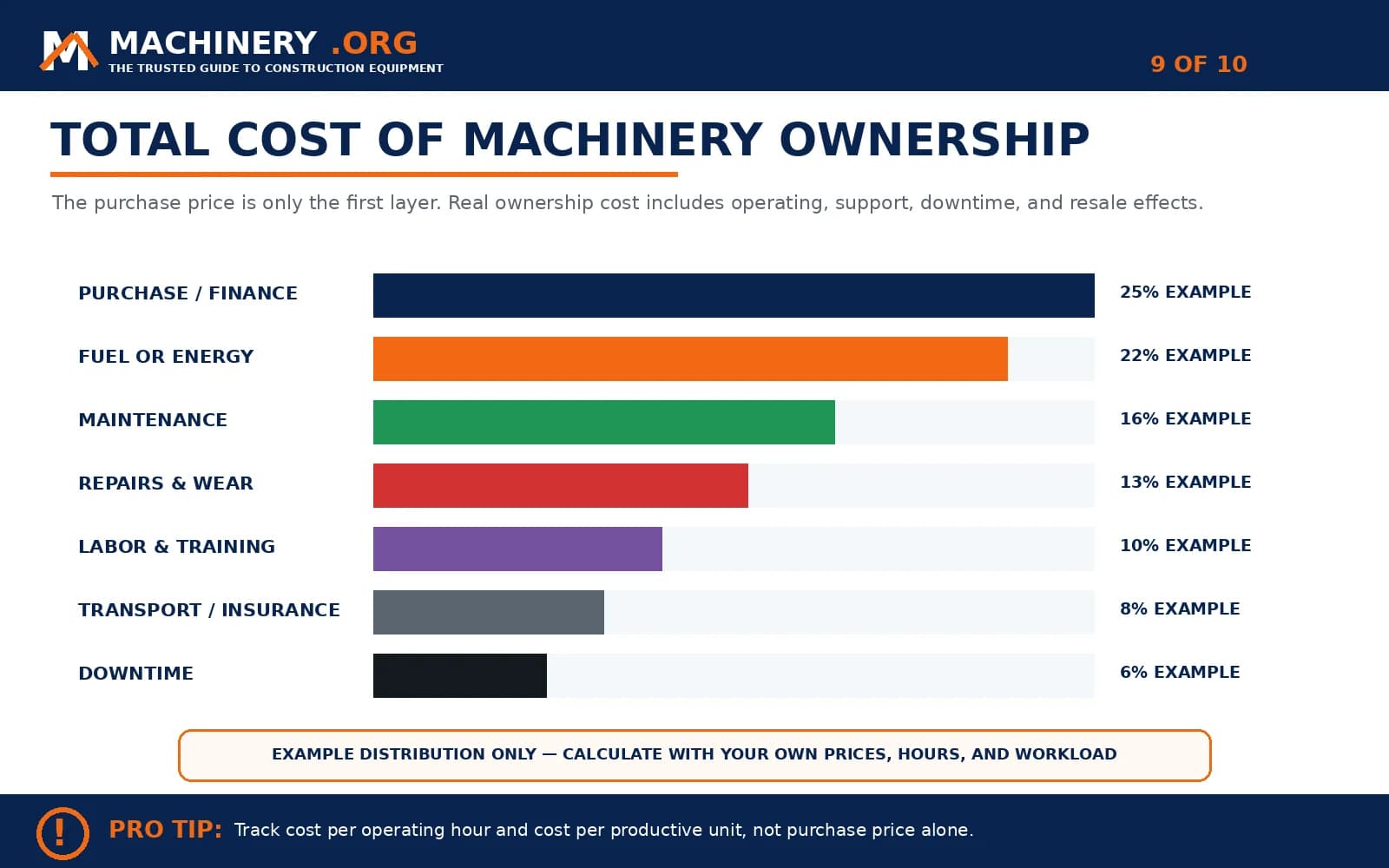
The purchase price is the most visible machinery cost, but it is rarely the largest decision factor over the full life of the asset. Total cost of ownership, often called TCO, combines every meaningful cost required to acquire, operate, support, and eventually sell the machine. Businesses that understand TCO make better buying decisions, set more accurate job rates, plan maintenance more effectively, and identify machines that look inexpensive but cost too much to keep productive.
A practical ownership calculation includes acquisition and financing, taxes and delivery, fuel or energy, routine maintenance, repairs, wear parts, attachments, operator labor, training, insurance, storage, transport, downtime, and resale value. Some costs are easy to track from invoices. Others, especially downtime and lost production, require estimates. The calculation does not need to be perfect to be useful. A consistent model is far better than comparing purchase price alone.
TCO should be measured over time and in relation to output. Cost per operating hour is a useful baseline. Cost per ton moved, cubic yard excavated, pallet handled, acre cleared, or job completed can be even more meaningful because it connects machine cost to business production.

Figure 15.1. Custom Machinery.org infographic for Total Cost of Machinery Ownership.
Acquisition and financing
Include purchase price, interest, fees, taxes, delivery, setup, and the initial attachment package. Down payment is a cash-flow event, while depreciation and finance cost affect the longer ownership model. Compare financing structures with the planned retention period.
Fuel or energy
Estimate consumption under real workload, not only the best published number. Engine load, idle time, operator behavior, terrain, attachment use, and travel all affect fuel. For electric machines, include energy price, charging efficiency, demand charges where applicable, and battery planning.
Maintenance and wear
Scheduled maintenance includes fluids, filters, inspections, grease, and service labor. Wear costs include tires, tracks, cutting edges, bucket teeth, forks, brakes, and other consumables. Preventive maintenance is not merely a cost; it is an investment that reduces failure and protects resale.
Repairs and component risk
Repair budgets should reflect machine age, hours, duty cycle, warranty status, and component condition. Used equipment may need a larger reserve. Engines, hydraulic pumps, final drives, transmissions, batteries, and undercarriages can create large one-time costs. Planning for them is more responsible than treating every repair as a surprise.
Labor, training, and productivity
Operator wages are part of production cost. Training can reduce fuel use, damage, and cycle time. A machine with a lower hourly ownership cost may still be more expensive per unit of output if it is too small or difficult to operate. Productivity belongs inside the TCO discussion.
Transport, insurance, and storage
Include trailers, permits, delivery charges, tie-down equipment, insurance, security, and storage. Heavy or wide machines may create recurring transport costs that a compact machine avoids. Site access and logistics can change the economics of a purchase.
Downtime cost
Downtime includes lost revenue, idle labor, missed deadlines, rental replacement, emergency transport, and customer impact. It is often the most underestimated cost. A reliable machine with strong parts support may justify a higher purchase price because it protects production.
Resale value
Expected resale or trade value reduces lifetime cost. Brand reputation, condition, service records, hours, configuration, and market demand influence resale. Good documentation and appearance can return real money at disposal time.
Build a simple TCO model
Choose an ownership period and expected annual hours.
Estimate every major cost category.
Subtract expected resale value.
Divide by lifetime hours for cost per hour.
Compare cost per productive unit for the actual job.
Update the model with real data each quarter or year.

Figure 15.2. Custom Machinery.org decision or checklist graphic for Total Cost of Machinery Ownership.
Use TCO to price work and choose fleet size
TCO becomes most useful when it informs job pricing. If a loader costs a calculated amount per productive hour, the business can build that cost into bids instead of relying on competitor prices or intuition. Add operator labor, mobilization, overhead, and profit to establish a sustainable rate. The same method shows whether a larger machine that completes the task faster has a lower cost per unit despite a higher hourly cost.
Fleet size can also be tested with TCO. An extra backup machine increases insurance, storage, and depreciation, but it may protect revenue during repairs. Renting can be cheaper for seasonal peaks, while ownership is stronger for steady utilization. Compare the cost of owning unused capacity with the cost and availability of rental or subcontract support.
Build a fleet cost discipline
Assign every machine a simple cost record. Track hours, fuel or energy, service, repair parts, technician labor, tire or undercarriage replacement, transport, and downtime. Review actual cost against the original estimate. Machines that repeatedly exceed the plan may need operating changes, preventive maintenance, reassignment, or replacement. Accurate records also strengthen resale value because buyers can see how the asset was maintained.
The model should support decisions rather than create false precision. Use ranges for uncertain repair and resale assumptions, and test best-case and worst-case scenarios. A transparent estimate with realistic assumptions is more valuable than an elaborate calculation built on numbers no one can defend.
Frequently Asked Questions
What costs are most often forgotten?
Downtime, transport, operator productivity, wear parts, and the cost of financing are frequently underestimated.
Is the lowest TCO machine always the cheapest to buy?
No. A higher-priced machine can have lower lifetime cost if it is more reliable, productive, efficient, and valuable at resale.
How often should TCO be updated?
At least annually, and more often for heavily used fleets or when fuel, finance, or repair conditions change significantly.
Key Takeaway
Total ownership cost turns equipment purchasing into a business decision. Count every meaningful lifecycle cost, measure productive output, and use actual fleet data to improve future purchases.
Get More Expert Guides & Updates
Subscribe for Machinery.org guide updates and product learning content.