
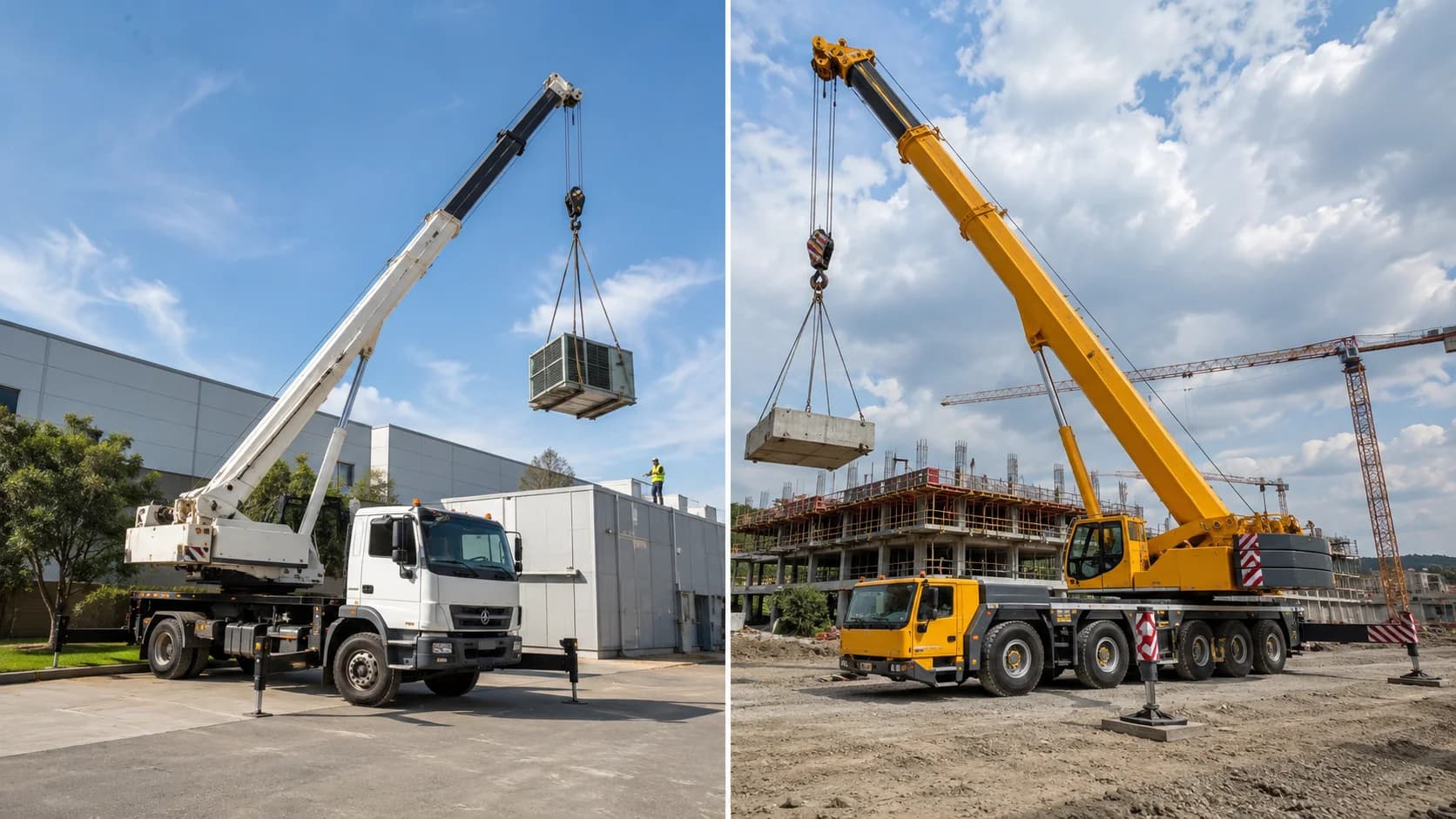
Truck-mounted cranes and purpose-built mobile cranes both bring lifting capability to a jobsite, but they are designed around different priorities. A truck-mounted crane places a crane or boom system on a road vehicle so one machine can transport itself, tools, and sometimes cargo efficiently between service calls. A dedicated mobile crane uses a carrier and upperworks engineered primarily around crane performance, counterweight, outrigger geometry, telescopic boom capability, and high lifting capacity. The categories overlap, and terminology varies by region, so selection should focus on actual equipment design and load charts rather than labels. This guide compares mobility, setup, capacity, payload, jobsite access, operating cost, and common applications to help contractors decide when a truck-mounted solution is enough and when a dedicated mobile crane is the better choice.
Use this guide with the exact manufacturer documentation. Capacities, configuration limits, inspection criteria, and operating procedures vary by crane model and jurisdiction.
What “Truck-Mounted Crane” Can Mean
Truck-mounted crane is a broad term that can include service-body cranes, knuckle-boom or articulating cranes, telescopic truck cranes, boom trucks, and other lifting systems installed on commercial truck chassis. Confirm this point against the exact crane data and the actual field condition before proceeding.
Some are designed primarily to load and unload their own cargo, while others perform construction lifts from outriggers and use dedicated crane controls and load charts. Confirm this point against the exact crane data and the actual field condition before proceeding.
Because configurations vary widely, the buyer should identify boom type, slew range, outrigger system, chart basis, control system, hook arrangement, and whether the truck has meaningful payload after the crane is installed. Confirm this point against the exact crane data and the actual field condition before proceeding.
A commercial truck chassis can simplify road service and daily transportation, but the crane installation must remain within axle, frame, stability, and manufacturer limits. Confirm this point against the exact crane data and the actual field condition before proceeding.
The name on the machine is less important than the rated chart and operational limitations for the exact truck-and-crane combination. Confirm this point against the exact crane data and the actual field condition before proceeding.
When uncertainty remains, conservative planning is more reliable than using every unit of theoretical capacity. Keep usable margin for normal variation in weight, radius, and positioning.
Purpose-Built Mobile Crane Design
Dedicated mobile cranes use carriers designed around lifting, with structural frames, large outriggers, counterweight systems, boom supports, steering, suspension, and braking selected for crane duty. Confirm this point against the exact crane data and the actual field condition before proceeding.
All-terrain and rough-terrain cranes are examples of purpose-built mobile cranes, while truck cranes may use a road carrier with crane upperworks designed specifically for lifting. Confirm this point against the exact crane data and the actual field condition before proceeding.
These machines often offer larger capacities, longer booms, more sophisticated counterweight options, multi-part reeving, jibs, and control systems than lighter truck-mounted lifting equipment. Confirm this point against the exact crane data and the actual field condition before proceeding.
The additional capability usually comes with more setup space, higher purchase or rental cost, heavier transport logistics, and more specialized operating requirements. Confirm this point against the exact crane data and the actual field condition before proceeding.
A dedicated mobile crane is justified when the lift envelope, capacity margin, height, radius, or duty cycle exceeds what a smaller truck-mounted system can provide reliably. Confirm this point against the exact crane data and the actual field condition before proceeding.
After weather changes, relocation, or a configuration change, reconfirm the condition that controls the lift instead of assuming the earlier setup is still valid.
Mobility and Daily Productivity
Truck-mounted cranes can excel in utility, delivery, maintenance, roofing, sign work, material placement, and field service because the same vehicle can carry tools or materials and travel directly between jobs. Confirm this point against the exact crane data and the actual field condition before proceeding.
For many short-duration picks, fast road travel and compact setup can create more daily productivity than mobilizing a larger crane that has unused capacity. Confirm this point against the exact crane data and the actual field condition before proceeding.
Dedicated mobile cranes become more productive when one setup can complete many heavy or long-radius lifts, or when the crane must handle loads beyond the reach of common truck-mounted equipment. Confirm this point against the exact crane data and the actual field condition before proceeding.
Travel time, permit needs, counterweight trucks, crew size, rigging support, and the number of setups should be compared across the entire workday rather than only the lifting portion. Confirm this point against the exact crane data and the actual field condition before proceeding.
Jobsite productivity also depends on how quickly the machine can position, deploy supports, level, connect rigging, perform the lift, stow equipment, and clear the site. Confirm this point against the exact crane data and the actual field condition before proceeding.
A short handover record of configuration, key dimensions, support assumptions, rigging, and restrictions helps prevent the next shift from using an outdated plan.
Capacity, Radius, and Boom Reach
Smaller truck-mounted systems may have impressive close-in ratings but can lose capacity quickly as the boom extends or works over less favorable parts of the chassis. Confirm this point against the exact crane data and the actual field condition before proceeding.
Dedicated mobile cranes generally provide more robust charts across larger radii and boom lengths, but capacity still depends on counterweight, outrigger position, boom configuration, and swing direction where specified. Confirm this point against the exact crane data and the actual field condition before proceeding.
A comparison should start with the actual load, required hook height, working radius, lifting-point elevation, and obstruction geometry rather than with nominal crane tonnage. Confirm this point against the exact crane data and the actual field condition before proceeding.
Rigging weight, hook block, jibs, personnel platforms where allowed, and other accessories must be included when determining whether a crane has enough net capacity. Confirm this point against the exact crane data and the actual field condition before proceeding.
If the planned lift operates near the edge of a truck-mounted chart, moving to a larger dedicated crane can provide useful margin and reduce sensitivity to small changes in radius or load weight. Confirm this point against the exact crane data and the actual field condition before proceeding.
For example, a lift can change when the crane must be positioned farther away than planned. Recalculate the working condition rather than treating the extra radius as insignificant.
Setup Space, Outriggers, and Ground Loading
Both truck-mounted and mobile cranes may require outriggers, but support geometry and reaction loads vary widely, so pad size and ground assessment should match the specific machine. Confirm this point against the exact crane data and the actual field condition before proceeding.
A compact truck can sometimes work in a smaller footprint, yet bodywork, cargo, stabilizers, traffic lanes, and boom sweep may still create significant space requirements. Confirm this point against the exact crane data and the actual field condition before proceeding.
Large mobile cranes need more room for outriggers, counterweight, tail swing, boom overhang, and support trucks, but that footprint can be efficient if it prevents multiple relocations. Confirm this point against the exact crane data and the actual field condition before proceeding.
Street work requires traffic control, safe pedestrian routing, clearance from utilities, and confirmation that underground vaults, trenches, or utilities can support stabilizer reactions. Confirm this point against the exact crane data and the actual field condition before proceeding.
Before selecting either type, a scaled site plan should show the carrier position, support footprint, maximum working radius, load path, delivery vehicle position, and access for riggers. Confirm this point against the exact crane data and the actual field condition before proceeding.
On a congested project, the limiting condition may occur later in the swing or at the set point, so check the complete lift envelope before mobilization.
Matching the Crane Type to the Application
Truck-mounted cranes are strong choices for distributed service work, material delivery, utility tasks, small equipment placement, building maintenance, and jobs where highway mobility is central to the business model. Confirm this point against the exact crane data and the actual field condition before proceeding.
Dedicated mobile cranes are generally better for structural steel, precast placement, mechanical equipment, industrial shutdowns, large roofing units, bridge work, and other lifts requiring substantial capacity or reach. Confirm this point against the exact crane data and the actual field condition before proceeding.
A contractor should compare total cost per completed lift, including travel, labor, permits, setup, standby time, rigging, support trucks, and the risk of needing a second mobilization if the crane proves too small. Confirm this point against the exact crane data and the actual field condition before proceeding.
Operator qualification, inspection programs, maintenance support, replacement parts, and local service availability can influence ownership decisions as much as the technical lift chart. Confirm this point against the exact crane data and the actual field condition before proceeding.
The best equipment is the smallest crane that can safely and efficiently complete the entire planned envelope with suitable margin and without creating excessive access or setup problems. Confirm this point against the exact crane data and the actual field condition before proceeding.
Marking the crane center, support locations, load path, and landing area before setup makes the assumptions visible to the entire lifting team.
Field Planning Checklist
Before the lift begins, convert the planning discussion into a short field checklist. A checklist does not replace judgment; it makes sure the agreed assumptions are visible and repeatable. The following items should be adapted to the exact crane, manufacturer instructions, project lift plan, and local requirements:
- Define the exact load and radius.
- Identify required hook height and boom clearance.
- Compare net chart capacity after deductions.
- Check whether the vehicle must also carry cargo.
- Measure setup and outrigger footprint.
- Assess road travel and permit requirements.
- Review ground and underground structures.
- Estimate number of daily setups.
- Compare support-truck and crew needs.
- Choose based on cost per completed lift, not purchase price alone.
A useful completion rule is that every unchecked item must have an owner and a reason. If the crew cannot confirm a load weight, support condition, configuration setting, or communication method, that uncertainty should be resolved before the lift proceeds. This is particularly important when a change appears small, because crane capacity and stability can be sensitive to geometry and support conditions.
Common Planning Mistakes to Avoid
- Using a crane’s advertised maximum capacity as though it applies at every radius and boom length. The better practice is to identify the assumption during planning, assign a clear verification method, and stop when the field condition no longer matches the basis of the lift.
- Assuming site ground is adequate because trucks or smaller equipment have already driven over it. The better practice is to identify the assumption during planning, assign a clear verification method, and stop when the field condition no longer matches the basis of the lift.
- Leaving rigging, hook, attachment, counterweight, support, or configuration details until the crane is already set up. The better practice is to identify the assumption during planning, assign a clear verification method, and stop when the field condition no longer matches the basis of the lift.
- Treating alarms, limiters, or electronic displays as replacements for a planned load chart and physical inspection. The better practice is to identify the assumption during planning, assign a clear verification method, and stop when the field condition no longer matches the basis of the lift.
- Continuing after site conditions, weather, crane level, access, or load geometry changes from the approved plan. The better practice is to identify the assumption during planning, assign a clear verification method, and stop when the field condition no longer matches the basis of the lift.
Frequently Asked Questions
Is a boom truck the same as a mobile crane?
It is a type of mobile lifting equipment, but designs vary. Many boom trucks use commercial truck chassis and are optimized for road mobility and service work, while purpose-built cranes may offer greater capacity and specialized crane carriers. Always confirm model-specific limits in the crane manual and project plan.
Which is faster to move between jobs?
Truck-mounted systems are often efficient for frequent road moves, particularly when the crane and service body travel as one unit. Larger mobile cranes may need additional counterweight or accessory trucks. Always confirm model-specific limits in the crane manual and project plan.
Can truck-mounted cranes lift construction materials onto roofs?
Many can, provided the load, radius, height, support configuration, and chart allow it. Long-radius rooftop placement can reduce capacity quickly, so the exact lift geometry must be checked. Always confirm model-specific limits in the crane manual and project plan.
When should I choose a larger mobile crane?
Choose it when the load chart, boom reach, hook height, duty cycle, wind area, or required capacity margin exceeds what the truck-mounted unit can provide comfortably. Always confirm model-specific limits in the crane manual and project plan.
Do truck-mounted cranes need outrigger pads?
Many do. The need and size depend on the support reactions and ground. A compact crane can still create high concentrated loads, so ground support should be planned for the specific machine. Always confirm model-specific limits in the crane manual and project plan.
Conclusion
Good crane work is built on disciplined preparation. The most useful habit is to keep connecting the planned lift back to measurable facts: actual load, actual radius, actual configuration, actual support condition, and actual clearance. When those facts remain inside the manufacturer limits and the crew understands the plan, the crane can be used efficiently without relying on guesswork. When one of those facts changes, the plan should change with it. Treat the load chart, setup information, rigging data, safety systems, and site conditions as one connected system, and involve qualified personnel whenever the lift is unusual, close to a limit, or affected by uncertain ground or structural conditions.
Get More Expert Guides & Updates
Subscribe for Machinery.org guide updates and product learning content.