
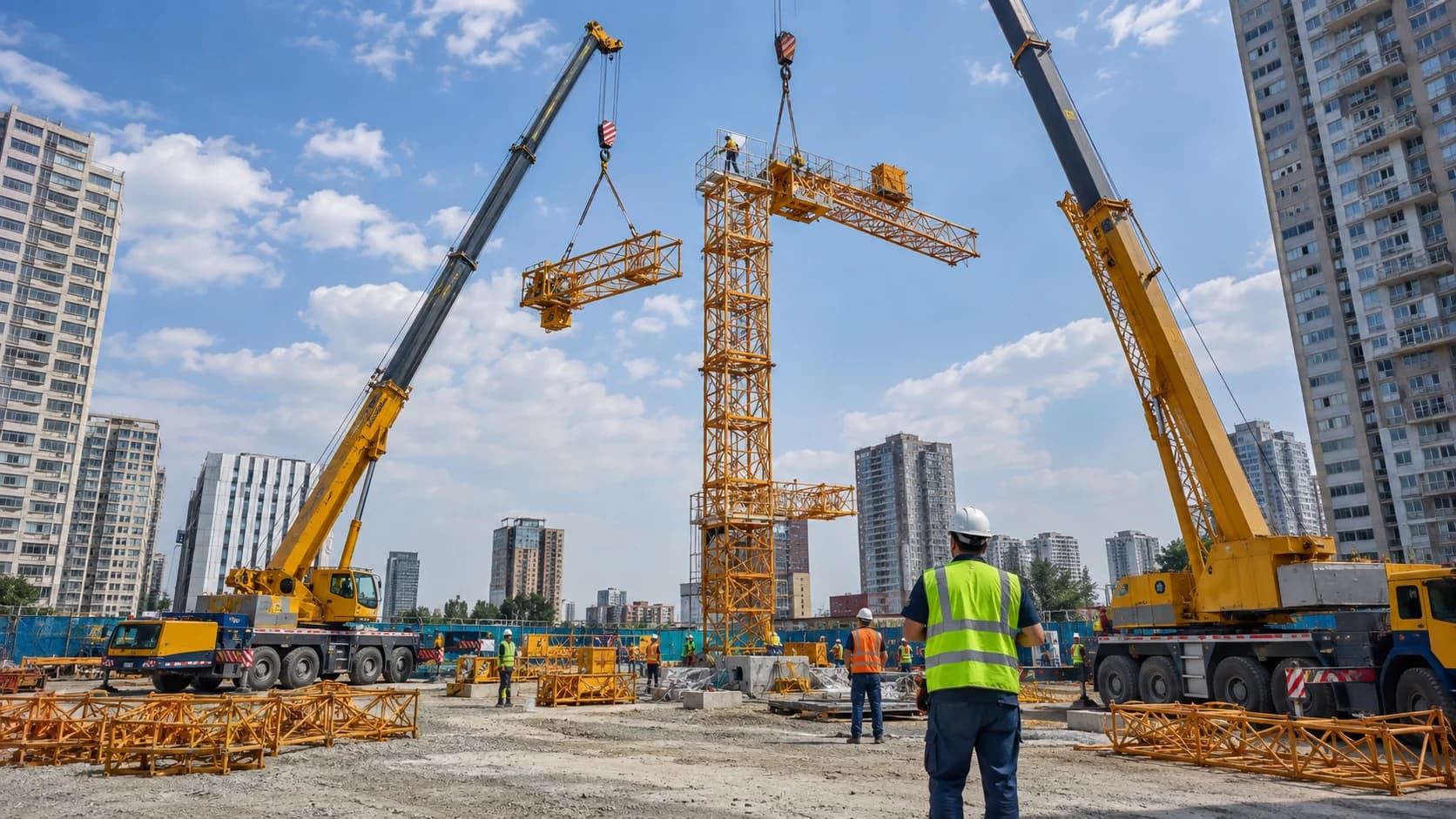
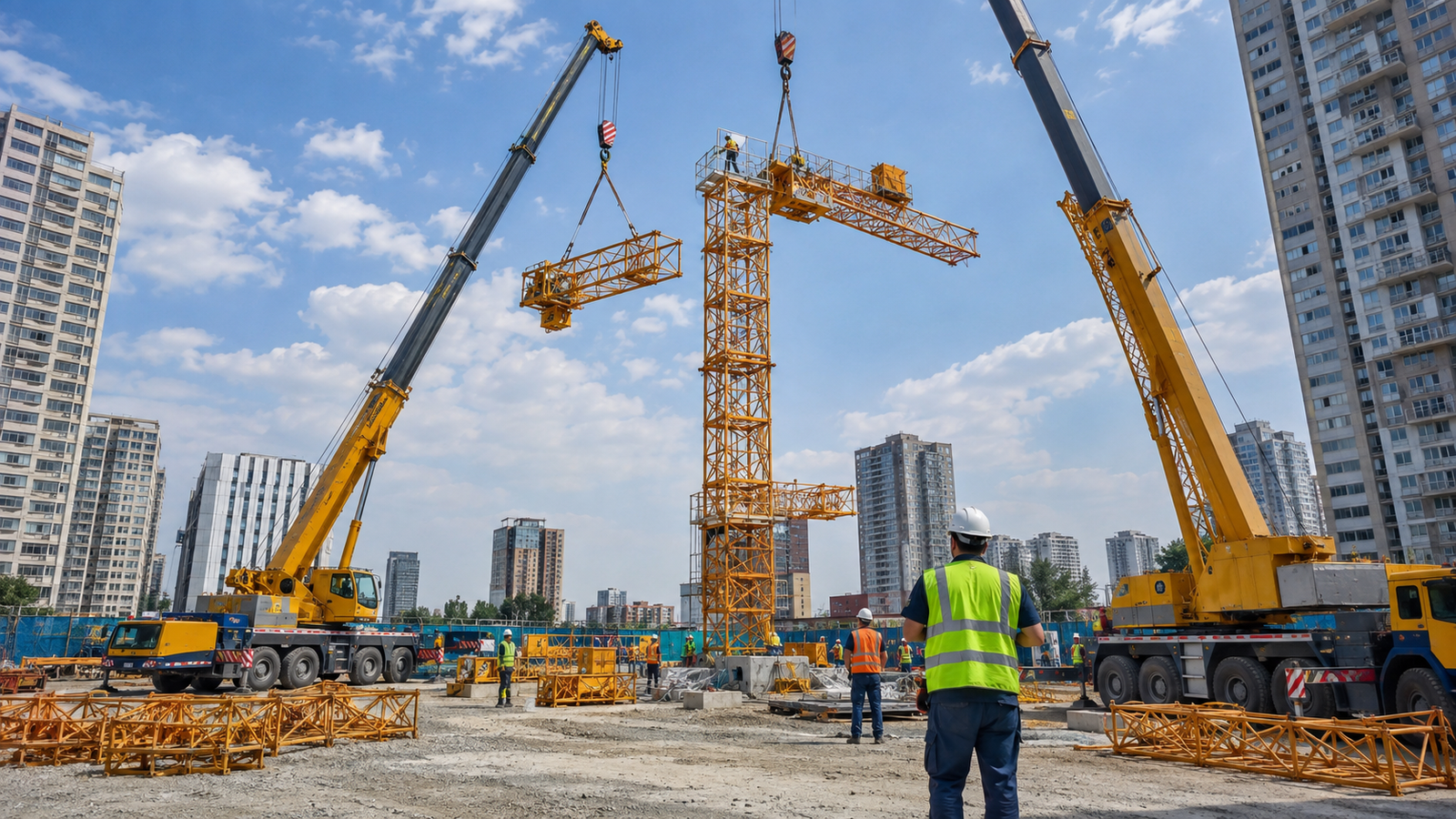
Tower crane erection and dismantling are among the most planning-intensive crane activities on a construction project. The crane changes from individual transported components into a tall engineered structure, and many steps occur before the finished machine can use its normal load chart. The erection crane, tower crane foundation, mast sections, climbing frame, slewing unit, jib, counter-jib, counterweights, ropes, electrical systems, ties, and access systems all have to arrive in the correct sequence and be assembled under a manufacturer-approved method. Dismantling is equally demanding because the finished building may restrict the space that was available during erection. Weather, road closures, exclusion zones, component storage, assist-crane capacity, temporary loading, and rescue planning all need attention. This guide describes the major planning stages so project teams can understand the process and coordinate it effectively with specialist tower crane contractors and engineers.
Use this guide with the exact manufacturer documentation. Capacities, configuration limits, inspection criteria, and operating procedures vary by crane model and jurisdiction.
Early Planning: Location, Foundation, and Final Removal
Tower crane location should be selected by considering required reach and capacity together with foundation feasibility, building geometry, oversailing restrictions, tie locations, delivery routes, erection-crane access, and eventual dismantling. Confirm this point against the exact crane data and the actual field condition before proceeding.
The foundation or base is designed for project-specific reactions and may be a concrete foundation, integrated building element, base frame, or another engineered solution approved for the crane. Confirm this point against the exact crane data and the actual field condition before proceeding.
Design teams should identify where the mast passes relative to slabs, façades, structural frames, and future services so the crane does not conflict with permanent work. Confirm this point against the exact crane data and the actual field condition before proceeding.
The dismantling concept should be reviewed before erection because later floors, landscaping, façades, utilities, or neighboring construction can remove the space needed by an assist crane. Confirm this point against the exact crane data and the actual field condition before proceeding.
A coordinated site drawing showing crane centerline, jib radius, counter-jib sweep, foundation, access roads, assembly area, exclusion zones, and neighboring hazards is a core planning document. Confirm this point against the exact crane data and the actual field condition before proceeding.
Marking the crane center, support locations, load path, and landing area before setup makes the assumptions visible to the entire lifting team.
Erection Crane and Component Logistics
The assist crane must have sufficient capacity at the actual radius and hook height for every tower crane component, including the heaviest pick and the most distant pick in the erection sequence. Confirm this point against the exact crane data and the actual field condition before proceeding.
Trailer arrival sequence should match erection sequence so critical components can be picked directly or staged without double handling and without blocking crane access. Confirm this point against the exact crane data and the actual field condition before proceeding.
Mast sections, slewing units, jibs, counter-jibs, counterweights, cab modules, climbing frames, ropes, and platforms require stable storage and clear identification before lifting. Confirm this point against the exact crane data and the actual field condition before proceeding.
The assist-crane setup itself needs engineered ground support, outrigger space, counterweight logistics, and a lift plan that remains valid as the tower crane grows taller. Confirm this point against the exact crane data and the actual field condition before proceeding.
Road closures, permits, deliveries, pedestrian control, lighting, noise restrictions, and nearby business access may be as important to the erection schedule as the mechanical assembly work. Confirm this point against the exact crane data and the actual field condition before proceeding.
When uncertainty remains, conservative planning is more reliable than using every unit of theoretical capacity. Keep usable margin for normal variation in weight, radius, and positioning.
Typical Tower Crane Erection Sequence
A common sequence begins with verifying the completed foundation or base, installing initial mast sections, and then lifting the slewing assembly or upper crane structure into position. Confirm this point against the exact crane data and the actual field condition before proceeding.
The counter-jib is installed with its machinery and the manufacturer-specified initial ballast sequence so the crane remains within permitted temporary balance conditions. Confirm this point against the exact crane data and the actual field condition before proceeding.
The main jib is assembled and lifted in the prescribed method, after which remaining counterweights, trolley components, hook system, ropes, and electrical connections are completed as specified. Confirm this point against the exact crane data and the actual field condition before proceeding.
Temporary erection configurations can have restrictions that differ from normal operation, so component order, temporary ballast, and boom orientation must not be rearranged for convenience. Confirm this point against the exact crane data and the actual field condition before proceeding.
After assembly, inspections, functional tests, limit checks, rope verification, commissioning, and required documentation are completed before the crane is released for routine lifting. Confirm this point against the exact crane data and the actual field condition before proceeding.
After weather changes, relocation, or a configuration change, reconfirm the condition that controls the lift instead of assuming the earlier setup is still valid.
Climbing and Tie-In Planning
When the building exceeds free-standing tower height, the crane may climb by adding mast sections while a climbing frame temporarily supports and separates major crane components. Confirm this point against the exact crane data and the actual field condition before proceeding.
Climbing creates a temporary condition with strict requirements for wind, crane balance, trolley or jib position, hydraulic jack operation, and the sequence of inserting or removing tower sections. Confirm this point against the exact crane data and the actual field condition before proceeding.
Tie frames and anchors must be installed at designed elevations and connected to structural elements capable of carrying the specified reactions. Confirm this point against the exact crane data and the actual field condition before proceeding.
The project schedule should coordinate concrete strength, façade work, formwork, and floor access with tie installation so the crane is not forced to climb before the building can support it. Confirm this point against the exact crane data and the actual field condition before proceeding.
Climbing operations require exclusion zones and clear communication because people may be working at height around large moving structural components while the crane is temporarily reconfigured. Confirm this point against the exact crane data and the actual field condition before proceeding.
A short handover record of configuration, key dimensions, support assumptions, rigging, and restrictions helps prevent the next shift from using an outdated plan.
Dismantling Strategy
Dismantling generally reverses many erection steps, but the site is now more congested and may require a different assist crane position, different delivery route, or specialized rooftop or small-crane strategy. Confirm this point against the exact crane data and the actual field condition before proceeding.
The crane may need to be climbed down, ties removed in sequence, and tower height reduced before the jib, counter-jib, upperworks, and mast sections can be taken away. Confirm this point against the exact crane data and the actual field condition before proceeding.
Temporary counterweight balance during dismantling is critical because removing components changes the crane configuration step by step, and each step must follow the manufacturer method. Confirm this point against the exact crane data and the actual field condition before proceeding.
Completed façades, roofs, landscaping, roads, public spaces, and adjacent buildings can limit where components may be lowered, so landing areas and transport paths should be preserved in the project plan. Confirm this point against the exact crane data and the actual field condition before proceeding.
A dismantling plan should also include what happens to the foundation, tie openings, embedded anchors, temporary structural elements, and any roof or slab penetrations after the crane is gone. Confirm this point against the exact crane data and the actual field condition before proceeding.
For example, a lift can change when the crane must be positioned farther away than planned. Recalculate the working condition rather than treating the extra radius as insignificant.
Weather, People, and Emergency Planning
Wind is a major constraint because large lattice components present significant sail area during erection and dismantling, and manufacturer limits may be lower than normal operating wind limits. Confirm this point against the exact crane data and the actual field condition before proceeding.
Competent supervision, qualified erection personnel, assist-crane operators, riggers, signal persons, electricians, engineers, and site management need clearly defined roles and one coordinated sequence. Confirm this point against the exact crane data and the actual field condition before proceeding.
Exclusion zones should protect workers and the public from suspended components, falling objects, slewing equipment, counterweight handling, and movement of erection vehicles. Confirm this point against the exact crane data and the actual field condition before proceeding.
Rescue planning should address personnel working at height in the mast, jib, climbing frame, and machinery areas, including access limitations while the crane is partly assembled. Confirm this point against the exact crane data and the actual field condition before proceeding.
The operation should stop when actual conditions—weather, ground, component fit, crane behavior, or site access—depart from the approved plan, and changes should be reviewed before work resumes. Confirm this point against the exact crane data and the actual field condition before proceeding.
On a congested project, the limiting condition may occur later in the swing or at the set point, so check the complete lift envelope before mobilization.
Field Planning Checklist
Before the lift begins, convert the planning discussion into a short field checklist. A checklist does not replace judgment; it makes sure the agreed assumptions are visible and repeatable. The following items should be adapted to the exact crane, manufacturer instructions, project lift plan, and local requirements:
- Select tower crane location with dismantling in mind.
- Complete foundation engineering and verification.
- Confirm erection-crane capacity for every pick.
- Sequence deliveries and staging.
- Protect adequate assembly and exclusion space.
- Use manufacturer erection and climbing procedures.
- Coordinate tie locations with building structure.
- Set wind and weather stop criteria.
- Plan rescue and work-at-height access.
- Preserve dismantling access through project completion.
A useful completion rule is that every unchecked item must have an owner and a reason. If the crew cannot confirm a load weight, support condition, configuration setting, or communication method, that uncertainty should be resolved before the lift proceeds. This is particularly important when a change appears small, because crane capacity and stability can be sensitive to geometry and support conditions.
Common Planning Mistakes to Avoid
- Using a crane’s advertised maximum capacity as though it applies at every radius and boom length. The better practice is to identify the assumption during planning, assign a clear verification method, and stop when the field condition no longer matches the basis of the lift.
- Assuming site ground is adequate because trucks or smaller equipment have already driven over it. The better practice is to identify the assumption during planning, assign a clear verification method, and stop when the field condition no longer matches the basis of the lift.
- Leaving rigging, hook, attachment, counterweight, support, or configuration details until the crane is already set up. The better practice is to identify the assumption during planning, assign a clear verification method, and stop when the field condition no longer matches the basis of the lift.
- Treating alarms, limiters, or electronic displays as replacements for a planned load chart and physical inspection. The better practice is to identify the assumption during planning, assign a clear verification method, and stop when the field condition no longer matches the basis of the lift.
- Continuing after site conditions, weather, crane level, access, or load geometry changes from the approved plan. The better practice is to identify the assumption during planning, assign a clear verification method, and stop when the field condition no longer matches the basis of the lift.
Frequently Asked Questions
Can a tower crane be erected in any sequence if the pieces fit?
No. Temporary configurations during erection have specific balance and structural requirements. The manufacturer method and engineered erection plan must control component order, counterweight, orientation, and lifting points. Always confirm model-specific limits in the crane manual and project plan.
Why plan dismantling before the crane is erected?
Because the completed building can block assist-crane positions and landing areas. Early planning protects the space and access needed to remove the tower crane safely at the end of the project. Always confirm model-specific limits in the crane manual and project plan.
What is tower crane climbing?
It is a controlled process that increases or decreases tower height by using a climbing system to create space for inserting or removing mast sections. It is a specialized operation with strict configuration and weather limits. Always confirm model-specific limits in the crane manual and project plan.
Why are tie-ins important?
Ties restrain the mast laterally when the crane exceeds its free-standing configuration. They transfer forces into the building and therefore require engineered anchor points and structural coordination. Always confirm model-specific limits in the crane manual and project plan.
Can erection continue in high wind?
Only within the specific limits and procedure for the erection activity. Large components can have high wind area, so erection or dismantling limits may be more restrictive than routine crane operation. Always confirm model-specific limits in the crane manual and project plan.
Conclusion
Good crane work is built on disciplined preparation. The most useful habit is to keep connecting the planned lift back to measurable facts: actual load, actual radius, actual configuration, actual support condition, and actual clearance. When those facts remain inside the manufacturer limits and the crew understands the plan, the crane can be used efficiently without relying on guesswork. When one of those facts changes, the plan should change with it. Treat the load chart, setup information, rigging data, safety systems, and site conditions as one connected system, and involve qualified personnel whenever the lift is unusual, close to a limit, or affected by uncertain ground or structural conditions.
Get More Expert Guides & Updates
Subscribe for Machinery.org guide updates and product learning content.