
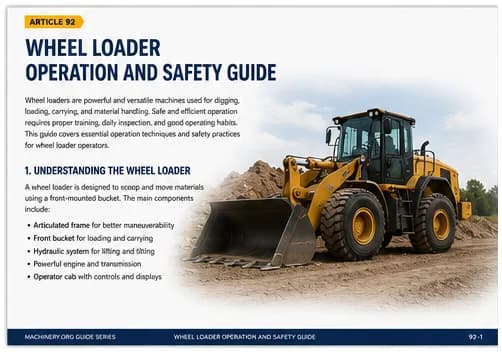
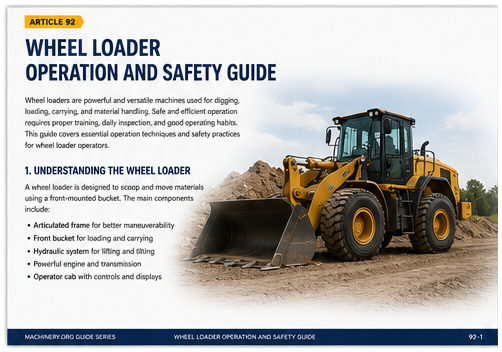
Figure 92.1 - Wheel loader operation and safety overview.
Image Description: A standalone guide image showing a wheel loader and the main operation and safety concepts for material handling.
Introduction
Wheel loaders are among the most productive machines on construction sites, quarries, farms, recycling yards, snow operations, and material handling facilities. They move soil, gravel, sand, feed, mulch, pallets, debris, and snow with speed and capacity. Their size and power make them valuable, but those same qualities create risk when operators do not follow disciplined procedures. A wheel loader has weight, momentum, articulation, blind spots, high bucket forces, and a raised-load stability profile that must be respected at all times.
This Machinery.org guide explains practical wheel loader operation and safety habits for owners, supervisors, and operators. It is not written only for beginners. Experienced operators also benefit from revisiting the basics because most incidents come from routine tasks performed too casually. Mounting the machine, starting safely, traveling with the bucket low, loading trucks, working around people, managing slopes, and parking correctly are all simple actions that have serious consequences when ignored.
A safe wheel loader operator works with a system. The system begins before startup with inspection and job planning. It continues through slow, smooth control inputs, careful visibility checks, correct bucket positioning, and awareness of ground conditions. It ends with proper parking, shutdown, and post-shift inspection. When each part of the system is respected, the loader becomes more productive and less likely to cause damage, injury, or unnecessary wear.
Understanding the Wheel Loader
A wheel loader is designed to scoop, carry, lift, and load material. Most loaders use an articulated frame, meaning the front and rear sections pivot in the middle for steering. This improves maneuverability, but it also changes the stability profile of the machine during turns. A loader that feels stable when straight may feel different when articulated with a full bucket. Operators must understand this before making sharp turns or lifting high while steering.
The bucket, lift arms, hydraulic cylinders, tires, brakes, transmission, and operator cab all work together. A loader used for heavy production should be inspected and maintained as a complete system, not as separate parts. Tire condition affects traction and bucket penetration. Hydraulic response affects loading speed and control. Brake performance affects safety on ramps and in busy yards. Visibility affects every movement around people, trucks, stockpiles, and structures.
Wheel loaders often work in repeat cycles, which can create complacency. Loading the same truck or moving the same material all day may feel predictable, but changing pile conditions, traffic, ground moisture, and fatigue can alter the risk. Good operators keep scanning even during repetitive work.
Pre-Operation Inspection
Pre-operation inspection should cover tires, rims, hydraulic hoses, cylinders, bucket edge, lights, mirrors, glass, brakes, steering, fluid levels, warning systems, and attachment condition. The operator should walk around the machine before climbing into the cab. Look under the loader for fluid leaks. Check for loose wheel hardware, cuts in tires, damaged steps, broken handrails, cracked bucket welds, missing teeth, and buildup around cooling screens. Any damage affecting safety or control should be corrected before operation.
Inside the cab, adjust the seat and mirrors, fasten the seat belt, check the display, confirm that controls return to neutral, and verify that the horn, backup alarm, lights, and cameras function if equipped. Cab cleanliness is part of safety. Bottles, tools, and debris on the floor can interfere with pedals. Muddy glass reduces visibility. A professional operator treats the cab as a control station, not a storage space.
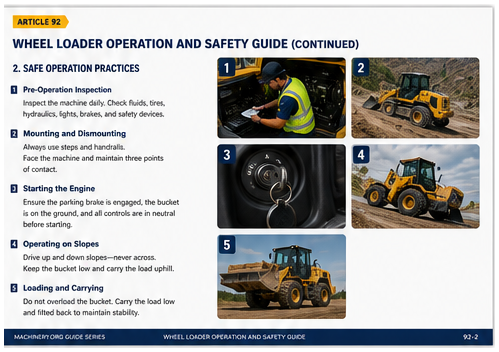
Figure 92.2 - Wheel loader safe operation practices checklist.
Image Description: A standalone checklist guide image showing operator inspection, slope operation, mounting, starting, and bucket travel positions.
Safe Loading and Carrying Techniques
The loader bucket should generally be carried low during travel. A low bucket improves stability, visibility, and control. Raising the bucket while traveling increases the center of gravity and can reduce stability, especially during turns or on uneven ground. When approaching a pile, the operator should enter straight, maintain controlled speed, and avoid ramming aggressively. Good bucket filling comes from correct angle, smooth throttle, and good material technique, not from abusing the machine.
When loading trucks, approach squarely, slow before raising, and avoid swinging the bucket over people or cabs. The operator should communicate with truck drivers and spotters using site-approved signals or radios. Material should be dumped smoothly to avoid shock loads, spillage, or truck damage. When backing away, lower the bucket as soon as practical and check the travel path before reversing.
Carrying loose material across a yard requires awareness of roadways, pedestrians, other machines, and blind corners. A wheel loader has large blind spots. Mirrors and cameras help, but they do not replace turning the head, using alarms, and following traffic plans.
Operating on Slopes and Rough Ground
Slopes require special care because a loader’s weight shifts with grade, articulation, bucket position, and load weight. Operators should avoid cross-slope travel when possible and should keep the heavy end positioned correctly according to safe practice and manufacturer guidance. The bucket should remain low, speed should be reduced, and sudden steering should be avoided. Soft ground, loose gravel, snow, or mud can reduce traction and braking performance.
On rough ground, the operator should slow down and avoid bouncing the machine. Repeated impact shortens tire life, stresses pins and bushings, and makes the load harder to control. If the route is extremely rough, it may be better to grade the travel path before production begins. Time spent improving the route often pays back through faster cycles and less machine damage.
Communication and Jobsite Awareness
Wheel loaders often work in shared spaces. That means safety depends on communication as much as machine control. The site should have defined travel lanes, loading zones, pedestrian exclusion areas, and clear rules for truck positioning. Operators should never assume that people see the loader. Eye contact, horns, lights, alarms, and spotters all support safer work.
Visibility is a constant challenge. Large buckets, high lift arms, stockpiles, and truck bodies can block the operator’s view. Before reversing, turning, or entering a congested area, slow down and verify the path. A loader should never be operated faster than the operator can see and stop safely.
Parking and Shutdown
At the end of work, park on level ground when possible, lower the bucket fully, set the parking brake, return controls to neutral, allow the engine to idle down according to the manufacturer’s guidance, and remove the key. If the loader is parked on a jobsite, choose a location that does not block traffic or create a visibility hazard. Post-shift inspection should identify new leaks, damage, tire issues, or attachment wear that appeared during the shift.
Stockpile Management and Loading Efficiency
Wheel loader safety improves when stockpiles are managed correctly. A pile with steep unstable faces can collapse unexpectedly, bury the bucket, or roll material toward the machine. Operators should approach the pile squarely, avoid undercutting high faces, and keep the work area shaped so trucks and loaders have predictable paths. A clean loading face improves bucket fill and reduces the temptation to ram into material aggressively. Good stockpile management is therefore both a production tool and a safety tool.
Loading efficiency also depends on cycle planning. The shortest path is not always the safest or most efficient path if it crosses pedestrian routes, blind corners, soft ground, or truck staging areas. Operators should use repeatable travel lanes, maintain enough turning room, and avoid carrying the bucket high while moving. A slightly longer but smoother route often reduces tire wear, spills less material, and prevents near misses.
Maintenance Awareness During Operation
A skilled loader operator listens to the machine while working. Changes in brake feel, steering response, bucket drift, hydraulic noise, tire bounce, or transmission behavior should not be ignored until the end of the shift. The operator is often the first person to know when something feels wrong. Reporting early warning signs helps maintenance teams correct issues while they are still manageable. In high-production work, this awareness can prevent breakdowns during the busiest part of the day.
Operators should also understand that rough technique creates maintenance cost. Spinning tires, slamming into piles, traveling with a high load, hard braking, and shock-loading the bucket all shorten the life of components. Safe operation and low operating cost are closely connected.
Operator Training and Program Review
Operator training should include both empty-machine practice and loaded-cycle practice. New wheel loader operators should learn how the machine feels when straight, articulated, empty, loaded, uphill, downhill, and near stockpiles. Supervisors should review travel speed, bucket height, backing behavior, horn use, communication with truck drivers, and correct parking. When these habits are coached early, the loader becomes smoother, safer, and less costly to operate. This also helps reduce tire wear, spillage, avoidable repairs, and confusion between operators during busy loading periods.
FAQ
Why should the bucket stay low during travel? A low bucket helps maintain stability and improves visibility, especially when carrying heavy material or traveling over uneven ground.
What is a common wheel loader safety mistake? Turning sharply with a raised, loaded bucket is one of the common mistakes that can reduce stability and increase rollover risk.
How can supervisors improve loader safety? Use traffic plans, clear pedestrian zones, consistent training, maintenance records, and a culture where operators can stop work when conditions are unsafe.
Key Takeaway
Wheel loader safety comes from controlled speed, good visibility, low-load travel, inspection discipline, and clear jobsite communication. A productive loader is not just fast; it is predictable, stable, and operated with respect for the machine’s weight and surroundings.
Get More Expert Guides & Updates
Subscribe for Machinery.org guide updates and product learning content.