

Verified guide word count: 3,482 words
Introduction
Weak subgrade and deteriorated pavement often fail repeatedly because the material beneath the surface cannot provide uniform support, even after a new wearing course is placed.
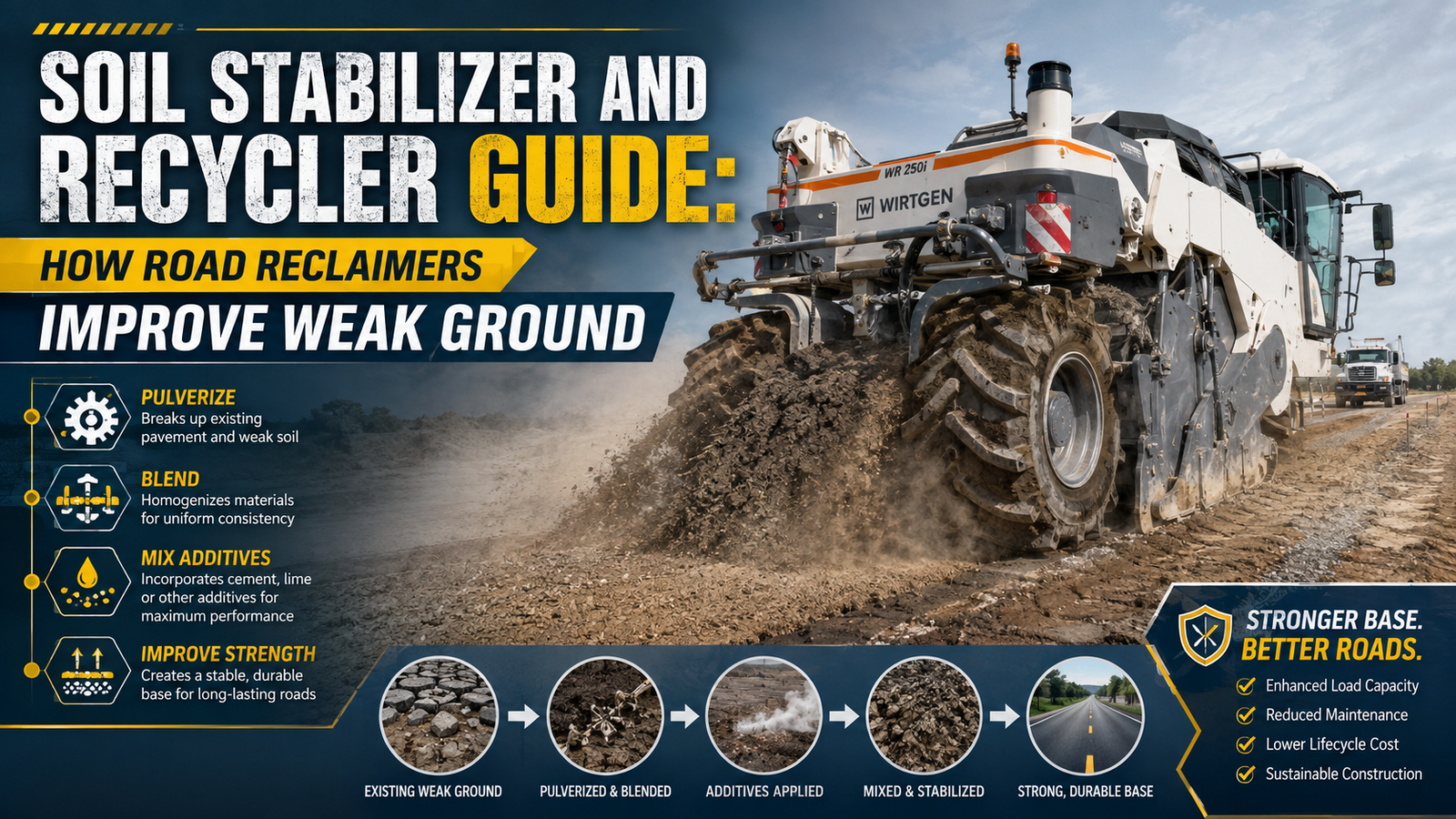
Soil stabilizers and road recyclers improve the foundation by pulverizing existing material, blending it to a controlled depth, and mixing water or binders that modify strength, plasticity, moisture response, or structural behavior.
The machines are powerful, but the treatment is still an engineered process that depends on testing, binder selection, accurate application, moisture control, uniform mixing, grading, compaction, and curing.
This guide explains how road reclaimers are used for soil stabilization and full-depth reclamation and how operators control the process in the field.
How the Recycler Processes Material
A large rotor fitted with cutting and mixing tools penetrates the existing pavement, base, or soil and breaks it into smaller particles inside a mixing chamber. In practice, crews should verify this condition under the actual job environment rather than relying only on a display or a previous setting. Small changes in material, temperature, wear, or machine position can change the result, so measured checks and consistent observation are important.
Rotor speed, travel speed, cutting depth, chamber geometry, tool condition, and material type determine how thoroughly the layer is pulverized. This point also affects productivity because the machine works best when the surrounding process is stable. When the condition begins to drift, the operator should identify the source, make one logical correction, and allow enough operating time to judge whether the correction worked.
Dry binder may be spread on the surface ahead of the machine, while liquid water, emulsion, or other additives can be injected directly through calibrated spray systems. From a quality-control perspective, the result should be checked repeatedly at planned intervals instead of only after a visible defect appears. A sequence of measurements reveals trends early and gives supervisors time to correct the process before a long section or a large volume of material is affected.
The recycler should create a reasonably uniform mixture through the full design depth rather than leaving untreated seams, large slabs, or concentrated binder streaks. Maintenance and operation are connected here. Wear, looseness, buildup, damaged sensors, or restricted flow can force the operator to compensate with controls, but compensation rarely produces the same consistency as restoring the component to proper condition.
After processing, graders and rollers shape and compact the new layer, so the recycler should be planned as part of a complete production train. The safest and most efficient approach is to include this item in the pre-shift plan and to define who is responsible for checking it during production. Clear communication between the main machine operator, ground crew, trucks, quality personnel, and support equipment reduces delays and prevents conflicting adjustments.
For a soil stabilizer and road recycler crew, the practical objective in this area is repeatability. Record the starting condition, observe how the machine and material respond, and use measured results to decide whether another adjustment is necessary. This disciplined method reduces rework, makes troubleshooting faster, and produces a process that can be repeated by the next shift.
Soil Stabilization vs Full-Depth Reclamation
Soil stabilization treats weak native or imported soil to improve workability, reduce plasticity, manage moisture, or increase strength depending on the binder and soil chemistry. Experienced crews treat this as one variable in a larger system rather than an isolated setting. If performance changes, they compare material condition, machine speed, mechanical condition, and downstream capacity before assuming that one control must be adjusted.
Full-depth reclamation pulverizes an existing asphalt pavement together with a designed amount of base to create a recycled foundation layer. In practice, crews should verify this condition under the actual job environment rather than relying only on a display or a previous setting. Small changes in material, temperature, wear, or machine position can change the result, so measured checks and consistent observation are important.
Cement, lime, foamed asphalt, asphalt emulsion, or other materials may be used, but binder choice and percentage should come from laboratory and field testing. This point also affects productivity because the machine works best when the surrounding process is stable. When the condition begins to drift, the operator should identify the source, make one logical correction, and allow enough operating time to judge whether the correction worked.
Existing pavement thickness, base quality, weak pockets, utilities, contaminants, and drainage conditions should be investigated before a treatment method is selected. From a quality-control perspective, the result should be checked repeatedly at planned intervals instead of only after a visible defect appears. A sequence of measurements reveals trends early and gives supervisors time to correct the process before a long section or a large volume of material is affected.
The same recycler can perform different processes, so operators must understand the design objective rather than assuming every pass is simply a deeper form of milling. Maintenance and operation are connected here. Wear, looseness, buildup, damaged sensors, or restricted flow can force the operator to compensate with controls, but compensation rarely produces the same consistency as restoring the component to proper condition.
For a soil stabilizer and road recycler crew, the practical objective in this area is repeatability. Record the starting condition, observe how the machine and material respond, and use measured results to decide whether another adjustment is necessary. This disciplined method reduces rework, makes troubleshooting faster, and produces a process that can be repeated by the next shift.
Controlling Mixing Depth
Depth determines which materials are included in the treated layer and therefore controls both composition and the quantity of material receiving the binder. The safest and most efficient approach is to include this item in the pre-shift plan and to define who is responsible for checking it during production. Clear communication between the main machine operator, ground crew, trucks, quality personnel, and support equipment reduces delays and prevents conflicting adjustments.
If the machine runs too shallow, untreated weak material can remain immediately below the improved layer and continue to deform under traffic. Experienced crews treat this as one variable in a larger system rather than an isolated setting. If performance changes, they compare material condition, machine speed, mechanical condition, and downstream capacity before assuming that one control must be adjusted.
If it runs too deep, the same binder mass becomes diluted through more material than the mix design assumed and may produce lower strength. In practice, crews should verify this condition under the actual job environment rather than relying only on a display or a previous setting. Small changes in material, temperature, wear, or machine position can change the result, so measured checks and consistent observation are important.
Existing asphalt thickness can vary, so the crew should verify depth physically in test sections and decide how to handle changes before full production. This point also affects productivity because the machine works best when the surrounding process is stable. When the condition begins to drift, the operator should identify the source, make one logical correction, and allow enough operating time to judge whether the correction worked.
Accurate depth control is essential because the rotor can follow an incorrect setting very consistently while still producing the wrong structural layer. From a quality-control perspective, the result should be checked repeatedly at planned intervals instead of only after a visible defect appears. A sequence of measurements reveals trends early and gives supervisors time to correct the process before a long section or a large volume of material is affected.
For a soil stabilizer and road recycler crew, the practical objective in this area is repeatability. Record the starting condition, observe how the machine and material respond, and use measured results to decide whether another adjustment is necessary. This disciplined method reduces rework, makes troubleshooting faster, and produces a process that can be repeated by the next shift.
Binder Application and Calibration
Dry binders should be spread at a calibrated mass per unit area so each recycler pass receives approximately the designed quantity. Maintenance and operation are connected here. Wear, looseness, buildup, damaged sensors, or restricted flow can force the operator to compensate with controls, but compensation rarely produces the same consistency as restoring the component to proper condition.
Wind, truck traffic, inconsistent spreader speed, or overlapping spreader passes can create binder variation before the recycler reaches the material. The safest and most efficient approach is to include this item in the pre-shift plan and to define who is responsible for checking it during production. Clear communication between the main machine operator, ground crew, trucks, quality personnel, and support equipment reduces delays and prevents conflicting adjustments.
Liquid injection systems should tie application rate to machine travel and should stop or adjust flow when the recycler slows, accelerates, or stops. Experienced crews treat this as one variable in a larger system rather than an isolated setting. If performance changes, they compare material condition, machine speed, mechanical condition, and downstream capacity before assuming that one control must be adjusted.
Blocked nozzles or inaccurate flow meters can create untreated zones that may not be obvious from the surface after mixing. In practice, crews should verify this condition under the actual job environment rather than relying only on a display or a previous setting. Small changes in material, temperature, wear, or machine position can change the result, so measured checks and consistent observation are important.
Quality-control staff should verify spread rate, liquid rate, samples, or strength indicators according to the project plan instead of assuming that the control display guarantees uniform treatment. This point also affects productivity because the machine works best when the surrounding process is stable. When the condition begins to drift, the operator should identify the source, make one logical correction, and allow enough operating time to judge whether the correction worked.
For a soil stabilizer and road recycler crew, the practical objective in this area is repeatability. Record the starting condition, observe how the machine and material respond, and use measured results to decide whether another adjustment is necessary. This disciplined method reduces rework, makes troubleshooting faster, and produces a process that can be repeated by the next shift.
Moisture and Pulverization
Material that is too dry can create excessive dust, resist compaction, and reduce the effectiveness of some chemical reactions. From a quality-control perspective, the result should be checked repeatedly at planned intervals instead of only after a visible defect appears. A sequence of measurements reveals trends early and gives supervisors time to correct the process before a long section or a large volume of material is affected.
Material that is too wet can become sticky, pump under equipment, smear during grading, and compact poorly even if the recycler mixes it thoroughly. Maintenance and operation are connected here. Wear, looseness, buildup, damaged sensors, or restricted flow can force the operator to compensate with controls, but compensation rarely produces the same consistency as restoring the component to proper condition.
Water can be applied by tanker ahead of the machine or injected into the mixing chamber, but either method requires calibration and field moisture checks. The safest and most efficient approach is to include this item in the pre-shift plan and to define who is responsible for checking it during production. Clear communication between the main machine operator, ground crew, trucks, quality personnel, and support equipment reduces delays and prevents conflicting adjustments.
Rotor speed and travel speed should be adjusted during a test strip until the reclaimed gradation is fine enough for shaping and compaction without unnecessary extra passes. Experienced crews treat this as one variable in a larger system rather than an isolated setting. If performance changes, they compare material condition, machine speed, mechanical condition, and downstream capacity before assuming that one control must be adjusted.
Worn or missing rotor tools reduce pulverization quality and increase machine load, so tool condition should be monitored as a production variable. In practice, crews should verify this condition under the actual job environment rather than relying only on a display or a previous setting. Small changes in material, temperature, wear, or machine position can change the result, so measured checks and consistent observation are important.
For a soil stabilizer and road recycler crew, the practical objective in this area is repeatability. Record the starting condition, observe how the machine and material respond, and use measured results to decide whether another adjustment is necessary. This disciplined method reduces rework, makes troubleshooting faster, and produces a process that can be repeated by the next shift.
Pass Overlap and Mixing Uniformity
Adjacent recycler passes should overlap enough to avoid an untreated seam, but excessive overlap can change processing intensity and binder distribution if the surface application plan does not account for it. This point also affects productivity because the machine works best when the surrounding process is stable. When the condition begins to drift, the operator should identify the source, make one logical correction, and allow enough operating time to judge whether the correction worked.
Operators can use guide marks, steering systems, or machine automation to maintain consistent lane spacing and reduce unprocessed strips. From a quality-control perspective, the result should be checked repeatedly at planned intervals instead of only after a visible defect appears. A sequence of measurements reveals trends early and gives supervisors time to correct the process before a long section or a large volume of material is affected.
End-of-pass zones deserve extra attention because the machine changes speed while the rotor is lowered or raised and liquid flow may also be transitioning. Maintenance and operation are connected here. Wear, looseness, buildup, damaged sensors, or restricted flow can force the operator to compensate with controls, but compensation rarely produces the same consistency as restoring the component to proper condition.
Visible dry-binder streaks, intact asphalt slabs, or abrupt changes in particle size are warning signs that mixing may not be uniform. The safest and most efficient approach is to include this item in the pre-shift plan and to define who is responsible for checking it during production. Clear communication between the main machine operator, ground crew, trucks, quality personnel, and support equipment reduces delays and prevents conflicting adjustments.
Uniform appearance is useful, but the final judgement should be supported by depth, moisture, density, and strength testing where required. Experienced crews treat this as one variable in a larger system rather than an isolated setting. If performance changes, they compare material condition, machine speed, mechanical condition, and downstream capacity before assuming that one control must be adjusted.
For a soil stabilizer and road recycler crew, the practical objective in this area is repeatability. Record the starting condition, observe how the machine and material respond, and use measured results to decide whether another adjustment is necessary. This disciplined method reduces rework, makes troubleshooting faster, and produces a process that can be repeated by the next shift.
Grading, Compaction, and Curing
The treated material should be shaped to the required elevation, crown, and cross slope while it remains workable, especially when cementitious binders begin reacting soon after mixing. In practice, crews should verify this condition under the actual job environment rather than relying only on a display or a previous setting. Small changes in material, temperature, wear, or machine position can change the result, so measured checks and consistent observation are important.
Motor graders should avoid repeatedly reworking stabilized material after the specified working time because late disturbance can damage developing bonds. This point also affects productivity because the machine works best when the surrounding process is stable. When the condition begins to drift, the operator should identify the source, make one logical correction, and allow enough operating time to judge whether the correction worked.
Roller selection should suit the material, with padfoot, smooth-drum, vibratory, pneumatic, or combined patterns used according to the design and test strip. From a quality-control perspective, the result should be checked repeatedly at planned intervals instead of only after a visible defect appears. A sequence of measurements reveals trends early and gives supervisors time to correct the process before a long section or a large volume of material is affected.
Density, moisture, surface tolerance, and other quality checks should be completed before the layer is covered by the next pavement course. Maintenance and operation are connected here. Wear, looseness, buildup, damaged sensors, or restricted flow can force the operator to compensate with controls, but compensation rarely produces the same consistency as restoring the component to proper condition.
Some stabilized materials require curing moisture, traffic restrictions, or a specified waiting period, so protection after compaction is part of the treatment rather than an optional final step. The safest and most efficient approach is to include this item in the pre-shift plan and to define who is responsible for checking it during production. Clear communication between the main machine operator, ground crew, trucks, quality personnel, and support equipment reduces delays and prevents conflicting adjustments.
For a soil stabilizer and road recycler crew, the practical objective in this area is repeatability. Record the starting condition, observe how the machine and material respond, and use measured results to decide whether another adjustment is necessary. This disciplined method reduces rework, makes troubleshooting faster, and produces a process that can be repeated by the next shift.
Safety, Troubleshooting, and Daily Control
Utilities, culverts, manholes, steel plates, buried structures, and other objects must be identified because contact with the high-energy rotor can cause major damage. Experienced crews treat this as one variable in a larger system rather than an isolated setting. If performance changes, they compare material condition, machine speed, mechanical condition, and downstream capacity before assuming that one control must be adjusted.
Dry binders can create inhalation and visibility hazards, so spreading, handling, personal protection, and dust-control procedures should follow the product and site requirements. In practice, crews should verify this condition under the actual job environment rather than relying only on a display or a previous setting. Small changes in material, temperature, wear, or machine position can change the result, so measured checks and consistent observation are important.
Large unprocessed chunks can indicate excessive speed, worn tools, insufficient rotor engagement, or material that is harder than expected. This point also affects productivity because the machine works best when the surrounding process is stable. When the condition begins to drift, the operator should identify the source, make one logical correction, and allow enough operating time to judge whether the correction worked.
Compaction failure should trigger checks of moisture, gradation, binder uniformity, depth, and timing instead of assuming the roller alone is responsible. From a quality-control perspective, the result should be checked repeatedly at planned intervals instead of only after a visible defect appears. A sequence of measurements reveals trends early and gives supervisors time to correct the process before a long section or a large volume of material is affected.
A daily production record should capture binder rate, water rate, depth, travel speed, weather, test results, and unusual material zones so the team can refine settings rather than restarting the learning process each shift. Maintenance and operation are connected here. Wear, looseness, buildup, damaged sensors, or restricted flow can force the operator to compensate with controls, but compensation rarely produces the same consistency as restoring the component to proper condition.
For a soil stabilizer and road recycler crew, the practical objective in this area is repeatability. Record the starting condition, observe how the machine and material respond, and use measured results to decide whether another adjustment is necessary. This disciplined method reduces rework, makes troubleshooting faster, and produces a process that can be repeated by the next shift.
Field Operating Checklist
Before work begins, review the job objective, material condition, planned production rate, machine configuration, inspection requirements, traffic or site movement, and the conditions that require the soil stabilizer and road recycler to stop. Confirm that high-wear components, sensors, guards, warning systems, fluid levels, and support equipment are ready. During production, watch for changes in sound, vibration, material flow, machine load, surface condition, and the distance between the main machine and support equipment. Measure quality early enough to identify trends. Record major setting changes, delays, unusual material, weather changes, and maintenance issues. At the end of the shift, clean and inspect the machine according to the manufacturer’s procedure, report defects while they are fresh in memory, and compare planned production with actual production. A short end-of-shift review helps the next crew begin from known conditions rather than repeating the same troubleshooting process.
Conclusion
The soil stabilizer and road recycler performs best when operators understand the physical process rather than treating the controls as isolated switches. Good production comes from correct setup, stable material flow, reasonable machine speed, mechanical condition, frequent measurement, and coordinated support equipment. The machine should be operated within the manufacturer’s requirements and the project specification, with changes made deliberately and verified from the result. When these habits become routine, quality becomes more consistent, wear is easier to manage, and the crew spends less time correcting preventable defects.
Get More Expert Guides & Updates
Subscribe for Machinery.org guide updates and product learning content.