
TYPHON Fury 10 vs. Fury 15 vs. Fury 20: Comparing Weight, Power, and Compaction Performance
Choosing the right road roller from the TYPHON Fury series comes down to matching the machine to the work you actually do.
Representative machinery image from the Machinery.org media library.
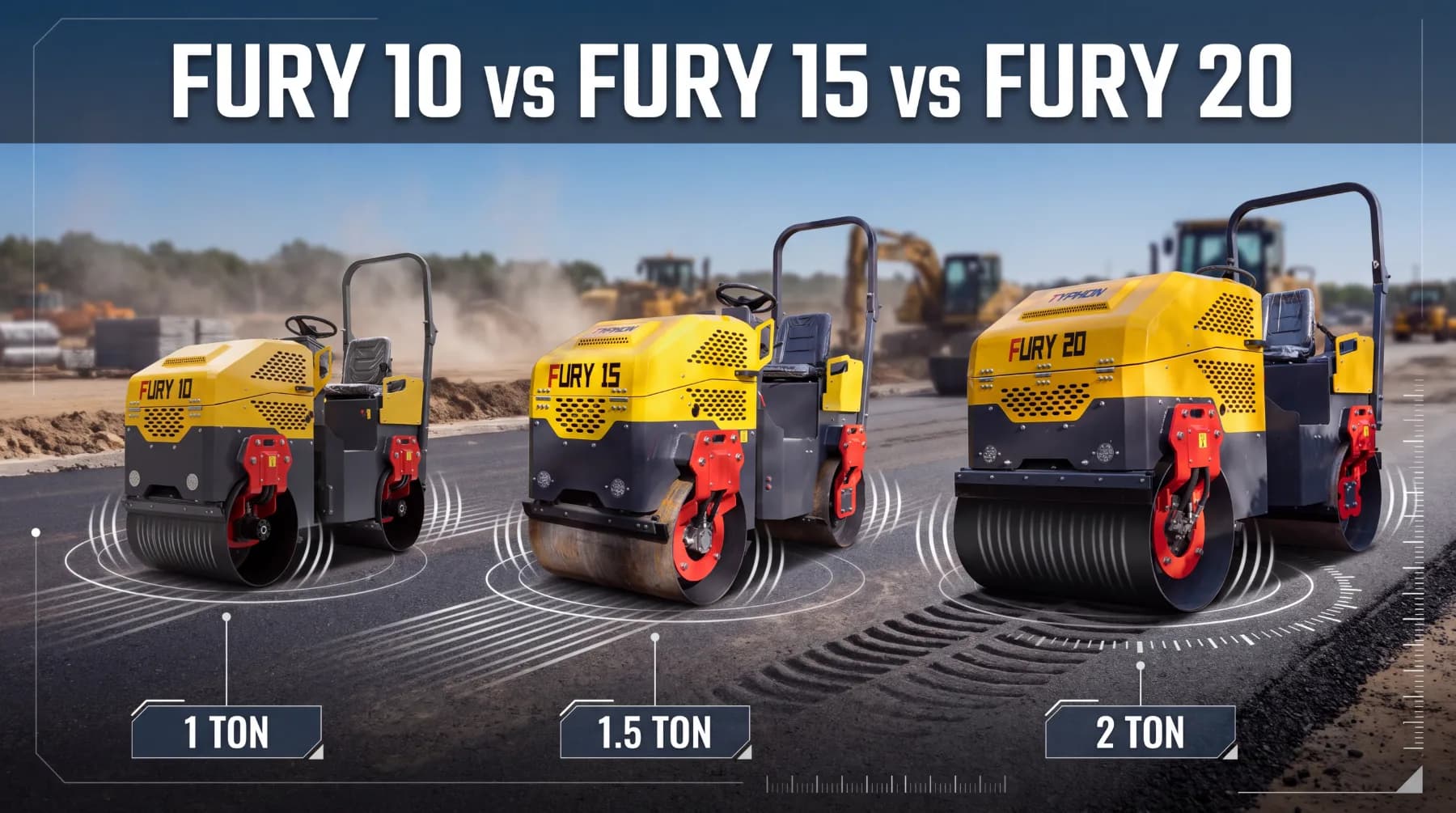
Choosing the right road roller from the TYPHON Fury series comes down to matching the machine to the work you actually do. The Fury 10, Fury 15, and Fury 20 share a common design foundation of hydraulic drive and vibratory compaction, yet each one is built for a different scale of job. When you compare the TYPHON Fury 10, Fury 15, and Fury 20 on weight, engine power, and compaction performance, a clear pattern emerges: a 1-ton machine, a 1.5-ton machine, and a 2-ton machine each earn their place in the lineup. This guide walks through all three models in detail, using their real specifications, then helps you choose the one that fits your projects with confidence.
TYPHON Fury 10: Compact Power for Tight-Space Compaction
The Fury 10 is the smallest member of the series, and its 1-ton operating weight defines what it does best. This is a machine built for agility. At a single ton, it moves and positions easily in spaces where a larger roller would struggle to turn or fit at all. With an overall length of 2,100 mm, a width of 860 mm, and a tight 200 mm turning radius, it slips into confined areas with ease. That makes it a natural fit for smaller roads, driveways, landscaping projects, parking lots, and construction sites where careful placement matters as much as raw compaction force.
Power comes from a 13.5 HP Briggs & Stratton air-cooled, four-stroke gasoline engine, a dependable and widely recognized platform matched to the machine's lighter configuration. This engine drives both the hydraulic system and the vibration that does the compaction work. Hydraulic dual-wheel drive gives the operator smooth, controlled movement across both front and rear drums, which is exactly what tight-space work demands. The 700 mm drum width and 530 mm drum diameter ensure uniform compaction and a smooth surface finish on every pass, while a 30% climbing ability keeps traction strong on sloped driveways and uneven ground.
The pairing of a 1-ton platform, a 13.5 HP engine, hydraulic drive, and vibratory compaction is deliberate rather than accidental. TYPHON did not simply shrink a larger machine and hope for the best. Instead, the Fury 10 is engineered as a complete, balanced tool for smaller-scale work, delivering the compaction capability those jobs require without the bulk that would make it awkward in confined areas. With a 5.5 L fuel tank, an efficient 300 g/kW·h fuel consumption rate, and a 0–8 km/h operating speed, it supports extended working hours with minimal downtime. For operators whose work centers on driveways, landscaping, and smaller roads, the Fury 10 offers the right combination of power and maneuverability day after day.
TYPHON Fury 15: A Balanced Step Up in Compaction Capability
The Fury 15 sits in the middle of the series, and that position is precisely its strength. With a 1.5-ton operating weight, it carries more mass than the Fury 10 while remaining more manageable than the largest model in the lineup. This makes it the sensible choice for operators who need more machine weight and compaction capability but do not want to move all the way up to the 2-ton platform. It answers a common need on the job: enough weight to work through denser material and thicker layers, without sacrificing the handling that keeps varied work moving smoothly.
Like the Fury 10, the Fury 15 runs on a 13.5 HP Briggs & Stratton gas engine, paired here with a heavier frame. This combination brings more static compaction force to the surface, since the added mass presses down harder on the material as the drum vibrates. Its 800 mm front and rear drum width and 530 mm drum diameter deliver uniform, reliable compaction across a wider working path than the Fury 10. Overall dimensions of 2,200 mm in length, 920 mm in width, and 1,620 mm in height keep the machine compact, while a 2,100 mm turning radius and hydraulic two-wheel-drive system provide stable traction and precise control. Like its siblings, it climbs inclines confidently with a 30% climbing ability.
What makes the Fury 15 appealing is its versatility. It bridges the gap between the agile Fury 10 and the heavier-duty Fury 20, giving operators a machine that performs well across many conditions. For projects that fall between small confined patches and large demanding sites, the Fury 15 often proves the most practical single choice. It brings solid compaction capability alongside reasonable maneuverability, so one machine can cover a wider variety of work without leaving you underpowered on bigger jobs or oversized on smaller ones. With the same efficient 5.5 L fuel tank and 300 g/kW·h consumption rate as the Fury 10, plus a 0–8 km/h travel speed, the balanced 1.5-ton Fury 15 is built to serve operators whose work spans a middle range of sizes and materials.
TYPHON Fury 20: Maximum Weight and Power in the Series
The Fury 20 is the strongest machine in the lineup, and everything about its specification reflects that role. At 2 tons, it brings the greatest operating weight of the three, which translates directly into more static force pressing down on the material. That added mass is a real advantage on demanding surfaces and larger applications, where working material toward its target density calls for more than a lighter machine can deliver. When the job involves thicker layers, denser material, or simply a lot of ground to cover, the extra weight of the Fury 20 becomes the tool that gets it done.
Backing that weight is a larger 23 HP Briggs & Stratton engine, a clear step up from the 13.5 HP engines found in the smaller models. This increase in power is not incidental. A heavier machine asks more of its engine, both to drive the roller across the surface and to power the vibration system that performs the compaction. The 23 HP engine gives the Fury 20 the output it needs to carry its 2-ton frame and support demanding operating requirements without straining. It also supports a faster 0–12 km/h travel speed, a more efficient 240 g/kW·h fuel consumption rate, and a large 36 L fuel tank for extended operation on bigger sites.
The Fury 20 combines that engine with hydraulic two-wheel drive and front drum hydraulic vibration, just as the smaller models do, but at a scale suited to heavier-duty performance. Its wider 1,000 mm drum width and 610 mm drum diameter cover more ground per pass and bring more compaction power to the surface. Overall dimensions of 2,300 mm in length, 1,120 mm in width, and 1,650 mm in height give it a substantial footprint, while a 30% climbing ability keeps it capable on inclines. For operators whose work leans toward highways, municipal roads, and industrial construction sites, this combination of maximum weight and maximum power makes the Fury 20 the clear choice within the series.
Weight vs. Compaction Force: How Much Does Machine Weight Matter?
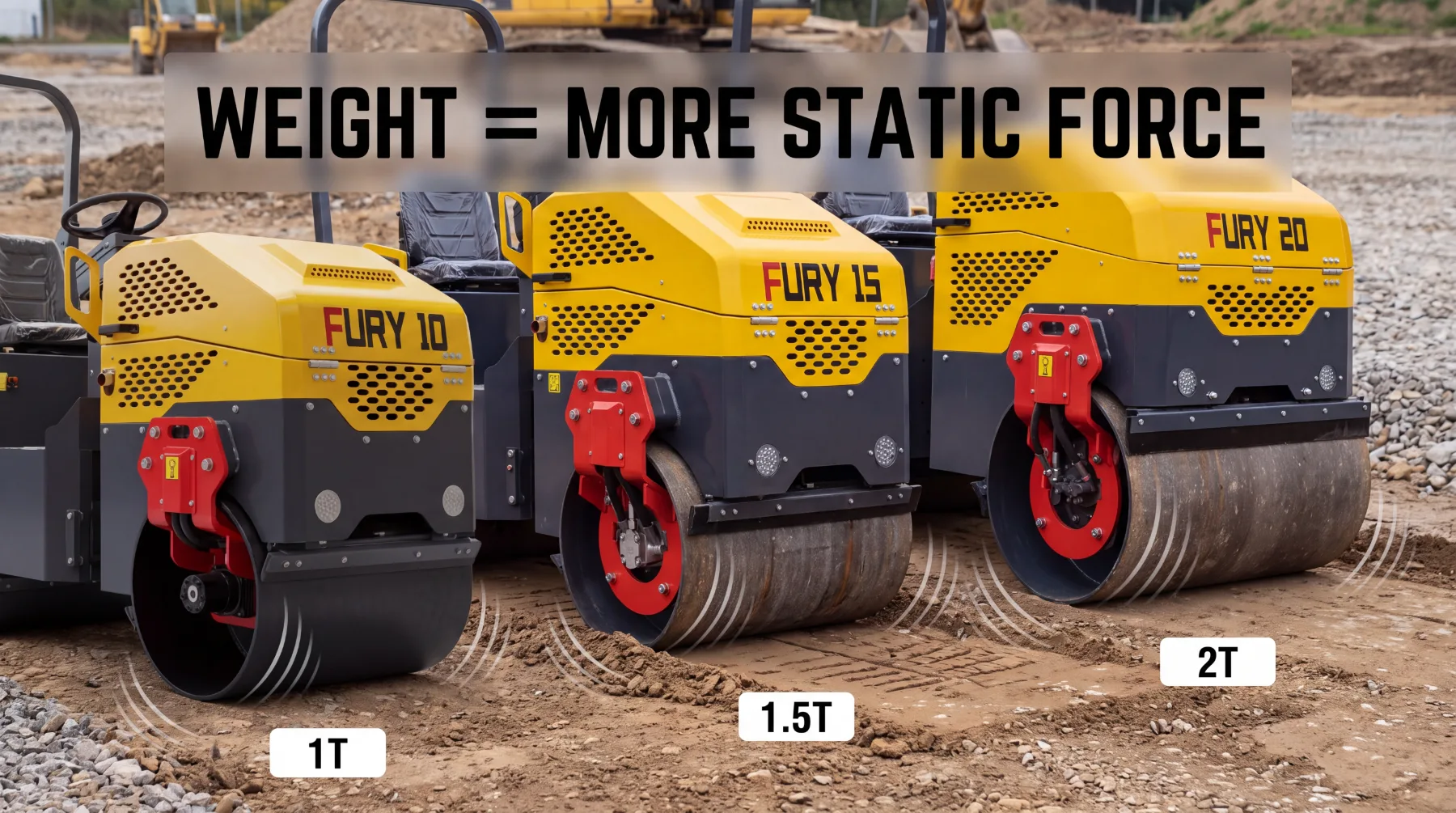
Machine weight is one of the most important factors in compaction, because a roller's mass works hand in hand with vibration to achieve density. The Fury series makes this easy to compare, stepping cleanly from the 1-ton Fury 10 to the 1.5-ton Fury 15 and up to the 2-ton Fury 20. As operating weight rises, so does the static force the drum applies to the surface. That static weight matters because it presses the material downward while the vibration works it into a denser state, and heavier machines simply bring more of that pressing force to bear.
Drum loading and ground pressure are where this difference shows most clearly. A heavier machine loads its drum with more weight, which increases the pressure the drum exerts on the ground beneath it. That higher ground pressure helps the machine work through denser material and thicker layers more effectively, since there is more force available to compact the surface with each pass. The 2-ton Fury 20, with the greatest mass and a wider 1,000 mm drum, brings the most substantial drum loading of the three, which is why it suits demanding surfaces so well. The lighter Fury 10, with its 700 mm drum and 1-ton frame, applies less ground pressure, which is entirely appropriate for the smaller, lighter compaction work it is designed to handle.
It would be a mistake, though, to treat weight as the only factor that decides compaction performance. All three models share the same core vibratory specification: a 35 kN excitation force, a 75 Hz vibration frequency, and a 0.5 mm nominal amplitude. Because that vibratory energy is common across the range, real-world differences in compaction come largely from operating weight combined with the material being compacted, layer thickness, and moisture. A heavier machine offers more static force, but that force still works together with vibration and must suit the material and conditions of the job. This is why matching the machine's weight to the work matters so much, with the Fury 20's 2-ton platform meeting the heavier demands where greater drum loading genuinely pays off.
Engine Power and Vibratory Performance: Where the Models Differ
Engine power is the most obvious difference between the models on paper, but understanding what that power actually does is far more useful than reading horsepower alone. The Fury 10 and Fury 15 both use 13.5 HP Briggs & Stratton engines, while the Fury 20 steps up to a 23 HP engine. That larger engine on the Fury 20 reflects its heavier 2-ton configuration, since a bigger, more demanding machine needs more output to perform dependably. Horsepower on its own, however, does not compact the ground. What matters is how that engine power works together with the hydraulic and vibration systems to deliver compaction on the surface.
The engine's job is to drive two things: the hydraulic system that propels the machine and the vibration system that does the actual compaction work. Hydraulic drive turns engine output into smooth, controlled movement, letting the operator travel and position the roller precisely. The vibration system converts engine power into the rapid drum vibration, delivering 35 kN of excitation force at 75 Hz, that presses material toward its target density. Both of these depend on the engine having enough output to supply them, which is exactly why the heavier Fury 20 carries a larger 23 HP engine. Its 2-ton frame and more demanding operating profile ask more of the engine, both to move the machine at its higher 0–12 km/h speed and to sustain the vibration under heavier conditions.
For the Fury 10 and Fury 15, the shared 13.5 HP engine is matched to their lighter 1-ton and 1.5-ton configurations. These machines do not carry the mass of the Fury 20, so they do not need the same output to power their hydraulic and vibration systems effectively. Notably, all three models deliver the identical 35 kN excitation force, which underlines the key point when comparing them: engine power should be judged in the context of the whole machine, not as a standalone measure of compaction ability. A well-matched engine, paired with hydraulic drive and a capable vibration system, is what produces dependable compaction. Each Fury model pairs an appropriate engine with its weight and systems, so power and performance stay in balance across the range.
Choosing the Right Fury: Maneuverability vs. Heavy-Duty Compaction
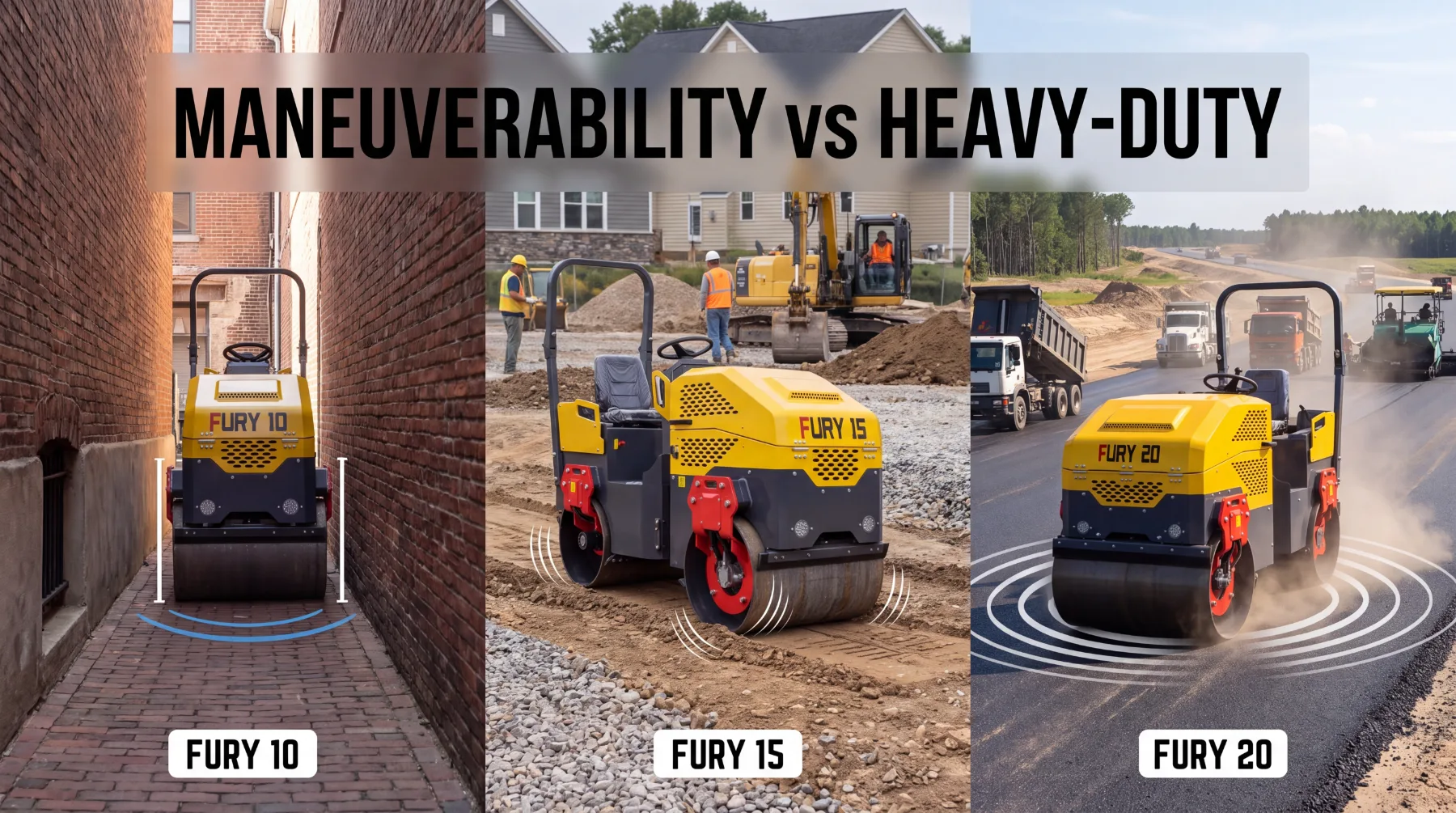
Selecting the right Fury model means weighing maneuverability against compaction strength, then matching that balance to the work you actually do. The decision turns on a few practical considerations: the size of your typical jobs, the conditions you work in, how much room you have to maneuver, and how much compaction forces your surfaces demand. No single model is best for every situation, which is precisely why the series offers three distinct choices. The goal is to match the machine to your reality rather than reaching for the largest or the smallest by default.
- Fury 10: For smaller jobs in tight spaces, its compact 1-ton platform, 860 mm width, and 200 mm turning radius maneuver easily through confined areas and smaller patches. Driveways, landscaping work, and smaller roads all favor its agility.
- Fury 15: At 1.5 tons with an 800 mm drum, it offers more machine weight and a wider working path than the Fury 10 while staying reasonably manageable, making it a dependable middle choice for work that spans a range of sizes and conditions.
- Fury 20: At 2 tons with a 23 HP engine and a 1,000 mm drum, it is the choice when heavy-duty compaction takes priority, suiting highways, municipal roads, and larger construction sites where capacity and compaction strength matter most.
The dependable approach is to define your typical work first. Consider the spaces you operate in, the materials you compact, the density you need to reach, and how demanding your workload is. A contractor handling residential driveways and landscaping will find the Fury 10 ideal, while one moving between mixed jobs benefits from the versatility of the Fury 15. For operators regularly tackling large, demanding surfaces, the Fury 20 delivers the weight and power the work requires. Choose the Fury model whose weight, power, and platform match those needs, so your machine fits the job rather than fighting against it.
Conclusion
The TYPHON Fury 10, Fury 15, and Fury 20 share a common design foundation of hydraulic drive, vibratory compaction, and an identical 35 kN excitation force at 75 Hz, yet they serve different work through their differences in weight and power. When you compare the TYPHON Fury 10, Fury 15, and Fury 20, the pattern is clear. The 1-ton Fury 10, with its 13.5 HP engine and 700 mm drum, brings compact agility to tight spaces, driveways, and landscaping. The 1.5-ton Fury 15, sharing that engine on a heavier frame with an 800 mm drum, offers a balanced middle-ground option for a broad range of work. The 2-ton Fury 20, powered by a larger 23 HP engine and a 1,000 mm drum, delivers the maximum weight and power in the series for demanding surfaces and larger applications. Define your space, material, density needs, and workload first, then choose the Fury model that matches them for dependable, confident performance you can trust on every job.
Frequently Asked Questions
What are the weight and drum differences across the Fury 10, Fury 15, and Fury 20?
The Fury 10 weighs 1 ton and uses a 700 mm drum, the Fury 15 weighs 1.5 tons with an 800 mm drum, and the Fury 20 weighs 2 tons with a 1,000 mm drum. These differences matter because a roller's mass works with vibration to achieve density, and a wider, heavier drum brings more compaction force and covers more ground per pass. The heavier Fury 15 and Fury 20 apply more static weight to the surface, helping them work through denser material and thicker layers. The lighter Fury 10 trades some of that mass for agility, with its compact footprint and 200 mm turning radius making it easier to maneuver in tight areas. Weight and drum width together influence both compaction capability and how easily each machine handles on site.
What are the engine differences across the Fury series?
The Fury 10 and Fury 15 both use 13.5 HP Briggs & Stratton engines, while the Fury 20 steps up to a 23 HP Briggs & Stratton engine. A heavier machine asks more of its engine, both to move the roller and to power the vibration system, so the Fury 20's larger engine matches its 2-ton frame and supports a faster 0–12 km/h travel speed. The 13.5 HP engine shared by the Fury 10 and Fury 15 suits their lighter 1-ton and 1.5-ton configurations, which travel at 0–8 km/h and do not require the same output. The engine choice signals the kind of work each machine is built for, with the Fury 20's larger engine reflecting its readiness for heavier-duty applications.
Do the three models differ in compaction force?
All three models share the same core vibratory specification: a 35 kN excitation force, a 75 Hz vibration frequency, and a 0.5 mm nominal amplitude. This means the vibratory energy each machine delivers starts from the same point. Because that force and frequency are shared, compaction performance is not decided by vibration alone. Operating weight plays a major role, since the static mass of the machine works together with vibration to compact the material. Drum width also matters, with the Fury 20's 1,000 mm drum covering more ground than the Fury 10's 700 mm drum. The material type, layer thickness, moisture, and surface temperature all influence the final result, so real-world differences come largely from weight, drum size, and how well each machine matches the job.
Which Fury model is best for tight or confined job sites?
The Fury 10 is the best choice for tight or confined job sites. Built around a compact 1-ton platform, it measures just 860 mm wide with a tight 200 mm turning radius, letting it move and position easily where a larger machine would be difficult to work with. This makes it a natural fit for driveways, landscaping, smaller roads, and parking lots where careful placement matters. The Fury 15, at 1.5 tons, provides a middle ground with more mass and an 800 mm drum while remaining reasonably manageable. The 2-ton Fury 20, with its 1,120 mm width and 1,000 mm drum, is built for heavier-duty applications and larger sites rather than confined-area agility. Match the machine's size to the space you actually work in.
How do I decide between the Fury 10, Fury 15, and Fury 20?
Start by defining the real demands of your typical work. Consider the size of your jobs, the working conditions, how much room you have to maneuver, and how much compaction strength your surfaces require. The Fury 10 suits compact jobs where its 1-ton platform and 700 mm drum maneuver easily in confined spaces and handle smaller-scale work. The Fury 15 offers a balanced 1.5-ton option with an 800 mm drum, giving more machine mass than the Fury 10 while staying manageable, which makes it a dependable middle choice for varied work. The Fury 20 is the higher-power choice, pairing its 2-ton platform, 23 HP engine, and 1,000 mm drum for demanding applications like highways and larger construction sites. Choose the model whose weight, power, and drum match your needs.

Previous Article
How Compact Dumpers Improve Material Handling on Tight Jobsites
Next Article
How Engine Displacement Affects Mini Excavator Performance
Reader feedback
Have any comments, corrections, or suggestions for this blog post? Reach out to our support team.
Report feedback