
Vermeer and Interlune Expand Partnership to Develop Construction Equipment for Future Lunar Operations
Vermeer and lunar resource company Interlune are expanding their partnership beyond helium-3 extraction and into a broader challenge: developing construction tools that could prepare the lunar surface for future infrastructure. The collaboration brings together Vermeer's experience in trenching, surface mining and unde
Vermeer and Interlune Expand Partnership to Develop Construction Equipment for Future Lunar Operations
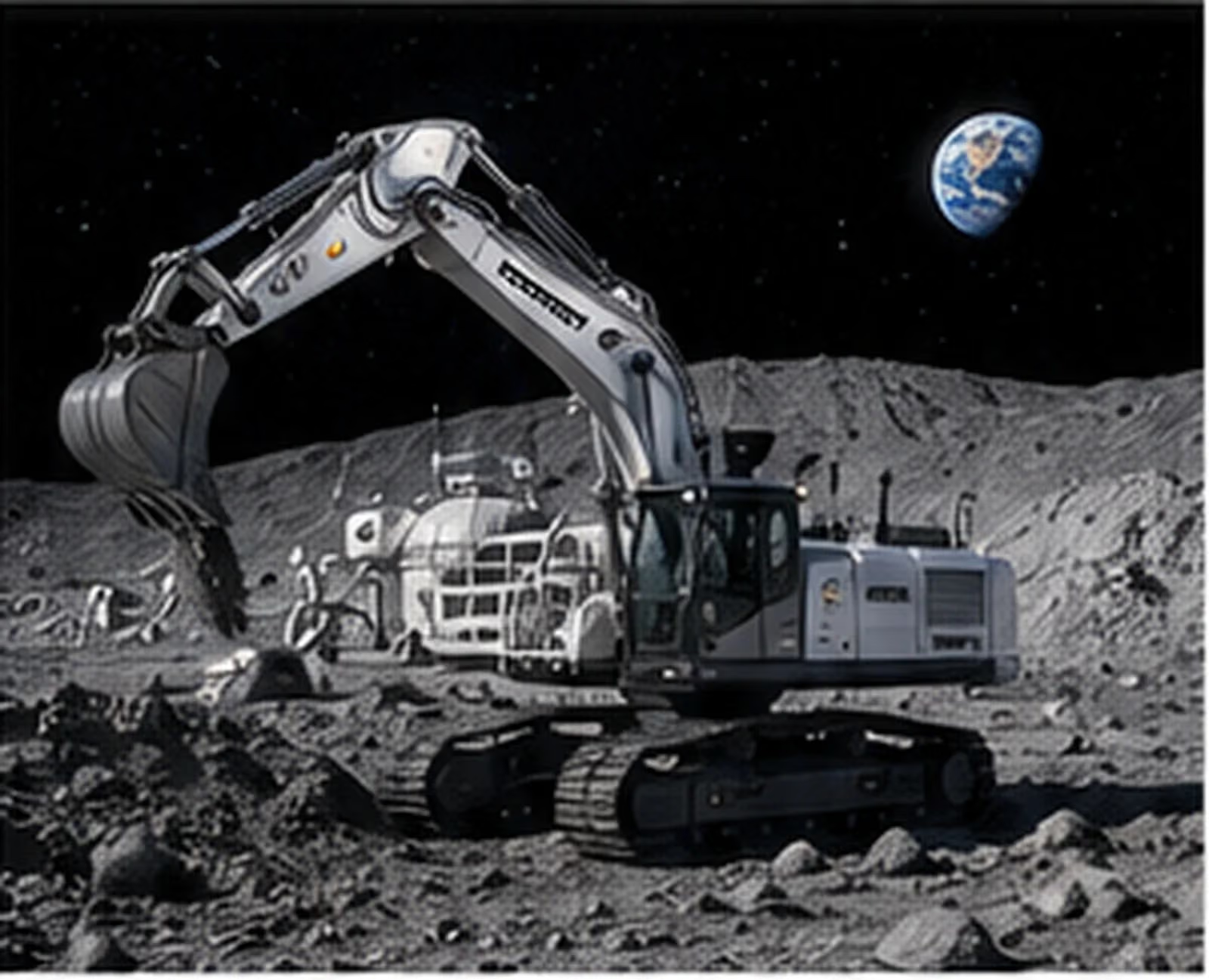
Vermeer and lunar resource company Interlune are expanding their partnership beyond helium-3 extraction and into a broader challenge: developing construction tools that could prepare the lunar surface for future infrastructure. The collaboration brings together Vermeer's experience in trenching, surface mining and underground construction with Interlune's work in lunar resources and space systems.
The expanded partnership was reported on July 30, 2026, and signals a shift from experimental lunar excavation toward a more complete construction-equipment toolkit. The two companies are considering machines and implements for tasks such as surface leveling, rock removal, compaction, trenching and site preparation — work that would look familiar to earthmoving contractors on Earth, but must be performed in an environment unlike any conventional jobsite.
From Helium-3 Mining to Lunar Construction
Vermeer and Interlune originally began working together around Interlune's plan to extract helium-3 from lunar regolith. A full-scale prototype excavator was developed to demonstrate continuous collection and processing concepts.
That work provided a foundation for a broader realization: if humans establish a long-term presence on the Moon, they will need far more than a mining machine. They will need roads or prepared travel surfaces, cleared areas for habitats, trenches for utilities, compacted zones, berms and potentially protective structures around energy systems.
These are fundamentally construction problems.
Interlune CEO Rob Meyerson told GeekWire that the partners decided to formalize a wider relationship so they could think beyond prototypes and toward resilient, sustainable operations. The first new demonstration tool is expected to focus on tasks such as leveling, rock removal and compaction.
That is a significant change in scope. A single-purpose resource harvester can be optimized around one process. Construction equipment must handle changing terrain, uncertain material conditions and a wider variety of tasks.
Why Earthmoving on the Moon Is So Difficult
At a basic level, excavation is the process of applying force to material, breaking it free and moving it somewhere else. The physics remain the same on the Moon, but almost every environmental condition changes.
Lunar gravity is roughly one-sixth of Earth's. That reduces machine weight and therefore reduces the traction force available at the ground. A machine that relies on its mass to push a blade or force a bucket into material may not behave the same way.
The Moon also has no atmosphere. Conventional diesel engines cannot operate without oxygen, which means lunar construction equipment must use electric power or another self-contained energy system.
Dust is another major problem. Lunar regolith is fine, abrasive and electrostatically charged. It can infiltrate joints, damage seals, coat sensors and create wear in mechanisms that would be easier to protect on Earth.
Temperature extremes add further engineering challenges. Equipment can move between intense heat in sunlight and severe cold in shadow. Lubricants, batteries, electronics and structural materials must function across conditions that are far outside a normal construction-equipment duty cycle.
Traction Becomes a Design Problem
On Earth, a dozer or loader develops pushing force through its weight and the friction between tracks or tires and the ground. Lower gravity changes that relationship.
Engineers may need to rethink machine geometry, track design, operating speed and tool engagement. Instead of taking deep aggressive cuts, lunar machines may need to remove thin layers of material in repeated passes.
Vermeer CEO Jason Andringa discussed a concept similar to surface mining, using a large drum attachment to mill the upper layer of regolith. Depending on the material properties, the processed surface could then be compacted.
This approach makes sense because it spreads cutting effort across a rotating tool rather than relying on the machine to force a large blade through the soil. It also connects directly with Vermeer's existing experience in trenchers and surface-mining equipment.
Autonomous Operation Will Be Essential
Communication delays between Earth and the Moon make traditional remote control difficult. Depending on position and network conditions, commands and video cannot always behave like a real-time connection on a local jobsite.
That means lunar construction equipment will need a high level of autonomy. Operators on Earth may define work areas, objectives and safety limits, while the machine handles many low-level decisions by itself.
A lunar grader or surface-preparation machine might receive a digital terrain model, identify rocks, plan passes and adjust tool depth automatically. Human supervisors would monitor progress and intervene when necessary.
This model resembles the direction already visible in terrestrial mining, where autonomous haul trucks and remotely supervised machines perform repetitive tasks in controlled environments.
The Moon makes autonomy less optional. Sending people solely to operate equipment would be extremely expensive, and construction may need to begin before large human crews arrive.
Reliability Has a Different Meaning in Space
A broken hydraulic hose on Earth can cause serious downtime, but a service truck can eventually reach the machine. On the Moon, every repair is a logistics problem.
Equipment therefore needs to be designed with extreme reliability, redundancy and simplified maintenance. Components may need to be modular so robotic systems or astronauts can replace them with limited tools.
Engineers will also need to decide which systems can tolerate failure. A machine may need multiple sensors, independent braking methods or backup communications paths so one fault does not end the mission.
Predictive maintenance becomes especially valuable. Sensors could monitor motor temperatures, bearing vibration, electrical performance and structural loads, allowing teams to identify degradation before a failure occurs.
Vermeer's experience building machines for difficult terrestrial conditions provides a useful starting point, but lunar reliability requirements are more severe because rescue and repair options are limited.
The First Tool May Ride on a Lunar Vehicle
Interlune has indicated that the initial demonstration tool could be installed on a lunar vehicle rather than being a completely independent machine. The target timeframe discussed publicly is 2028 or 2029.
That approach reduces risk. Instead of designing a full propulsion platform, power system and construction implement simultaneously, the partners can focus first on the work tool.
A modular attachment could perform leveling or rock removal while relying on an existing lunar mobility platform for movement, communications and energy.
This mirrors a familiar principle in terrestrial construction: attachments allow one carrier machine to perform multiple tasks. Excavators, skid steers and compact track loaders become more valuable because they can use buckets, augers, hammers, grapples and other tools.
Lunar construction may adopt the same modular philosophy, especially when launch mass is expensive and every kilogram of equipment must justify its place.
Building Roads Without Asphalt
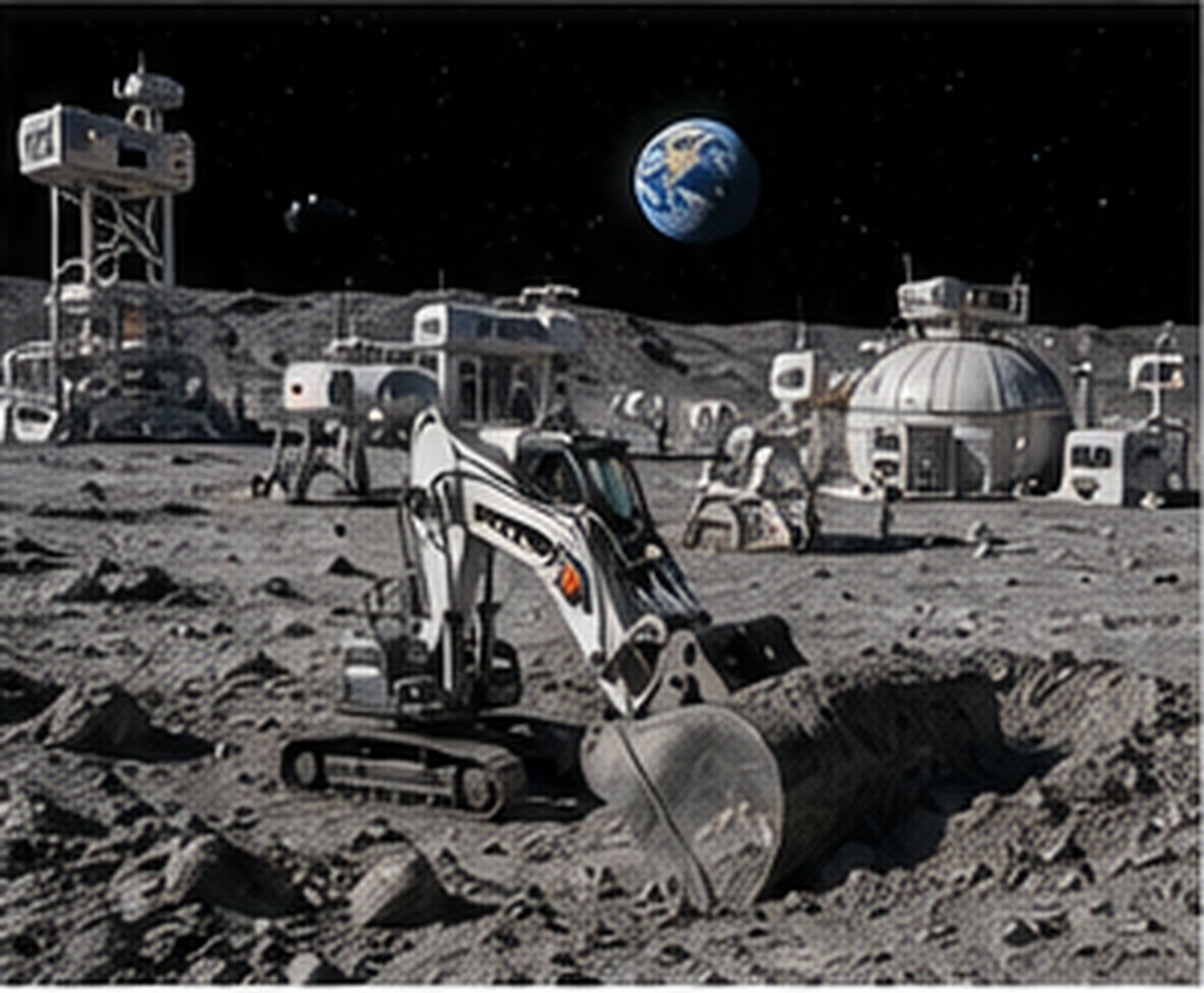
A lunar road will not look like a highway on Earth. There may be no asphalt plant, water truck or conventional aggregate base. Instead, the priority may be creating a stable surface that reduces dust and prevents vehicles from sinking or slipping.
Surface preparation could involve removing large rocks, grading high points, filling depressions and compacting the regolith. Future systems might also sinter or melt surface material to create harder travel paths, but basic mechanical preparation is likely to remain important.
Dust control is especially critical because vehicle movement can throw abrasive particles onto nearby equipment, solar panels and habitats.
A well-prepared route could therefore improve both mobility and equipment life.
This gives traditional earthmoving expertise surprising relevance. Contractors already understand that good roads depend on drainage, compaction, material properties and repeated grading. The details change on the Moon, but the concept of creating a stable working surface remains familiar.
Trenches Could Protect Utilities
Future lunar bases will need power cables, communications lines and potentially fluid or thermal-control systems. Leaving these systems exposed creates risks from dust, temperature variation, vehicle traffic and debris from spacecraft operations.
Trenching could provide protection.
Interlune is already working with the Colorado School of Mines on a NASA-supported implement related to trenching or lunar-soil excavation. That research can feed directly into the expanded Vermeer partnership.
A lunar trencher would need to handle abrasive regolith while producing predictable depth and spoil placement. It might also need to operate autonomously along a digital route.
The resulting technology could become one of the first recognizable pieces of construction equipment used beyond Earth.
Protective Berms and Site Preparation
One of the more unusual potential tasks is building protective berms around critical infrastructure. Lunar bases may use nuclear or other high-energy power systems that need physical separation and shielding.
Regolith is readily available and can provide mass for protection. Rather than transporting shielding material from Earth, construction equipment could move local soil into engineered berms.
This is an example of in-situ resource utilization: using material already present at the destination instead of launching everything from Earth.
Construction equipment is central to that strategy because raw lunar material must be excavated, transported, shaped and sometimes processed before it becomes useful.
The same logic applies to landing pads and habitat areas. Local material can reduce the amount of construction mass that must be launched, but only if machines can handle it reliably.
What Vermeer Brings to the Partnership
Vermeer is best known for equipment used in underground construction, surface mining, tree care, agriculture and related industries. Its machines are designed to cut, grind, trench and move difficult materials.
That experience is valuable because lunar construction is likely to require continuous excavation and surface-processing methods rather than simply copying a conventional excavator.
Vermeer also has deep knowledge of wear systems. Cutting teeth, drums, bearings and structures in trenching equipment operate in highly abrasive environments on Earth. The Moon is more extreme, but many engineering principles remain relevant.
The company's manufacturing experience is equally important. A prototype can demonstrate a concept, but flight hardware must be repeatable, documented and built under strict quality controls.
Interlune contributes the space-environment knowledge, mission architecture and resource-processing objectives needed to transform terrestrial machinery concepts into lunar systems.
What Interlune Brings
Interlune is focused on extracting lunar resources, particularly helium-3. The company has already been developing missions to measure and process lunar material.
That means it understands the operational environment in which construction equipment would work. It can define mission requirements, power limitations, communication constraints and the characteristics of lunar regolith.
Interlune also provides the link to space agencies and the growing commercial lunar economy.
The partnership is therefore complementary. Vermeer knows how to build rugged industrial machinery. Interlune knows why and how that machinery would be used on the Moon.
Lessons That Could Return to Earth
Vermeer has emphasized that lunar projects can improve its terrestrial engineering. That idea is realistic because extreme design challenges often force teams to develop technologies that later have broader applications.
A lunar machine must be energy efficient, reliable, autonomous and easy to monitor remotely. Those same characteristics are valuable on mines, construction sites and infrastructure projects on Earth.
Dust-resistant sensors, low-maintenance electric drives, autonomous work planning and modular repair systems could all have terrestrial value.
Remote construction in dangerous areas is another possible application. Technology developed for the Moon could improve equipment used around unstable slopes, contaminated sites, disaster zones or other locations where keeping operators away from the machine is desirable.
A New Category of Heavy Equipment
The most interesting aspect of the Vermeer-Interlune partnership may be that it treats lunar construction as an industrial equipment market rather than solely an aerospace experiment.
For decades, space hardware was custom-built in very small quantities. A sustained lunar economy would require something different: durable tools that can repeatedly perform work and eventually be produced, serviced and improved like industrial equipment.
That transition creates opportunities for companies with experience in construction machinery, mining and material processing.
The future lunar equipment industry may include familiar categories such as excavators, compactors, trenchers, haulers and loaders, but each will be redesigned around lower gravity, vacuum, dust and remote operation.
What to Watch Next
The first major milestone will be the development and testing of the demonstration tool planned for the next few years. Earth-based tests can simulate some aspects of lunar soil and terrain, but no terrestrial site can reproduce all lunar conditions at once.
Engineers will need to validate traction, cutting forces, dust protection, autonomy and energy use before hardware is considered for flight.
It will also be important to see how the tool integrates with future lunar vehicles. Mechanical interfaces, power connections, communication standards and control systems will determine whether attachments can be shared across different platforms.
A standardized attachment ecosystem could accelerate lunar construction in the same way standardized couplers and hydraulic interfaces increase versatility on Earth.
Why This News Matters to the Machinery Industry
For most contractors, lunar construction will not affect equipment purchasing decisions anytime soon. Yet the project is important because it shows how far traditional machinery expertise can travel.
Excavation, grading and compaction are not uniquely Earth-bound activities. Wherever humans build infrastructure, they need ways to shape terrain and move material.
Vermeer and Interlune are effectively taking familiar construction problems and redesigning the tools for a new environment.
The partnership also highlights the growing overlap between heavy equipment, robotics, autonomy and aerospace engineering. The next generation of machinery companies may compete not only on horsepower and hydraulic flow, but also on software, sensing, energy management and remote operation.
If humans build permanent infrastructure on the Moon, construction equipment will be one of the enabling technologies that makes it possible. The machines may look very different from those on today's jobsites, but the work — clearing, digging, leveling, compacting and preparing ground — will be immediately recognizable to anyone in the earthmoving industry.
Sources
- GeekWire — “Interlune builds on partnership with equipment company to lay the groundwork for moon infrastructure,” July 30, 2026.
- Interlune / Vermeer partnership reporting and prototype information referenced by GeekWire.
Previous Article
Komatsu and AIM Intelligent Machines Advance Autonomous Dozers and Excavators
Next Article
Caterpillar Expands $100 Million Workforce Initiative With Up to $10 Million Commitment in Illinois
Corrections and reader feedback
Found an error or have source material we should review? Send a correction report and an administrator can review it.
Report a correction